
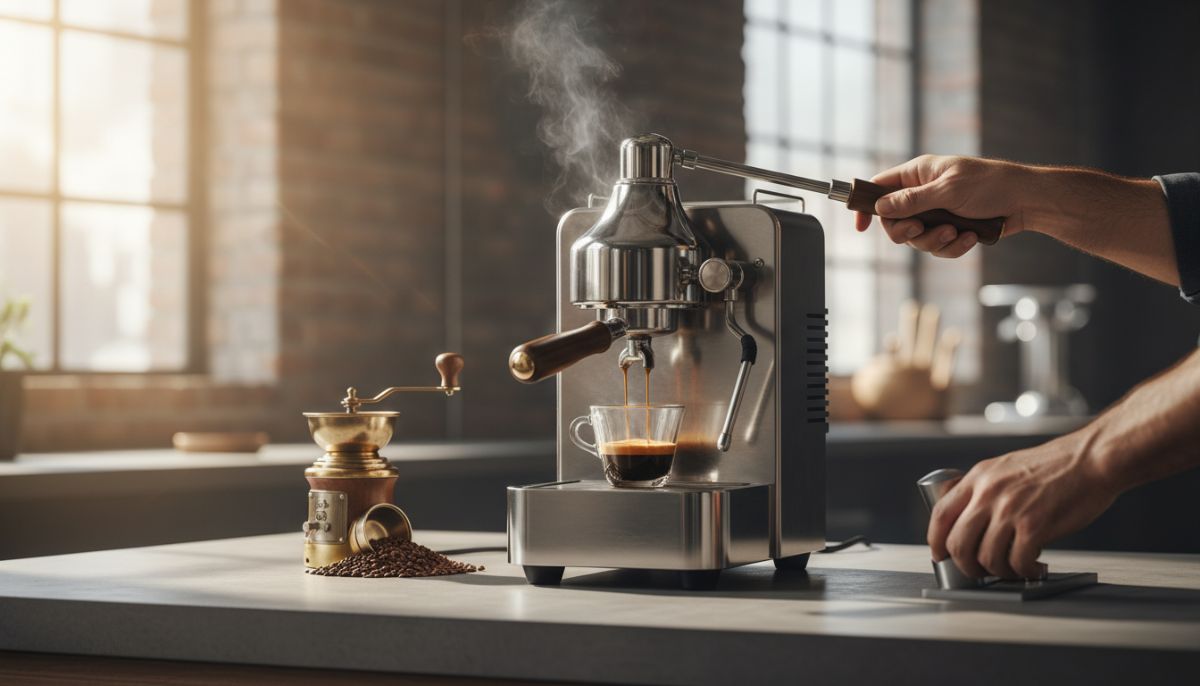
In an era of automated perfection, manual lever espresso machines are making a massive comeback. We explore the physics, flavor profiles, and tactile joy of ‘old school’ brewing to see if simpler really is better.
Key Takeaways
- Unmatched Texture: Lever machines naturally create a declining pressure profile, often resulting in a thicker, syrupy body that pump machines struggle to replicate.
- Tactile Feedback: Direct levers offer a physical connection to the extraction process, allowing you to feel channeling as it happens.
- Simplicity & Longevity: With fewer electronic components and pumps to fail, these machines are built to outlast their owners.
- Steep Learning Curve: They require patience, physical effort, and precise puck preparation to master.
There is a distinct sound associated with modern espresso: the rhythmic vibration of a pump kicking into gear. It is the sound of convenience, consistency, and automation.
But recently, a different sound has been echoing through the kitchens of home baristas and high-end specialty cafes alike. It is the sound of silence, punctuated only by the mechanical click of a spring or the squeak of a piston.
The manual lever espresso machine is back.
In a world obsessed with PID controllers and app-connected brewing, the resurgence of 1950s technology seems counterintuitive. Why go back to manual labor when a machine can do it for you? The answer lies in the pursuit of the perfect shot. Let’s dive deep into the world of levers to see if old school really is better.
Understanding the Lever Machine Anatomy
To understand the hype, you have to understand the mechanics. Lever machines strip espresso brewing down to its physics. Instead of an electric pump forcing water through coffee, a piston drives the water. This is achieved in one of two ways.
Spring Levers
The most common commercial lever is the spring lever. You pull the handle down to compress a massive spring and fill the group head with water (pre-infusion). When you release the handle, the potential energy stored in the spring drives the piston up, forcing water through the coffee.
The beauty here is consistency. The spring dictates the pressure, not your arm strength.
Direct Levers
Direct levers are fully manual. There is no spring. You pull the lever up to let water in, and you push the lever down to create pressure. You are the pump.
This offers ultimate control but requires significant skill. If you push unevenly, your pressure fluctuates. However, it allows for on-the-fly saves that automatic machines can’t dream of.
The Magic of the Pressure Profile
The primary argument for lever machines is the flavor profile. This is largely due to the pressure curve.
Most standard espresso machines hit the coffee puck with a flat 9 bars of pressure from start to finish. Lever machines, particularly spring levers, operate differently. They hit the puck with high pressure initially (often 9-11 bars) and then the pressure naturally declines as the spring expands and the puck degrades.
This declining pressure profile mimics what modern enthusiasts spend thousands of dollars trying to replicate with flow control modifications. For a deeper understanding of why variable pressure matters, read our guide to flow control and why it is worth the upgrade.
As the puck erodes during extraction, it offers less resistance. Keeping the pressure high often leads to bitterness or astringency. By letting the pressure drop naturally, lever machines tend to produce sweeter, rounder shots with a mouthfeel that is difficult to replicate on a pump machine.
The Unforgiving Nature of the Lever
While the output can be god-tier, the input required is substantial. Lever machines are not point-and-shoot devices.
Because these machines often start with a soft pre-infusion followed by a high-pressure spike, any flaw in your puck preparation will be magnified. If your tamping is uneven or your grind distribution is clumpy, the water will find the path of least resistance immediately.
To succeed with a lever, you must master the art of distribution. You cannot skip steps. You need to understand how to spot and fix uneven water flow before you even think about pulling the handle. If you feel resistance disappear mid-shot on a direct lever, you know you’ve channeled.
Temperature Stability: The Old Debate
Historically, lever machines struggled with temperature. They were essentially large brass heatsinks. If left on too long, the group head would get too hot. If not warmed up enough, they were too cold.
However, modern iterations have addressed this. Many high-end home lever machines now utilize dual boilers or hybrid heating systems to maintain consistency. While the mechanism is mechanical, the thermal management can be quite advanced.
It is fascinating to see how manufacturers are blending this old tech with modern precision. While they don’t always operate like standard machines, understanding how PID controllers ensure temperature stability is still relevant for the boiler systems powering these manual beasts.
Durability and Maintenance
One of the strongest arguments for buying a lever machine is longevity. Vibratory pumps die. Rotary pumps seize. Electronics fry.
A lever machine is essentially a boiler, a piston, and some seals. There is very little that can go wrong that cannot be fixed with a wrench and a set of O-rings. It is not uncommon to see lever machines from the 1960s still in daily operation.
That said, maintenance is different. You need to lubricate the piston gaskets regularly to ensure smooth motion. While you might not be descaling a pump, you still need to adhere to a cleaning manifesto for daily and weekly maintenance to keep those mechanical parts moving freely without friction.
Dialing In: A Different Approach
When you switch to a lever, your recipes might need to change. Because of the pressure profiling and the typical 1:2 ratio preferences of modern espresso, the basket geometry becomes crucial.
Many lever enthusiasts find that they can grind finer than they would on a pump machine because the long, low-pressure pre-infusion allows the water to saturate the puck fully before the high pressure hits. This finer grind can lead to higher extraction yields and more flavor.
However, this also means you need to be precise with your inputs. You must learn how to dial in espresso ratios specifically for the declining pressure curve. A ratio that works on a flat-9-bar pump might taste sour or empty on a lever without adjustment.
Is a Lever Machine Right for You?
The rise of the manual lever machine isn’t just a hipster trend; it’s a return to the roots of espresso with the benefit of modern manufacturing. But is it better?
If you value convenience, speed, and push-button consistency, the answer is no. A lever machine demands your attention. It requires physical effort. It takes up vertical space.
But if you are chasing the absolute pinnacle of texture, if you want to feel the extraction rather than just watch it, and if you want a machine that will likely outlive you, then the answer is a resounding yes.
The lever machine puts the “barista” back in espresso making. It removes the barrier of the pump and connects your hand directly to the coffee. For many, once they pull that lever down, they never want to push a button again.
Frequently Asked Questions
Yes, they generally have a steeper learning curve. They require physical effort to pull the lever and demand precise puck preparation, as they are less forgiving of poor distribution than many automatic machines.
In a spring lever machine, you pull the lever to compress a spring, and the spring provides consistent pressure during extraction. In a direct (manual) lever, the barista manually applies force to the lever to create the pressure, offering more control but requiring more skill.
Many enthusiasts believe lever machines produce superior espresso with better mouthfeel and reduced bitterness. This is largely due to the natural ‘declining pressure profile’ that occurs as the lever rises, which optimizes extraction as the coffee puck erodes.
They require different maintenance. While they have fewer electrical parts and pumps to fail, the piston seals and gaskets require regular lubrication and replacement to ensure the lever operates smoothly.