
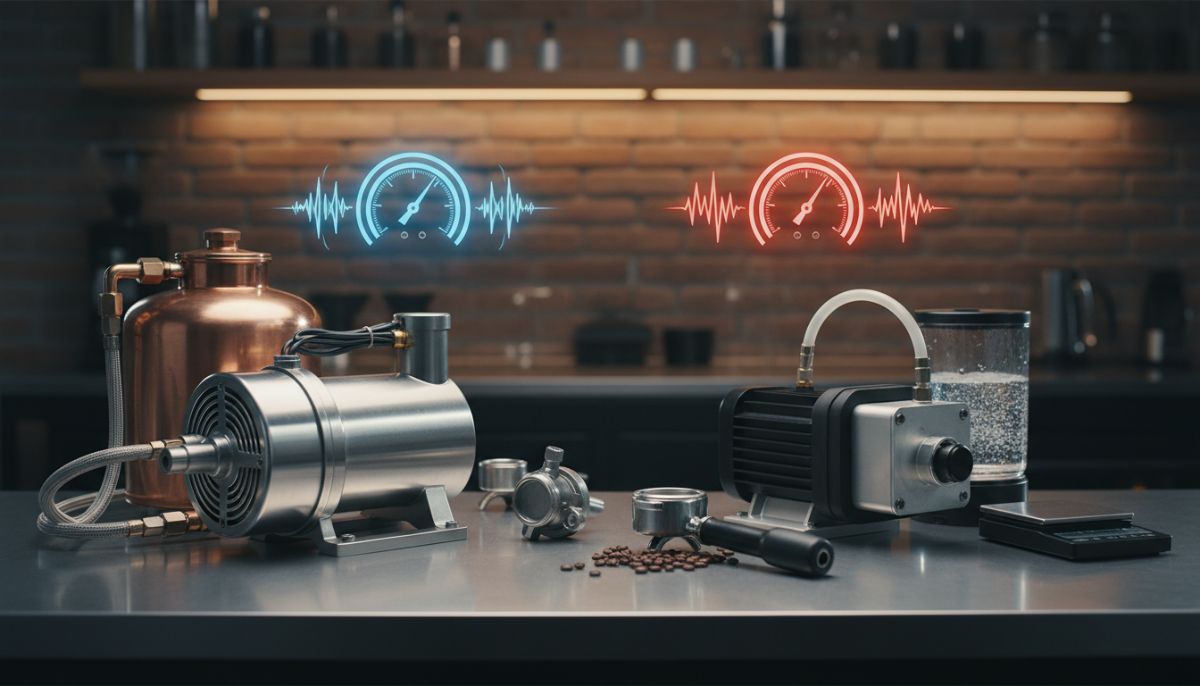
Is a rotary pump worth the extra cost, or is a vibratory pump sufficient for home espresso? We break down the differences in noise, pressure profiles, plumbing capabilities, and extraction quality.
Key Takeaways
- Noise Level: Rotary pumps are nearly silent, while vibratory pumps produce a distinct buzzing sound.
- Pressure Delivery: Rotary pumps offer instant pressure, whereas vibratory pumps have a natural, gradual ramp-up.
- Plumbing: Only rotary pump machines can be plumbed directly into a water line; vibratory pumps generally rely on internal reservoirs.
- Cost & Size: Vibratory pumps are smaller and cheaper to replace, making them standard in compact, prosumer machines.
The Hidden Heart of Your Espresso Machine
When shopping for a high-end espresso machine, you will inevitably face a choice regarding the internal mechanics: Rotary vs. Vibratory pumps. While boiler types and PIDs get all the marketing glory, the pump is the heart of the operation. It is responsible for generating the critical 9 bars of pressure required to emulsify oils and create crema.
Does the type of pump actually change the taste of your coffee? Or is the upgrade purely about luxury and silence? In this guide, we strip away the marketing jargon to compare the noise, pressure dynamics, and performance of these two technologies.
The Vibratory Pump: The Industry Workhorse
If you have a home espresso machine under $2,000, chances are it uses a vibratory pump (often called a “vibe pump”). These small, electromagnetic devices use a piston attached to a magnet inside a metal coil. When electricity flows through the coil, the magnet moves the piston back and forth at a high frequency—usually 60 times per second.
The Pros of Vibe Pumps
The biggest advantage is size and cost. Vibe pumps are compact, allowing manufacturers to build smaller footprint machines. They are also inexpensive to replace. If your pump fails after five years, a replacement part is significantly cheaper than a rotary motor.
The Cons: Noise and Lifespan
The rapid movement of the piston creates a distinct buzzing or humming noise. While newer machines use rubber mounts to dampen the sound, you will always know when a vibe pump is running. Additionally, because they rely on rapid vibration, they tend to have a shorter lifespan than their rotary counterparts.
The Pressure Profile
Vibe pumps do not hit full pressure instantly. They build up pressure gradually over the first few seconds of the shot. Interestingly, many baristas consider this a feature, not a bug. This slow ramp-up acts as a form of natural pre-infusion, which can help mitigate errors in puck preparation. If you struggle with uneven extractions, this gradual rise can help prevent channeling. For a deeper dive on fixing extraction issues, read our guide on spotting and fixing channeling.
The Rotary Pump: The Commercial Standard
Rotary vane pumps are the standard in commercial café machines. They utilize a mechanical motor to spin a disc with offset vanes inside a chamber. As the disc spins, it creates pressure almost instantly.
The Pros: Silence and Power
The most immediate difference is the sound. Rotary pumps are whisper-quiet. You will hear the water hitting the puck and the solenoid valve clicking, but the motor itself is barely audible. This makes for a much more pleasant morning routine.
Plumbability
One of the biggest functional advantages of a rotary pump is the ability to plumb the machine directly into a water line. Vibe pumps generally cannot handle the line pressure of a direct water connection. A plumbed-in machine means you never have to refill a reservoir again. However, if you choose to plumb in, you must ensure your filtration is perfect. Poor water quality can ruin a high-end pump quickly. See our insights on water chemistry and filtration to protect your investment.
The Pressure Profile
Rotary pumps deliver immediate, consistent pressure. There is no ramp-up unless the machine has a specific pre-infusion chamber or flow control device installed. This consistency is highly prized for repeatability, a factor that pairs well with other precision tools. For example, consistent pressure works best when paired with temperature stability via PID controllers.
Head-to-Head: Performance Comparison
1. Extraction Quality
Does the pump change the flavor? This is a debated topic. The instant pressure of a rotary pump can be unforgiving. If your tamp is uneven, the sudden hit of water might cause a fracture in the puck. Vibe pumps are slightly more forgiving due to the ramp-up.
However, many rotary machines now come with E61 groups that include a pre-infusion spring, or they offer flow control options. If you are interested in manipulating pressure manually, a rotary pump is often a better base for flow control modifications, as they handle back-pressure changes more smoothly.
2. Durability and Maintenance
Rotary pumps are heavy-duty industrial motors. They are built to last for decades if well-maintained. Vibe pumps are considered consumable parts, though they often last 5-10 years in a home environment. Regardless of the pump type, regular upkeep is non-negotiable. Check our daily and weekly cleaning manifesto to keep your hydraulics healthy.
3. Machine Architecture
You will typically find rotary pumps in Dual Boiler machines, whereas vibe pumps are common in Single Boilers and Heat Exchangers. If you are trying to decide between these machine types, the pump is just one variable. For a broader comparison of machine types, review our breakdown of Single Boiler vs. Heat Exchanger vs. Dual Boiler architectures.
Which Pump is Right for You?
Choose a Vibratory Pump If:
- You have a limited budget and want to maximize value.
- You have limited counter space (vibe pump machines are usually smaller).
- You rely on a water reservoir and cannot plumb the machine in.
- You want a machine that is naturally more forgiving of puck prep errors.
Choose a Rotary Pump If:
- Silence is a priority for your household.
- You plan to plumb the machine directly into a water line.
- You want commercial-grade longevity and build quality.
- You plan to experiment with advanced pressure profiling.
Conclusion
Ultimately, both pumps are capable of producing exceptional espresso. The vibratory pump is a loud but capable underdog that saves you money and space. The rotary pump is the silent, robust professional that offers luxury and plumbing options.
If you are upgrading your setup, don’t let the pump be the only deciding factor. Consider your grinder as well, as the grind consistency often impacts flavor more than the pump type. (Curious about that? Read about flat vs. conical burrs here). Choose the pump that fits your lifestyle, your budget, and your tolerance for noise.
Frequently Asked Questions
Generally, no. Rotary pumps are significantly larger and require a different mounting setup and motor. Most espresso machine chassis designed for vibratory pumps do not have the physical space to accommodate a rotary pump.
Not necessarily. While rotary pumps offer more consistency, the taste difference is subtle. A vibratory pump’s slow pressure ramp-up can actually improve extraction by acting as pre-infusion. The grinder and bean quality have a much larger impact on taste.
If you hear a loud buzzing or humming, you likely have a machine with a vibratory pump. This is normal operation. However, if the noise changes pitch or becomes rattling, check to ensure the water reservoir is full and that internal hoses aren’t vibrating against the casing.
In most cases, yes. Vibratory pumps are not designed to handle the inlet pressure from a direct water line. Rotary pumps are balanced systems that can easily accept line pressure.