
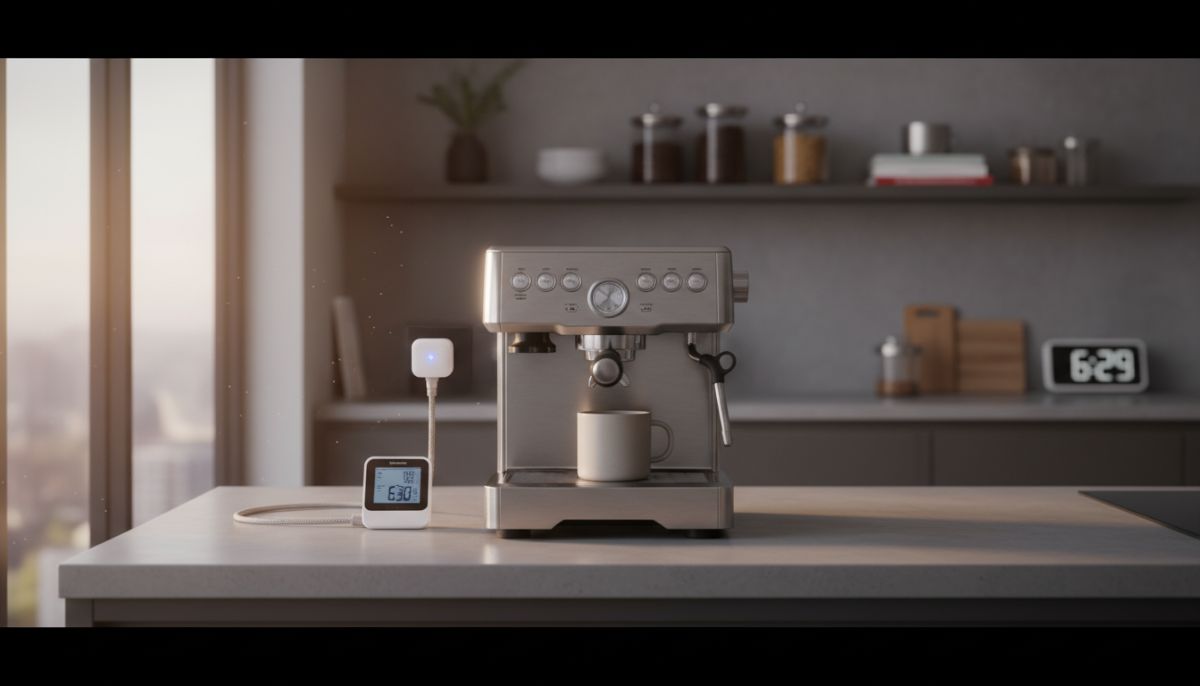
Stop waiting 30 minutes for your espresso machine to heat up. Learn how to safely automate your morning coffee routine with smart plugs and timers.
Key Takeaways
- Time Saving: Eliminate the 20-40 minute wait for your machine to reach thermal stability every morning.
- Consistency: Ensure your entire machine (boiler and grouphead) is thoroughly heat-soaked before you pull your first shot.
- Safety First: Learn why amperage ratings matter when pairing smart plugs with high-wattage espresso equipment.
- Remote Control: Manage your machine from bed or on your way home from work via smartphone apps.
The Morning Waiting Game
There is nothing quite as heartbreaking as waking up, stumbling into the kitchen craving a latte, and realizing you forgot to turn on the espresso machine. For owners of high-end equipment, this means a mandatory waiting period. While a simple appliance might heat up in seconds, quality espresso requires thermal mass.
Whether you are rocking a massive dual boiler or a classic heat exchanger, the water might get hot quickly, but the metal components—specifically the portafilter and grouphead—take time to catch up. Pulling a shot too early results in sour, underextracted coffee because the cold metal sucks the heat right out of the brew water.
Fortunately, you don’t have to stand in the kitchen staring at the pressure gauge. By integrating a smart plug or a heavy-duty timer into your setup, you can hack your morning routine. This is one of the most effective methods for hacking your machine’s warm-up time without compromising on quality.
Why Thermal Stability Requires Time
To understand why automation is a game-changer, we need to look at the physics of the machine. High-end espresso machines utilize heavy brass or stainless steel components to maintain temperature consistency during the shot. However, that same mass takes a long time to absorb heat.
This is particularly true for machines using the classic E61 design. The extensive brass housing needs to be fully heat-soaked to prevent temperature fluctuations. If you are interested in the mechanics of this, we’ve broken down the battle of saturated groupheads vs. E61 thermal stability in a separate guide.
By using a smart timer to turn your machine on 30 to 45 minutes before your alarm goes off, you ensure that every component—from the boiler to the basket—is at the perfect equilibrium. This allows your PID controller to stabilize the temperature precisely where you set it, ready for that first extraction the moment you walk into the kitchen.
Smart Plugs vs. Old-School Timers
In the past, baristas relied on mechanical analog timers. These dialed devices are reliable but limited. You set them once, and they repeat the cycle daily. If you go on vacation or sleep in on a Sunday, the machine turns on regardless, wasting energy.
The Smart Plug Advantage
Modern Wi-Fi-enabled smart plugs offer superior flexibility. Here is why they are the preferred choice for the modern home barista:
- Scheduling: Set different distinct schedules for weekdays and weekends.
- Remote Access: Did you forget to turn the machine off before leaving for work? Check your app and kill the power remotely.
- Geofencing: Some advanced setups can turn your machine on automatically when your phone’s GPS detects you are within a 5-mile radius of home.
- Voice Control: Integration with Alexa, Google Home, or Siri allows you to shout, "Turn on the coffee machine!" without leaving bed.
Critical Safety Warning: Check Your Amperage
This is the most important section of this article. Do not buy the cheapest smart plug you find on Amazon. Espresso machines are high-wattage appliances. A typical prosumer machine, especially powerful dual boiler systems, can draw significant power.
Most standard smart plugs are rated for 10 or 15 amps. You must verify the power draw of your specific machine. If your machine draws 1500W to 2000W, you need a plug explicitly rated for 15 Amps or higher (ideally 16A or 20A for headroom). Using an under-rated plug can lead to overheating, melting plastic, and significant fire hazards.
The “Manual Switch” Requirement
Smart plugs only work if your espresso machine has a mechanical on/off switch. If your machine uses a digital standby button (soft switch), a smart plug will simply cut power to the unit, but when power is restored, the machine will likely remain in “Standby” mode rather than turning on fully.
Setting Up Your Routine
Once you have acquired a high-quality, high-amperage smart plug, the setup is straightforward. However, automation implies you need to be disciplined about your evening routine.
1. The Night Before Prep
For the system to work, the machine must be ready to brew. This means checking your water reservoir level the night before. Running a machine on a timer with an empty tank can damage the pump or heating element, although most modern machines have low-water sensors to prevent this.
2. Cleaning is Crucial
Never leave a dirty puck in the portafilter overnight. Old coffee oils will bake onto the shower screen as the machine heats up the next morning. Make sure you follow a strict cleaning manifesto regarding daily maintenance before you go to bed. A clean machine is a happy machine.
3. The Warm-Up Buffer
Set your timer for at least 30 minutes before you intend to brew. If you wake up at 7:00 AM, set the plug to activate at 6:30 AM. This gives the heat time to radiate from the boiler to the grouphead and portafilter.
Energy Consumption Myths
A common concern is that pre-heating a machine wastes electricity. While it does consume power, the energy required to maintain temperature once the machine is hot is significantly lower than the energy required to heat it from cold.
Furthermore, trying to rush the process by flushing massive amounts of water through the grouphead to heat it up manually also wastes energy (and water). A timer allows the machine to heat passively. If you are concerned about efficiency, you can program the smart plug to turn off automatically after your morning window, ensuring the machine never runs idly all day.
Conclusion
Automating your morning espresso routine with a smart plug is one of the highest value-for-money upgrades you can make. It costs a fraction of a new grinder or tamper but dramatically improves your workflow. By removing the wait time, you remove the friction between you and your morning cup, ensuring you have the time to dial in your shot properly rather than rushing out the door.
Just remember: Safety first. Check your amperage, keep your reservoir full, and enjoy the luxury of a café-ready kitchen the moment your feet hit the floor.
Frequently Asked Questions
No. You must check the amperage rating. Most espresso machines require a heavy-duty smart plug rated for at least 15 Amps to handle the high power draw safely.
Usually, no. Smart plugs work best with machines that have mechanical toggle switches. Machines with digital ‘soft’ power buttons often revert to standby mode when power is restored.
For E61 grouphead machines or large dual boilers, set the timer to turn on 30 to 45 minutes before you plan to brew to ensure full thermal stability.
Yes, provided the machine is in good working order, has sufficient water in the reservoir, and the smart plug is rated correctly for the machine’s wattage.