
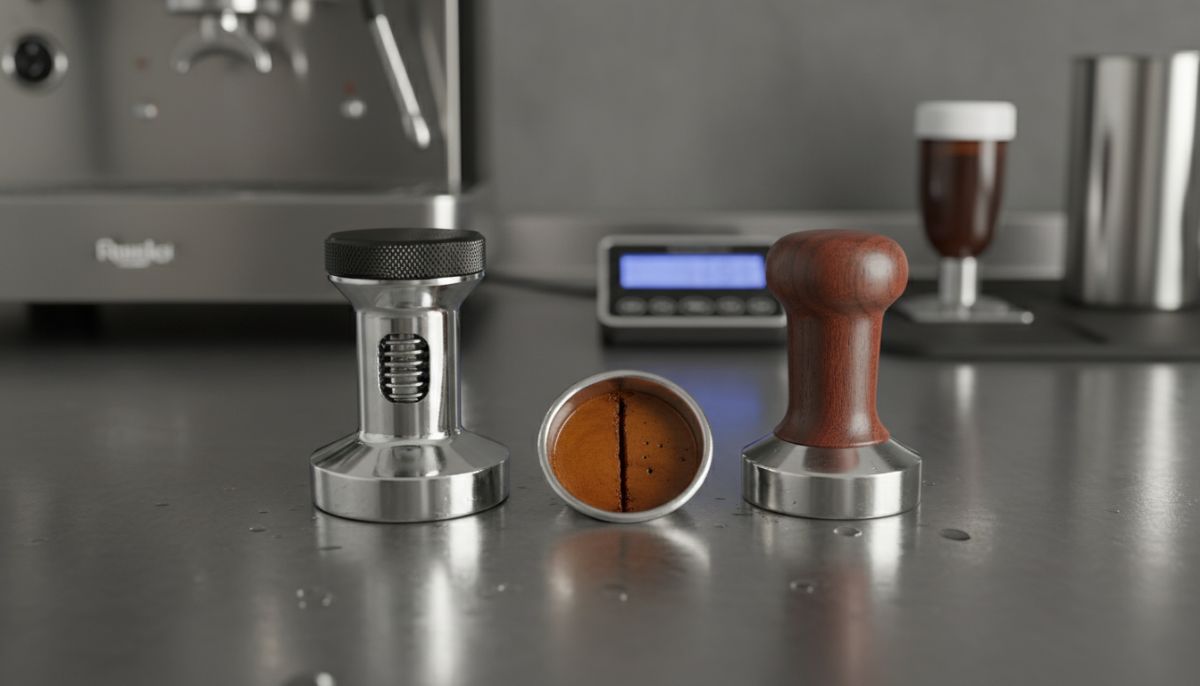
Are spring-loaded tampers worth the hype? We analyze if calibrated leveling tampers truly fix channeling and improve your espresso workflow or if they are just another gadget.
Key Takeaways:
- Eliminates Leveling Errors: The primary benefit of modern spring-loaded tampers is keeping the puck perfectly flat, reducing the risk of channeling.
- Standardized Pressure: While specific poundage (e.g., 30 lbs) matters less than full compression, these tools ensure you apply enough force every time.
- Not a Magic Bullet: A calibrated tamper cannot fix poor distribution or incorrect grind size.
- Workflow Efficiency: They significantly speed up the workflow for both beginners and high-volume environments.
The Quest for the Perfect Puck
You have bought the high-end machine. You have aligned your burrs. You have weighed your dose down to the tenth of a gram. Yet, the shot runs fast, sprays the back of your cup, and tastes astringent. What went wrong?
Often, the culprit is the final human variable: the tamp. Traditional manual tamping requires muscle memory, a keen eye for leveling, and consistent pressure. It is a skill that takes time to master. Enter the spring-loaded tamper (often called a calibrated or leveling tamper). These devices promise to remove human error from the equation.
But do they actually guarantee consistency, or are they just an expensive crutch? Let’s dive into the mechanics and the results.
Understanding the Mechanics: Force vs. Leveling
To understand if these tools work, we must distinguish between the two main features often grouped under “spring-loaded.”
1. Calibrated Force Feedback
The original iteration of spring-loaded tampers focused purely on pressure. They contain an internal spring calibrated to “click” or release when a specific amount of force (usually 25-30 lbs) is applied. This signals the barista to stop pushing.
2. Self-Leveling Collars
The true game-changer in recent years has been the addition of a leveling collar (or rim) that sits on top of the portafilter basket. The tamping base “floats” on a spring. As you push down, the collar ensures the tamper enters the basket at a perfectly perpendicular angle relative to the basket rim.
This distinction is critical. While pressure is important, an unlevel tamp is the primary cause of uneven extraction. If your coffee bed is sloped, water will naturally flow toward the lower side, leading to uneven water flow and channeling.
The Pressure Myth vs. The Leveling Reality
For years, coffee forums debated the necessity of exactly 30 pounds of pressure. Modern espresso science suggests that once the coffee puck is fully compressed (removing the air pockets), adding more pressure yields diminishing returns. You cannot “over-tamp” coffee easily, but you can certainly under-tamp or unevenly tamp.
A spring-loaded tamper ensures you hit that point of maximum density every single time without thinking about it. However, the leveling aspect is where the consistency guarantee truly comes from. By forcing the tamper to stay flat, you eliminate the variable of a “crooked arm” or bad posture.
If you are struggling with shots that swing wildly between sour and bitter, checking your puck prep is the first step. For a deeper dive into how preparation impacts flavor, read about the science of puck prep and WDT tools.
Do They Guarantee Consistency?
The short answer is: Yes, regarding the physical structure of the puck.
If you gave a standard tamper to five different people, you would likely get five different tamping angles and pressure profiles. If you gave those same five people a high-quality self-leveling spring tamper, the resulting pucks would be nearly identical.
However, a tamper cannot fix what happens before the tamp. If your grind distribution is clumpy or uneven in the basket, the tamper will simply compress those inconsistencies into a hard, uneven puck. This often results in sour espresso caused by underextraction in the dense areas and over-extraction in the loose areas.
Who Should Buy One?
The Beginner
If you are new to espresso, the learning curve is steep. You are already worrying about ratio, temperature, and grind size. Adding physical tamping technique to that list can be overwhelming. A spring-loaded tamper removes one major variable, allowing you to focus on dialing in your espresso ratios.
The Prosumer
For the enthusiast chasing the “God Shot,” consistency is everything. Even if you have great technique, fatigue or a moment of distraction can ruin a shot. Many prosumers use these tampers in conjunction with precision baskets like VST or IMS, which are notoriously unforgiving of bad prep.
Potential Downsides
There are very few performance downsides, but there are practical ones:
- Cost: High-end calibrated tampers (like the Normcore or The Force Tamper) cost significantly more than a standard slab of steel.
- Maintenance: Springs can wear out over time, and coffee grounds can get stuck in the mechanism, requiring occasional cleaning.
- Tactile Feel: Some purists miss the tactile feedback of feeling the puck compress manually.
Conclusion: An Essential Upgrade?
While a spring-loaded tamper does not technically “guarantee” a perfect shot—because grind and beans matter immenseley—it does guarantee a level, compressed bed. In the world of espresso, where we fight for consistency in every milligram, removing the variable of human error is easily worth the investment.
If you are tired of second-guessing your arm angle or seeing spurts of coffee spray your counter, this tool is one of the most effective upgrades you can make for your daily routine.
Frequently Asked Questions
Consistency matters more than specific pressure. As long as the puck is fully compressed to remove air pockets (usually requiring 15-25 lbs of force), adding more pressure has little effect. Spring-loaded tampers ensure you reach this full compression every time.
It significantly reduces channeling caused by uneven tamping or tilted pucks. However, it cannot fix channeling caused by poor grind distribution or old coffee beans.
Not always. A leveling tamper usually refers to a tool that rests on the basket rim to ensure flatness. Many modern spring-loaded tampers include a leveling plate, combining both features for the best results.
Yes, many high-volume cafes use them to prevent repetitive strain injuries (RSI) and to ensure that every barista on the team produces the same quality puck regardless of their physical strength.