
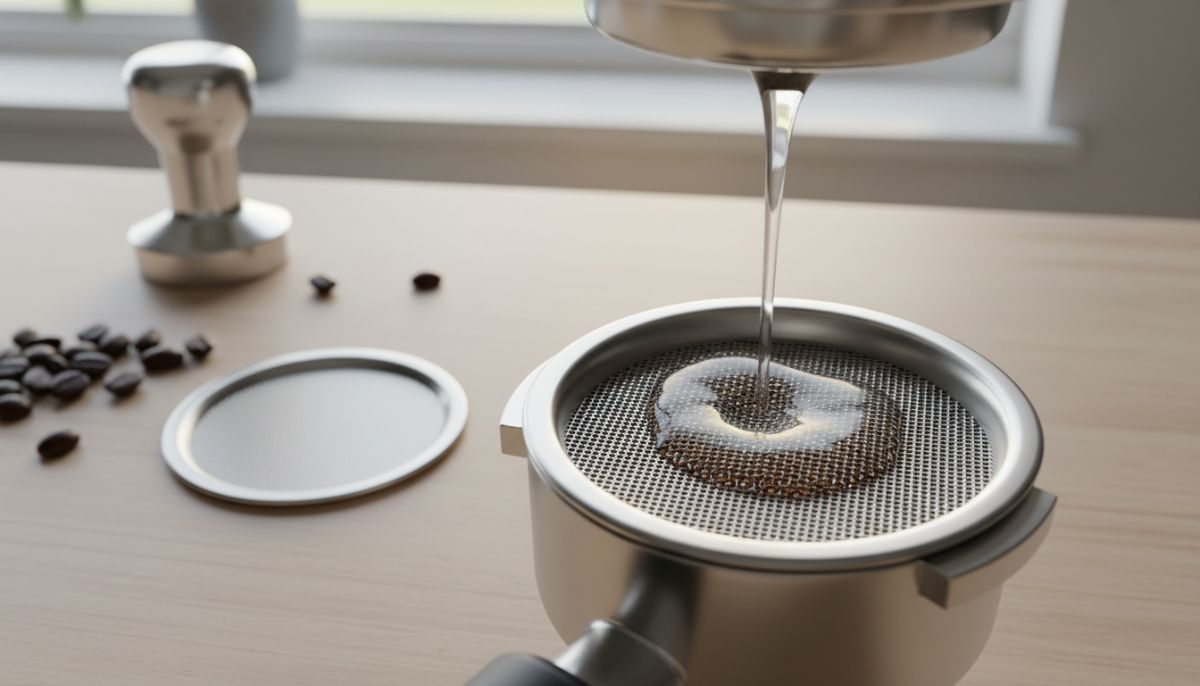
Discover why a simple stainless steel mesh disc is revolutionizing home espresso. Learn how puck screens improve water distribution, keep your grouphead spotless, and elevate your extraction consistency.
Key Takeaways
- Enhanced Cleanliness: Puck screens act as a barrier, keeping your shower screen almost entirely free of coffee grounds.
- Improved Water Dispersion: The mesh layers help soften the water flow, reducing the risk of channeling and promoting even extraction.
- Puck Integrity: Prevents water impact from disturbing the coffee bed, leading to more consistent shots.
- Affordable Upgrade: Compared to expensive equipment, this is a high-value modification usually costing under $20.
In the world of home espresso, we often obsess over the expensive gear. We analyze burr geometry, debate pump types, and spend thousands on machines. But sometimes, the most impactful upgrades are the smallest.
Enter the puck screen. This simple, multi-layered stainless steel mesh disc is arguably the best value-for-money accessory available today. It sits directly on top of your tamped coffee bed, acting as a secondary shower screen.
While it might look like a simple piece of metal, its impact on your workflow and cup quality is significant. Is it a magic wand? No. But does it solve two of the most annoying problems in espresso making? Absolutely.
The Hygiene Factor: Keep Your Machine Spotless
The immediate benefit of a puck screen is cleanliness. If you have ever removed a portafilter immediately after a shot, you know the mess. Coffee grounds often stick to the grouphead’s shower screen, requiring a flush and a scrub.
With a puck screen, the coffee never touches the machine’s shower screen. When you knock out the puck, the screen usually comes with it (or sits on top), leaving your grouphead surprisingly clean.
This doesn’t mean you can stop maintaining your gear. You still need to follow a routine for cleaning your espresso machine, specifically backflushing. However, the daily grime accumulation is drastically reduced, extending the life of your gaskets and shower screens.
Water Dispersion and Channeling
The primary technical function of the puck screen is to modify how water hits the coffee. In many machines, the water exits the grouphead with significant force. This jet-effect can disturb the top layer of the coffee puck before pressure even builds up.
When you place a puck screen on top, it acts as a buffer. The water hits the mesh first, breaks up, and rains down gently across the entire surface of the coffee. This even distribution is critical.
By softening that initial impact, you significantly reduce the risk of channeling. Channeling occurs when water finds a path of least resistance, leading to sour, underextracted shots. The screen forces the water to saturate the puck evenly from the very first second of the brew.
Impact on Extraction and Taste
Does a puck screen make the coffee taste better? The answer is generally yes, but it is nuanced. Because the water distribution is more even, you tend to get a higher extraction yield. This means you are pulling more flavor out of the coffee.
However, the screen adds resistance to the system. This brings us to a crucial adjustment point. If you use a puck screen with your current settings, your shot might run too slow. You will likely need to adjust your grind size.
Usually, you can grind slightly coarser when using a screen. This allows for a more uniform flow without the risk of clogging. If you are struggling with dialing in your ratios, a puck screen can act as a stabilizing variable, making your shots more reproducible.
The Puck Prep Ecosystem
A puck screen is not a replacement for good puck preparation; it is the final step in a precision workflow. You cannot rely on the screen to fix a bad tamp or clumpy grounds.
To get the most out of the screen, you should still use distribution techniques. Tools like the Weiss Distribution Technique (WDT) are essential for breaking up clumps deeper in the basket. For a deeper dive, read about the science of puck prep and WDT tools.
Think of the WDT tool as preparing the internal structure of the puck, while the puck screen protects the surface integrity during the shot.
Thermal Considerations
There is a debate regarding temperature. A cold metal screen has thermal mass. If you place a cold screen onto the coffee and immediately pull a shot, it could theoretically drop the brew temperature by a degree or two.
For machines with high thermal stability, this is negligible. However, if you are obsessed with temperature stability, you might want to preheat the screen. You can simply leave it on top of your machine or run it under the hot water tap for a few seconds before use.
Choosing the Right Thickness
Puck screens typically come in thicknesses ranging from 1.0mm to 1.7mm. The 1.7mm is the standard “thick” screen, which offers the best water dispersion but takes up more headspace in the basket.
If you are dosing high, a thick screen might hit the shower screen before you lock in. In this case, you may need to lower your dose or switch to a thinner 1.0mm screen. Alternatively, you can look into upgrading to precision baskets which often provide more depth and consistent geometry suited for accessories like this.
Cleaning the Screen Itself
The irony of the puck screen is that while it keeps your machine clean, the screen itself gets dirty. Coffee oils and fines get trapped inside the mesh layers over time.
A simple rinse after every shot is mandatory. Once a week, you should soak the screen in a solution of Cafiza or a similar espresso detergent. This dissolves the trapped oils and ensures the flow remains unrestricted.
Conclusion
Is a puck screen necessary? strictly speaking, no. People have made great espresso for decades without them. However, for the low cost, it is one of the most effective tools for improving consistency and workflow cleanliness.
It acts as an insurance policy against channeling and keeps your grouphead pristine. If you are looking to squeeze that extra 5% of quality out of your beans, the puck screen is the accessory that changes everything.
Frequently Asked Questions
Yes, you generally need to grind slightly coarser. The puck screen adds resistance to the water flow, so keeping your original grind size might choke the machine or result in a very slow extraction.
Rinse it with water immediately after every use. Once a week, soak it in a solution of hot water and espresso cleaning powder (like Cafiza) to remove built-up coffee oils and fines.
No. Tamping compresses the coffee bed to create resistance. The puck screen simply sits on top of the tamped puck to distribute water evenly; it does not compress the coffee.
You must buy the correct diameter for your portafilter. The most common size is 58.5mm for commercial machines, but 54mm (Breville) and 51mm options are also widely available.
Yes. Some baristas use a paper filter on the bottom of the puck and a metal screen on top. This is known as the ‘sandwich’ method and can further increase extraction yields.