
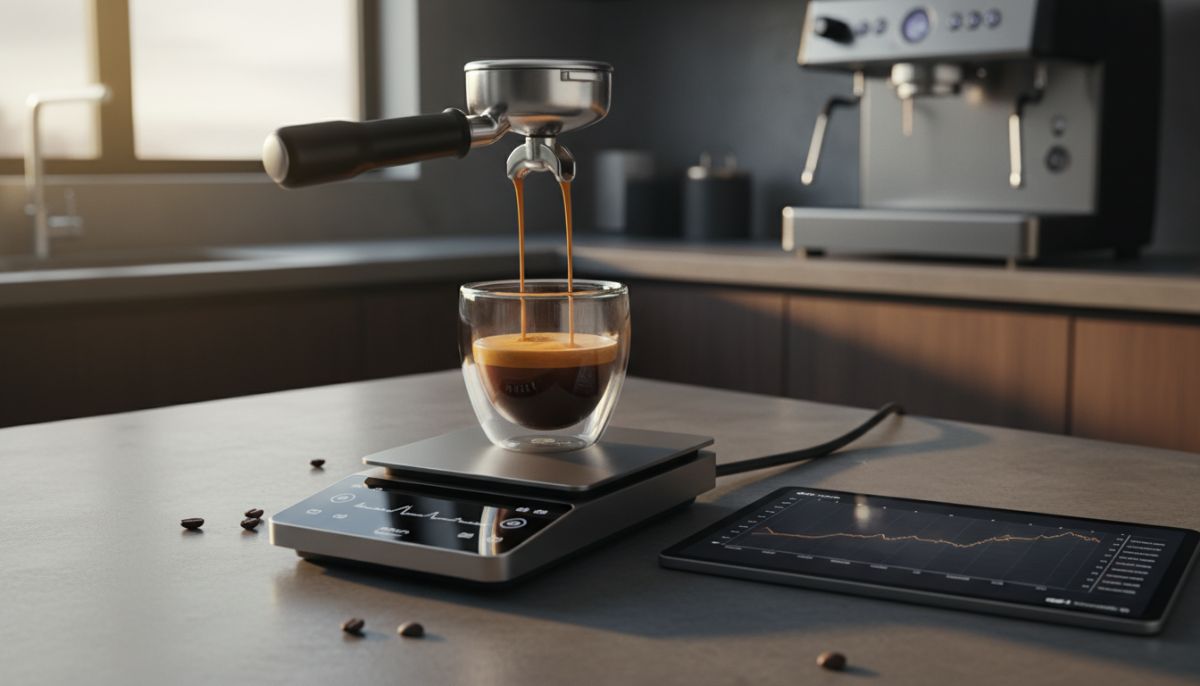
Is real-time flow rate tracking a gimmick or a game-changer? We explore how smart scales affect espresso consistency and whether the data is worth the cost.
Key Takeaways
- Real-time Diagnostics: Flow rate tracking helps visualize channeling and extraction consistency in real-time.
- Training Tool: It is an exceptional tool for building muscle memory, especially for manual lever machine users.
- Cost vs. Value: While powerful, it may be overkill for casual brewers who only need basic weight and time data.
- Not a Fix-All: Data tracking highlights puck prep issues but cannot fix them; technique remains king.
Introduction
In the world of high-end home espresso, data is the new currency. We obsess over water temperature, pressure profiles, and grinder RPMs. But one metric has recently moved from the commercial café bar to the home kitchen: flow rate tracking.
Traditionally, a scale was just a way to measure input and output. You weighed your dry dose, you weighed your liquid yield, and you stopped the shot. Simple. However, the rise of smart scales—led prominently by brands like Acaia—has introduced the ability to visualize the speed at which your espresso is extracting, measured in grams per second.
But with smart scales costing significantly more than their basic counterparts, the question arises: Is flow rate tracking a necessary diagnostic tool for the home barista, or is it just another expensive distraction?
What is Flow Rate Tracking?
At its core, flow rate tracking measures the liquid mass accumulating in your cup over time. A standard extraction might average a flow rate of 1.5 to 2.5 grams per second (g/s). However, this isn’t a static number.
In a typical shot, the flow starts slow (during pre-infusion), accelerates as the puck saturates, and often speeds up at the end as the puck degrades. A smart scale connects to an app (or uses an onboard graph) to show you this curve in real-time. This provides a visual representation of what is happening inside the basket, offering insights that taste alone might not reveal immediately.
The Diagnostic Power of Flow Data
Why would you want to watch a graph while brewing coffee? The answer lies in consistency and troubleshooting.
Spotting Channeling Instantly
One of the biggest enemies of good espresso is channeling—where water finds a path of least resistance through the coffee puck. Sometimes, you can see this with a bottomless portafilter. Other times, it is invisible to the naked eye.
On a smart scale, a sudden, sharp spike in flow rate mid-shot is a tell-tale sign that the puck has fractured. If you are trying to learn how to spot and fix uneven water flow, a smart scale provides immediate, objective confirmation that your puck prep needs work.
Mastering Pre-Infusion
If you are utilizing a machine capable of long pre-infusion phases, knowing when the basket is fully saturated is crucial. You can watch the scale for the very first drops (flow rate > 0g/s) to know exactly when to engage the pump fully. This precision helps in replicating shots with high accuracy.
Flow Rate vs. Flow Control
It is important not to confuse flow rate tracking with flow control. Tracking is passive; it tells you what is happening. Control is active; it allows you to manipulate the water debit.
However, these two concepts work best in tandem. If you have installed a flow control device on an E61 group, or if you are considering whether flow control is worth the upgrade, a smart scale is the speedometer to your accelerator. Trying to profile shots without seeing the real-time changes in flow is like driving a sports car with a broken dashboard—you are operating on feeling alone.
The Role in Dialing In Espresso
When you buy a new bag of beans, the dial-in process involves finding the sweet spot between sour and bitter. We traditionally do this by adjusting grind size and ratio.
Flow rate adds another dimension. If your shots are consistently running too fast despite fine grind settings, you might be looking at stale beans or poor burr alignment. By analyzing the data, you can see if the flow is degrading too quickly at the end of the shot. This might prompt you to adjust your ratio.
For a deeper dive on standard metrics, reviewing how to dial in espresso ratios and yield is essential before adding flow rate complexity to the mix.
Puck Prep: The Foundation of Stable Flow
A smart scale will ruthlessly expose flaws in your puck preparation. If you see erratic jagged lines on your flow graph, it usually points to inconsistent density in the coffee bed.
Before investing hundreds in a scale, ensure your distribution technique is solid. Tools like the Weiss Distribution Technique (WDT) are far cheaper and often more impactful on flavor. Understanding the science of puck prep will do more to stabilize your flow rate than simply monitoring it.
Do You Need It? The Verdict
Who Should Buy a Smart Scale?
The Data Profiler: If you are into pressure profiling or use a manual lever machine, a smart scale is invaluable. It helps you replicate the physical pressure you applied last time by matching the flow curve.
The Visual Learner: If you struggle to taste the difference between a channeled shot and a good one, the visual feedback loops accelerate your learning.
Who Can Skip It?
The Traditionalist: If you prefer the Italian workflow—dose, tamp, brew—and rely on the look of the cone and the color of the crema, flow rate tracking may feel like information overload.
The Budget Conscious: A $250 scale does not make the coffee taste better; it only tells you why it tastes that way. That money might be better spent on better beans or upgrading from a hopper to a single dosing workflow.
Conclusion
Flow rate tracking is not a strict necessity for making delicious espresso, but it is a powerful tool for making delicious espresso consistently. It bridges the gap between intuition and science, offering a look inside the portafilter that was previously impossible.
If you are happy with your morning routine, a standard timer and scale are sufficient. But if you find yourself constantly tweaking variables and chasing the “God Shot,” the insights from a flow-tracking smart scale might be the missing piece of your puzzle.
Frequently Asked Questions
While it varies by roast and recipe, a standard target is often between 1.5g and 2.5g per second. Faster flow rates are common for ‘turbo shots’, while slower rates apply to ristrettos.
You can calculate the *average* flow rate by dividing your total yield (grams) by the shot time (seconds), but you cannot see real-time fluctuations or channeling without a smart scale.
Yes, it is extremely helpful. Since manual levers rely on physical force, watching the flow rate helps the barista maintain consistent pressure throughout the shot.