
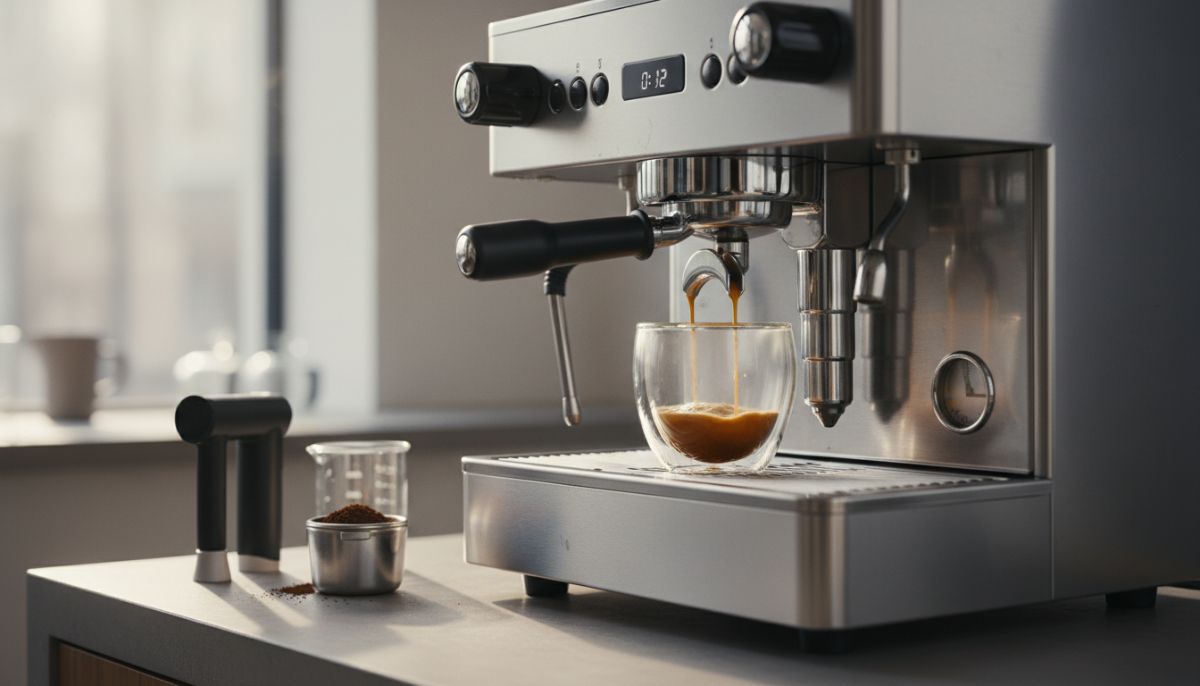
Forget everything you know about the 30-second rule. Turbo shots are rewriting the espresso playbook with faster brew times, coarser grinds, and higher extraction yields. Discover how to pull sweeter, clearer shots in under 15 seconds.
Key Takeaways
- Speed Defies Tradition: Turbo shots aim for 15–20 second extraction times, completely bypassing the traditional 25–30 second standard.
- Coarser is Key: By using a coarser grind setting, these shots reduce channeling and allow for more even water flow.
- Pressure Matters: Lower pressures (often around 6 bar) are frequently used to maximize flow rate without compressing the puck.
- Flavor Profile: Expect higher acidity, intense sweetness, and high clarity, though often with a thinner body than traditional espresso.
For decades, the "God Shot" was defined by a strict set of parameters. If your espresso didn’t pull in 25 to 30 seconds at 9 bars of pressure, it was immediately tossed in the sink. The assumption was that anything faster would be sour and underextracted, while anything slower would be bitter and astringent.
But recently, coffee science has thrown a wrench in the gears of tradition. Enter the Turbo Shot. This modern technique flips the script on extraction dynamics, utilizing coarser grinds and rapid brew times to achieve extraction yields that traditional methods struggle to reach. It sounds counterintuitive, but the results—sweet, vibrant, and incredibly consistent—speak for themselves. If you are ready to challenge the status quo and experiment with the physics of coffee, it is time to learn about fast extractions.
The Science Behind the Speed
To understand why a Turbo Shot works, we first have to unlearn a common misconception about extraction. We are taught that finer grinds equal more surface area, which should theoretically lead to higher extraction. While true in a vacuum, inside a pressurized portafilter, things get messy.
When you grind coffee very fine for a traditional 30-second shot, the resistance creates a high probability of micro-channeling. Water, taking the path of least resistance, may bypass clumps of coffee entirely while over-extracting others. This uneven flow limits your maximum potential extraction yield (EY).
Turbo shots utilize a coarser grind setting—closer to filter coffee than traditional espresso dust. Because the particles are larger, water flows through the puck with less resistance. This drastically reduces the likelihood of channeling. For a deeper dive into how uneven flow ruins flavor, read our guide on channeling 101 and how to spot it. By eliminating these dry pockets, you access more of the soluble mass in the coffee, often achieving extraction yields above 22% in nearly half the time.
Defining the Parameters: What is a Turbo Shot?
A Turbo Shot isn’t just a mistake that ran too fast. It is a calculated recipe. While parameters vary depending on the bean and equipment, the general profile looks like this:
- Ratio: 1:2.5 to 1:3 (e.g., 18g dose to 45–55g yield).
- Time: 12 to 19 seconds.
- Pressure: 6 bars (preferred) to 9 bars.
- Grind: Significantly coarser than standard espresso settings.
The goal is a long ratio in a short time. This high-flow approach washes out acidity and sweetness efficiently without extracting the heavy, dry tannins often found in slower shots. This relates closely to the concepts found in our article on understanding TDS and Extraction Yield, where high yield correlates with maximized flavor potential.
The Role of Pressure and Equipment
Can you pull a Turbo Shot on any machine? Technically, yes, but having control over pressure helps immensely. Traditional machines are set to 9 bars, which compresses the puck significantly. When you grind coarse for a turbo shot, 9 bars can sometimes cause the water to rush through too violently.
Reducing the pressure to 6 bars allows the water to flow fast without destroying the structural integrity of the puck. This is where machines with specific capabilities shine. If you are curious about modifying pressure variables, check out our guide on pressure profiling for home espresso.
Furthermore, the basket you use plays a critical role. High-precision baskets with larger surface areas (more holes) facilitate the high flow rate required for this technique. Standard baskets may offer too much resistance. To understand the hardware differences, review the debate between stock vs. precision baskets like VST and IMS. Using a precision basket is almost a prerequisite for getting the most out of a fast extraction strategy.
Grinder Geometry: Why Uniformity Wins
The success of a Turbo Shot relies heavily on grind uniformity. Because the contact time is so short, you cannot afford to have a mix of boulders (large chunks) and fines (dust). Boulders won’t extract in 15 seconds, leading to sourness, while fines will still over-extract.
This is where the debate on burr geometry becomes relevant. Flat burrs generally produce a more unimodal grind distribution (particles are mostly the same size) compared to conical burrs, which produce a bimodal distribution (a mix of sizes for texture). Turbo shots tend to shine on flat burrs because the uniformity allows for that aggressive, fast extraction without muddiness. For more on how your grinder shapes flavor, read our comparison of flat vs. conical burrs.
Step-by-Step: How to Dial in a Turbo Shot
Ready to try it? Here is a workflow to transition from traditional espresso to a Turbo Shot profile.
1. Coarsen Up
Take your current espresso setting and make a significant adjustment coarser. You might need to go 2–3 large steps coarser depending on your grinder. You are aiming for a texture that feels gritty, like table salt, rather than powdery.
2. Dose and Prep
Keep your dose standard (e.g., 18g). Puck preparation remains vital. Even though coarser grinds channel less, they still require distribution. Do not skip the WDT tool; ensuring an even bed is critical when water moves this fast.
3. The Pull
Lock in and start your shot. Aim for a 1:3 ratio. If you dose 18g, aim for roughly 54g out. Watch the timer. You want to hit this yield in about 15 seconds. If it takes 25 seconds, you are still too fine. If it takes 10 seconds, you are too coarse.
4. Taste and Adjust
Taste the result. It should be vibrant, juicy, and sweet. If it tastes sour or grassy, you may need to push the ratio longer (1:3.5) or fine up slightly. If it tastes watery, you might decrease the ratio slightly. For help with troubleshooting taste, refer to our guide on dialing in espresso ratios and yield.
The Trade-Off: Texture vs. Clarity
No brewing method is without its compromises. The traditional 9-bar, 30-second espresso is beloved for its syrup-like body and rich crema. Turbo shots, by nature of their coarser grind and faster flow, produce a shot with significantly less body and crema.
The texture will be closer to a very strong filter coffee or an AeroPress brew than a thick ristretto. If mouthfeel is your priority, the Turbo Shot might feel lacking. However, if flavor clarity and the elimination of bitterness are your goals, the trade-off is often worth it. This distinction is somewhat similar to the spectrum discussed in our guide to Ristretto, Normale, and Lungo, where the Turbo Shot sits at the extreme end of the “Lungo” philosophy but achieved in a fraction of the time.
Conclusion
The Turbo Shot is more than just a trend; it is a scientifically backed method that exposes the limitations of traditional dogma. By prioritizing flow dynamics and grind uniformity over arbitrary time constraints, you can unlock flavors in your coffee that 9-bar extractions often mask.
It requires a shift in mindset and a willingness to drink coffee that looks different—thinner crema and lighter color—but the resulting sweetness and high extraction yields are undeniable. Next time you are dialing in a new bean, don’t be afraid to break the rules. Go coarse, pull fast, and taste the difference.
Frequently Asked Questions
A turbo shot is a modern espresso technique that uses a coarser grind, a lower pressure (often 6 bar), and a fast extraction time (15–20 seconds) to achieve high extraction yields with improved flavor clarity.
While not strictly required, a machine with adjustable pressure (OPV or flow control) helps significantly. You can pull them on standard 9-bar machines, but the results are more consistent at lower pressures.
Turbo shots use coarser grinds and lower pressures, which generate less CO2 emulsification compared to traditional high-pressure espresso. The result is a thinner body and less crema, but often better flavor.
Turbo shots generally taste sweeter and more acidic with high clarity. They lack the bitterness often found in traditional espresso but also have a thinner mouthfeel.