
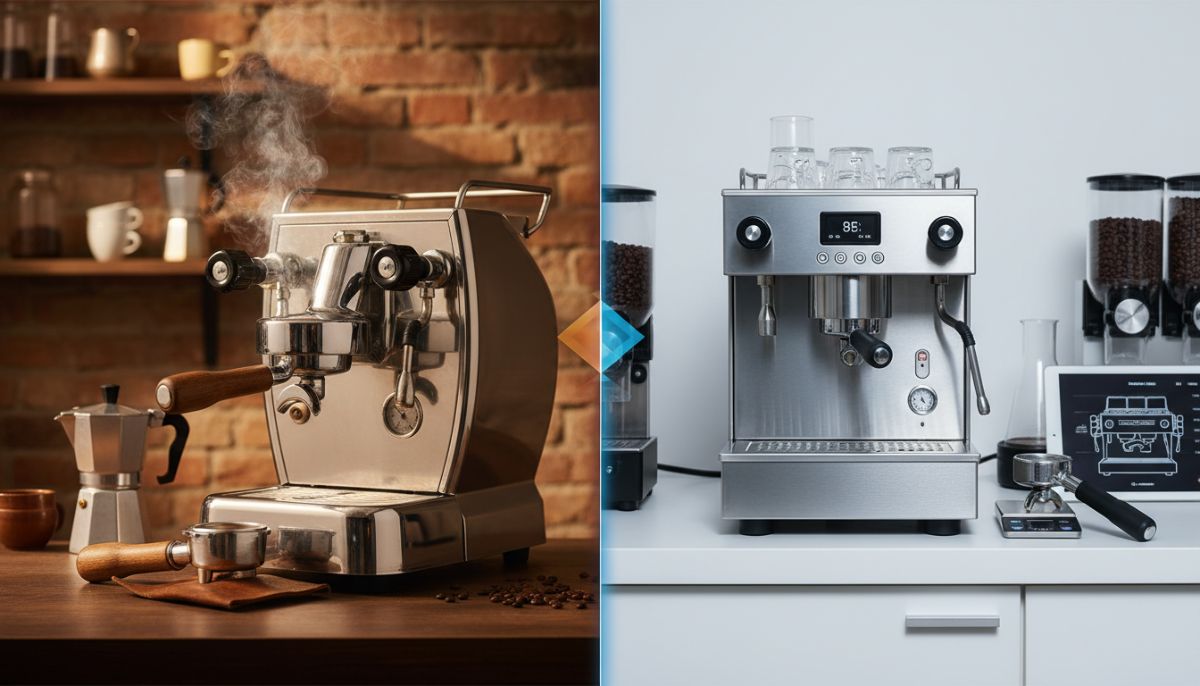
Art vs. Science. Soul vs. Precision. We break down the distinct design philosophies behind Italian and German espresso machines to help you decide which engineering style suits your brew bar.
Key Takeaways
- The Core Difference: Italian machines prioritize tradition, tactile feedback, and aesthetic flair, often relying on the legendary E61 grouphead.
- German Focus: German engineering emphasizes thermal precision, internal layout efficiency, and robust stainless steel construction.
- Materials Matter: Italian builds favor copper and brass for heat retention, while German designs lean heavily on insulated stainless steel boilers.
- The Verdict: Choose Italian for the romantic ritual of brewing; choose German for the scientific pursuit of the perfect variable control.
When you step into the world of high-end home espresso, you aren’t just buying an appliance; you are buying into a philosophy. For decades, the market has been dominated by two distinct schools of thought: the romantic heritage of Italian design and the calculated precision of German engineering.
Choosing between them is rarely about which machine makes “better” coffee. In the right hands, both can pull a god shot. Instead, the choice comes down to how you view the process of brewing. Is it an art form steeped in history, or a science requiring absolute control?
In this guide, we will dissect the mechanical hearts of these machines. We will explore the differences in boilers, groupheads, and internal layouts to help you decide which flag should fly on your countertop.
The Italian Philosophy: Romance, Tradition, and Chrome
Italy is the birthplace of espresso. The very word evokes images of bustling cafes in Milan and the clinking of ceramic cups. The Italian engineering philosophy is deeply rooted in this history. It is about preservation, sensory experience, and the “soul” of the machine.
The Cult of the E61 Grouphead
The centerpiece of almost every classic Italian machine is the E61 grouphead. Invented in 1961 by Faema, this chunk of chrome-plated brass is an icon. It uses a thermosyphon system to circulate hot water continuously from the boiler to the group, keeping everything at brew temperature.
Italian manufacturers like Rocket Espresso and Lelit adhere strictly to this design. The mechanical lever on the side allows for manual pre-infusion and gives the barista tactile feedback. It is a satisfying, heavy engagement that feels mechanical and alive.
To understand why this component is so revered, you have to look at the mechanics. E61 groupheads offer a natural ramp-up in pressure, which helps smooth out extraction inconsistencies. However, they are heavy thermal masses that take time to heat up—a trade-off for their legendary temperature stability once they reach saturation.
Copper, Brass, and Heat Exchangers
Open up a traditional Italian machine, and you will see a lot of copper and brass. Italian engineers favor these materials for their natural antimicrobial properties and excellent thermal conductivity. The classic Italian home machine is often a Heat Exchanger (HX) system.
In an HX setup, a steam boiler runs hot to provide endless steam power, while a tube passes through it to flash-heat the brew water. This design allows you to brew and steam simultaneously without the complexity of two boilers.
While effective, it requires a technique called a “cooling flush” to manage temperatures. This interplay reflects the Italian view: the barista must know their machine. It is a relationship, not just a transaction.
The German Philosophy: Precision, Steel, and Logic
If Italian machines are classic sports cars, German machines are high-performance luxury sedans. Brands like Profitec and ECM (which, while manufacturing in Italy and Germany, is heavily German-designed) take a different approach. Their goal is to eliminate variables.
Stainless Steel and Dual Boilers
German engineering generally favors stainless steel over copper. Stainless steel is non-corrosive and, while less conductive, provides incredible insulation when wrapped properly. The German philosophy often pushes consumers toward Dual Boiler systems sooner than Italian lineups do.
The logic is simple: separation of church and state. One boiler handles steam; the other handles brewing. This separation allows for precise thermal management. When deciding between single boiler vs. heat exchanger vs. dual boiler configurations, the German approach almost always favors the dual boiler for its ability to hold a specific temperature within a fraction of a degree.
The Obsession with PID Controllers
While Italian machines have adopted technology, German machines integrate it. You will rarely find a high-end German machine relying solely on a pressurestat. Instead, they utilize PID (Proportional-Integral-Derivative) controllers.
A PID controller actively monitors the boiler temperature and pulses the heating element to maintain stability. This is crucial for modern light roasts that require higher temperatures to extract sweetness. Understanding PID controllers is essential if you want to replicate specific flavor profiles consistently, a hallmark of the scientific approach to coffee.
Under the Hood: Internal Layout and Build Quality
The difference between the two philosophies is perhaps most visible when you remove the body panels. This is where the stereotypes of engineering hold true.
The Italian “Spaghetti”
Italian machines are often packed tight. Wires and copper tubes weave around each other to fit into compact, stylish frames. It is a marvel of packaging, but it can make maintenance a challenge. Replacing a vacuum breaker or a pump mount might require removing several other components first.
However, the parts are standardized. Whether it’s a vibration pump or a solenoid valve, parts for Italian machines are universally available. This ensures that a machine bought today can be kept running for thirty years.
The German Organization
Open a machine engineered in Heidelberg, and you find order. Wires are bundled and routed cleanly. Copper pipes are bent with geometric precision to avoid rubbing against the frame. Components are laid out logically, anticipating that a human will one day need to fix them.
This attention to detail extends to noise reduction. German brands are famous for mounting their pumps on high-quality rubber dampers or using rotary pumps in smaller footprints. If silence is a priority for you, the debate between rotary vs. vibratory pumps often leans in favor of the German-engineered implementation, where even vibratory pumps are whisper-quiet due to superior sound insulation.
Flow Control and Modern Adaptations
Interestingly, the lines are blurring. Italian manufacturers are adopting PIDs, and German manufacturers are using the E61 grouphead. However, they use them differently.
German engineers have refined the E61. They have added stainless steel mushrooms (the internal valve cap) to reduce scale buildup and modified the thermosyphon loops for faster heating. They have effectively “modded” the classic Italian design.
Furthermore, both schools are embracing flow control. This technology allows you to restrict the flow of water manually during the shot, mimicking the profile of a lever machine. Flow control explained simply is the ability to save a shot that is running too fast or to gently extract delicate flavors from single-origin beans. While the Italians invented the manual lever, the Germans have perfected the retro-fit valve that gives E61 machines this capability.
Which Philosophy Fits Your Countertop?
The decision ultimately comes down to your personality type.
Choose Italian Engineering If:
- You value aesthetics and want a centerpiece for your kitchen.
- You enjoy the tactile ritual of the process and learning to “surf” temperatures.
- You prefer the classic, heavy body and sweetness of traditional espresso roasts.
- You want a machine with a soul that feels like a classic car.
Choose German Engineering If:
- You demand consistency and want to eliminate variables.
- You drink lighter roasts and need precise temperature control.
- You appreciate clean internal layouts and easier DIY maintenance.
- You value silence and robust, over-engineered build quality.
Conclusion
Whether you choose the chrome-clad romance of Italy or the stainless steel precision of Germany, the most important factor is maintenance. No amount of engineering can save a machine from neglect.
Regular backflushing, descaling, and gasket changes are mandatory for both styles. To ensure your investment lasts a lifetime, commit to a routine. Check out our guide on the cleaning manifesto to keep either machine running like new.
In the end, both philosophies lead to the same destination: a delicious cup of coffee. The journey you take to get there is up to you.
Frequently Asked Questions
Generally, German machines (like ECM or Profitec) are praised for cleaner internal layouts and high-quality components which can reduce long-term wear and make repairs easier. However, Italian machines are built with standardized industrial parts that are also incredibly durable if maintained properly.
Not necessarily better, but different. Italian machines, particularly Heat Exchangers, often favor a temperature profile that suits classic, chocolatey medium-dark roasts. German dual boilers with PID control offer the precision required for modern, acidic light roasts.
Italian manufacturing tradition favors copper and brass because they are naturally antimicrobial and have excellent thermal conductivity, allowing the machine to retain heat effectively, which is crucial for temperature stability.
The E61 grouphead is a distinctly Italian invention, created by Faema in 1961. However, many German manufacturers utilize this grouphead in their machines due to its reliability and consumer popularity, often improving it with stainless steel internal components.