
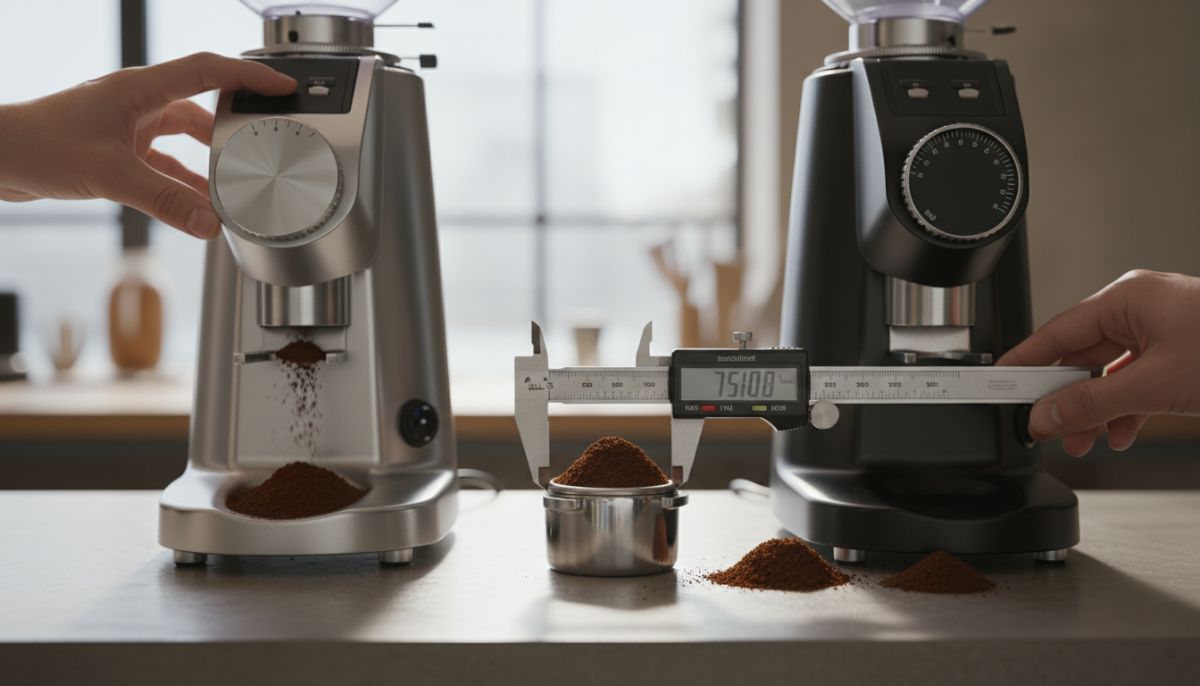
Struggling to dial in the perfect shot? The problem might be your adjustment mechanism. We compare stepless vs. stepped grinders to explain why micro-adjustments are critical for espresso.
Key Takeaways
- Precision is King: Espresso requires specific resistance; stepless grinders offer infinite adjustability to hit the perfect extraction time.
- The “Step” Problem: Stepped grinders often land “between” settings, causing shots to run either too fast or too slow with no middle ground.
- Versatility vs. Specialization: Stepped grinders are often easier for switching between brew methods (like French Press to Espresso), while stepless is superior for dedicated espresso use.
- Mechanism Matters: Micrometric adjustments and worm gears are the hallmarks of high-end stepless engineering.
Introduction
You have bought fresh beans. You have prepped your puck perfectly. You pull a shot, and it gushes out in 15 seconds—sour and thin. You adjust your grinder one setting finer, expecting perfection. Instead, the machine chokes, dripping out bitter sludge over 45 seconds.
Welcome to the purgatory of the stepped grinder. This scenario is the most common frustration for home baristas transitioning from pressurized baskets to professional extraction.
The debate between stepless vs. stepped grinders isn’t just about machinery; it is about control. While a stepped grinder might suffice for drip coffee, espresso is a game of pressure and resistance where microns matter. In this guide, we will break down why the adjustment mechanism is the single most important feature when choosing a grinder for espresso.
Defining the Contenders
What is a Stepped Grinder?
A stepped grinder uses a preset system of notches, clicks, or indentations to adjust the distance between the burrs. When you turn the dial or collar, it “locks” into a specific setting.
These are common on entry-level appliances and many manual grinders. They are fantastic for users who frequently switch brew methods. If you brew a V60 in the morning and an espresso in the afternoon, distinct clicks make it easy to return to previous settings.
What is a Stepless Grinder?
A stepless grinder has no fixed points. The adjustment collar or knob slides smoothly on a thread, allowing for infinite adjustability. There are no clicks.
This design is standard on commercial equipment and high-end consumer models. It allows you to move the burrs closer together by microscopic amounts, giving you total control over the particle size.
Why Espresso Demands Micro-Adjustments
Espresso is unique because it relies on the coffee puck itself to create resistance against 9 bars of water pressure. Small changes in grind size create massive changes in flow rate.
The Gap Between Clicks
On a stepped grinder, one “click” might represent a change in particle size that alters your shot time by 5 to 10 seconds. When you are dialing in your espresso ratios, you are typically aiming for a target window of roughly 25 to 30 seconds.
If Setting 4 gives you a 20-second shot (too fast) and Setting 3 gives you a 35-second shot (too slow), you are stuck. You cannot access the grind size that exists between those two numbers. This forces you to compensate by over-dosing or tamping harder, which introduces inconsistency.
The Stepless Advantage
With a stepless grinder, you can make an adjustment so slight it is barely visible to the naked eye. This allows you to shift that 20-second shot to a 22, 25, or 27-second shot with precision. This ability to fine-tune is what separates appliance-grade gear from a prosumer-grade setup.
Mechanisms of Adjustment
Not all stepless grinders operate the same way. Understanding the mechanics can help you choose the right tool for your bench.
Micrometric Collars
This is the most common design. The entire collar sitting below the hopper rotates. It is direct and responsive. However, because the threads are often fine, it can be difficult to remember your exact position if you switch beans often.
Worm Gear Drives
Found on many high-end Italian grinders, a worm gear uses a small knob to turn the main collar via a gear reduction. This allows for incredibly precise movements. You might turn the knob three full rotations just to change the grind size slightly. It is the ultimate tool for precision, though less ideal for users who want to switch rapidly between coarse and fine settings.
Are Stepped Grinders Ever Better?
Despite the superiority of stepless adjustment for espresso, stepped grinders have their place. If you are not strictly an espresso drinker, a stepless grinder can be a nightmare. Trying to move from a Turkish grind to a French Press coarse setting on a worm-gear stepless grinder takes time and effort.
Furthermore, the gap between hand grinders and electric options is closing. Many modern manual grinders offer “micro-stepped” adjustments that are tight enough for espresso. For a deeper look at manual options, check out our guide on hand grinders vs. electric options.
The Impact on Flavor and Workflow
The mechanism you choose impacts more than just the timer on your scale; it changes how you experience the coffee.
Dialing In and Waste
Stepless grinders allow you to save beans. Because you can make minor corrections, you are less likely to sink shots that are “way off.” However, because stepless grinders are often designed for commercial environments, some have larger grind chambers.
It is vital to consider retention. If you make a micro-adjustment, the old grounds inside the chute need to be cleared out before you see the result of that change. Always remember the importance of purging retained grounds when making fine adjustments.
Burr Geometry and Consistency
While the adjustment mechanism controls the distance between burrs, the shape of the burrs determines the particle distribution. Whether you choose flat or conical burrs, the ability to control their spacing remains paramount. You can read more about how geometry affects taste in our comparison of flat vs. conical burrs.
Workflow Considerations: Single Dosing vs. Hoppers
Your preferred workflow should dictate your choice of adjustment mechanism. If you fill a hopper and use the same beans for a week, a stepless worm gear is perfect. You set it once and make tiny tweaks as the beans age.
However, if you change beans every morning, you might struggle with a traditional stepless mechanism. In this case, a single dosing workflow with a large, clearly marked adjustment dial (even if it is stepless) is often easier to manage.
Conclusion
So, which wins the battle of stepless vs. stepped grinders? If your primary goal is true espresso—thick, syrupy, and perfectly extracted—a stepless grinder is non-negotiable. The ability to make micro-adjustments allows you to navigate the narrow variables of espresso extraction with confidence.
While stepped grinders offer convenience for multi-method brewing, they often lead to compromise in the espresso cup. Invest in precision, and your palate will thank you.
Frequently Asked Questions
Yes, you can, but it is more difficult. You may find that one setting chokes the machine while the next setting is too fast. You will often have to adjust your dose (amount of coffee) to compensate for the lack of grind precision.
Stepless means the grinder has no fixed ‘clicks’ or settings. The adjustment collar or knob can be rotated to any position, allowing for infinite or microscopic changes to the grind size.
Generally, no. While it can grind coarse enough, switching a stepless grinder from an espresso setting to a French Press setting requires many turns of the dial. It is often difficult to return to your exact espresso setting afterward.
Stepless grinders often require more precise machining, higher quality threading, and more robust stabilization mechanisms (like worm gears) to ensure the burrs do not shift during operation.