
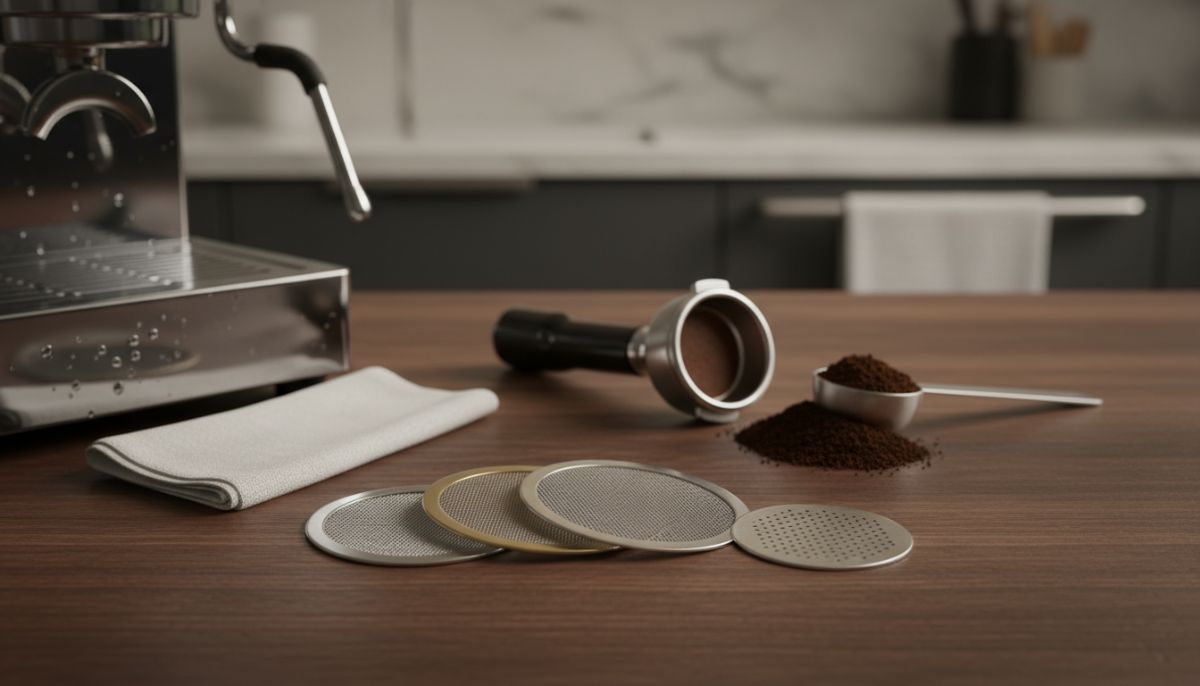
A definitive guide to espresso puck screens. We analyze whether sintered mesh filters improve extraction yield, reduce channeling, or simply keep your group head clean, complete with maintenance and dosing protocols.
Key Takeaways
- Function over Flavor: Puck screens primarily improve water dispersion and keep the shower screen clean. Flavor improvements are subtle and mostly result from reduced channeling.
- Headspace is Critical: Adding a 1.7mm screen requires reducing your coffee dose by 1-2 grams to prevent damaging the screen or the puck.
- Thermal Mass Matters: Thick metal screens absorb heat. Without preheating, they can drop brew temperatures by 2-4°C.
- Maintenance Reality: Coffee oils eventually clog the sintered mesh. An ultrasonic cleaner or Cafiza soak is mandatory for long-term durability.
The espresso puck screen has rapidly evolved from a niche modifier used by Flair 58 owners to a ubiquitous accessory on countertops next to La Marzocco and Breville machines. This simple disc of sintered stainless steel mesh promises to fix channeling, increase extraction yield, and keep your group head spotless. But does it actually deliver better espresso, or is it just another piece of metal adding friction to your workflow?
We break down the mechanics, the data, and the daily reality of using puck screens to help you decide if this upgrade belongs in your setup.
The Mechanics: What Does a Puck Screen Actually Do?
A puck screen sits directly on top of your tamped coffee bed. It acts as a secondary shower screen, creating an artificial barrier between the pressurized water leaving the group head and the coffee grounds.
1. Secondary Dispersion
Even high-end espresso machines can suffer from uneven water distribution. If the water hits the puck in a single concentrated jet, it digs a hole in the coffee bed, leading to channeling. A sintered metal screen disperses this water impact across its entire surface area before it touches the coffee. This ensures the water saturates the puck gently and evenly, significantly reducing the risk of “spurters” or uneven flow.
If you struggle with consistency, using a screen is often a more effective immediate fix than upgrading your machine. For a deeper dive on diagnosing flow issues, read our guide on spotting and fixing uneven water flow.
2. Puck Integrity and Compression
During extraction, the coffee puck swells. Without a screen, the expanding puck might press unevenly against the machine’s shower screen, leading to cracks or fractures in the coffee bed. The puck screen acts as a rigid restraint, holding the puck together firmly. This compression assists in maintaining a solid, cohesive puck throughout the shot, which is why users often report uniformly dry pucks that knock out easily.
The Cleanliness Factor: The Undeniable Benefit
The most immediate benefit of a puck screen is hygiene. By placing a physical barrier on top of the grounds, you prevent coffee back-flushing into the group head after the solenoid valve engages. The result is a shower screen that remains virtually perfectly clean after a shot.
For home baristas who dread chemical backflushing, this is a game-changer. While you still need to follow a regular machine maintenance schedule, the daily buildup of oils and grounds on your shower screen is nearly eliminated. This is particularly valuable for E61 group owners, where dismantling the group for deep cleaning is a manual process.
The Thickness Debate: 1.7mm vs. 1.0mm vs. Paper Filters
Not all screens are created equal. The market is dominated by two main thicknesses: the standard 1.7mm (often comprised of multiple mesh layers) and the thinner 1.0mm.
1.7mm Sintered Mesh (Standard)
- Pros: Extremely durable, excellent water dispersion, creates a very dry puck.
- Cons: Significant thermal mass (requires preheating), reduces basket capacity drastically.
- Best For: Lever machines (Flair, La Pavoni) or users prioritizing a dry puck knock-out.
1.0mm Ultra-Slim Screens
- Pros: Less headspace required, lower thermal mass (less impact on brew temp), flexible.
- Cons: Slightly less rigid, may not disperse water as aggressively as the thick version.
- Best For: Pump machines (Breville, Gaggia, Rocket) where headspace is limited.
Paper Filters (The Aeropress Hack)
Placing a paper filter on top offers similar dispersion benefits without the thermal mass or cleaning requirements. However, paper is single-use and does not compress the puck the way a rigid metal screen does. If you are comparing consumables vs. durable goods, paper offers a cleaner cup profile by filtering out more oils, while metal screens preserve the body and texture.
Critical Adjustments: Headspace and Dosing
You cannot simply drop a puck screen into your current routine without adjustment. The screen occupies physical space inside the filter basket. If your basket is already full, the screen will press against the group head gasket before you even lock the portafilter in, or the screw on the shower screen will dent the mesh.
The Rule of Thumb: Reduce your dose by 1 to 2 grams when using a 1.7mm screen. If you usually dose 18g in an 18g basket, you must drop to 16-16.5g.
Failure to adjust creates a “overfilled” scenario where the coffee cannot expand, leading to choking or severe channeling. Understanding how much room you have is vital; check our guide on espresso headspace and basket dosing to calculate the perfect fill level.
The Hidden Downsides: Thermal Mass and Workflow
Puck screens are not without friction. There are two specific pain points that manufacturers rarely advertise.
1. Temperature Drop
A thick block of stainless steel at room temperature will act as a heat sink. When 93°C water hits a cold 1.7mm puck screen, the water temperature can drop by 2-4°C before it touches the coffee. This can result in sour, under-extracted espresso.
The Fix: You must preheat the screen. Leave it inside the portafilter locked into the group head while the machine warms up, or flush hot water through it immediately before the shot.
2. The Knock-Box Workflow
Knocking out a puck with a screen is annoying. You cannot simply bang the portafilter into the knock box, or you will lose the screen in the trash. You must:
- Knock the puck gently into your hand (warning: the screen is scalding hot).
- Peel the screen off the puck.
- Rinse the screen immediately to prevent clogging.
This adds 15-20 seconds to your workflow per shot. If you are serving multiple guests, this friction adds up quickly.
Maintenance: The Clogging Issue
Over time, coffee oils polymerize inside the microscopic mesh of the screen. You may notice that after 2-3 months, your flow rate slows down, or water sprays erratically from the screen itself.
Running it under water is not enough. To maintain a puck screen, you need a deep cleaning protocol:
- Weekly: Soak in a solution of Cafiza or coffee detergent for 15 minutes to dissolve oils.
- Monthly: Use an ultrasonic cleaner. The cavitation bubbles are the only reliable way to dislodge fines stuck deep inside the sintered mesh layers.
Do Puck Screens Improve Taste?
Blind taste tests suggest that while puck screens improve extraction uniformity (measurable via Refractometer/TDS), the perceptible difference in flavor is minor for the average palate. The improvement is largely in consistency.
If you are already using advanced puck prep techniques like WDT, the screen provides diminishing returns on flavor. However, it ensures that your careful preparation isn’t ruined by a harsh shower screen water jet. For more on optimizing prep, review the science of puck prep.
Verdict: Should You Buy One?
Buy a Puck Screen If:
- You hate cleaning your group head and shower screen.
- You own a machine with high water flow that disturbs the puck (e.g., unmodified Gaggia Classic).
- You use a lever machine like the Flair 58 (it is essential here).
- You use precision baskets and want to maximize extraction yield.
Skip the Puck Screen If:
- You value a fast, low-friction workflow.
- You are not willing to adjust your dose or preheat the screen.
- You consistently pull great shots without one and don’t want another variable to manage.
Frequently Asked Questions
Generally, no, but because the screen increases resistance and reduces headspace, you might find your shots run slightly slower. You may need to coarsen your grind slightly or lower your dose to compensate for the added flow resistance.
Yes, but you must check the size. Breville 54mm machines require a specific 53.3mm or 53.5mm puck screen. Do not use a standard 58mm screen. Also, be mindful of the shower screen screw on Breville machines; a 1.7mm screen might hit it, so a 1.0mm screen is often a better fit.
Do not use your fingers immediately. Many users knock the puck onto a clean surface or the palm of their hand (carefully) to retrieve the screen. Alternatively, placing a magnet on the side of the basket can sometimes help lift the screen if it is magnetic, though most stainless steel screens are not strongly magnetic.
They serve different purposes. A paper Aeropress filter (cut to size) offers great filtration and clarity but is single-use. A metal puck screen is reusable and helps compress the puck, reducing the chance of cracks, but adds thermal mass. Metal screens are better for body; paper is better for clarity.
This indicates trapped rancid coffee oils inside the mesh. You need to deep clean it immediately using a coffee detergent (like Cafiza) and hot water. Soaking it for 20 minutes should dissolve the buildup.