
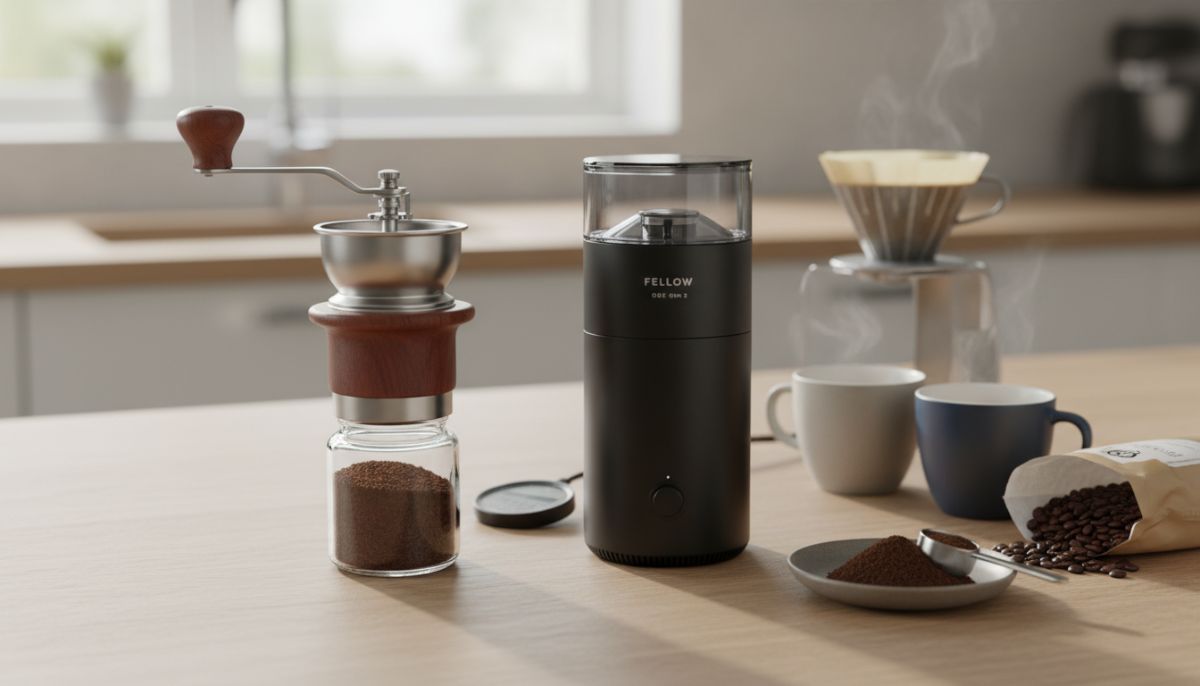
Debating between a Comandante C40 and a Fellow Ode? We break down the taste, effort, speed benchmarks, and value proposition to decide if manual grinding is right for your workflow.
Key Takeaways
- Value for Money: A $250 manual grinder often outperforms electric grinders in the $500–$700 range regarding particle consistency and cup clarity.
- Time Commitment: Expect 30–45 seconds for filter coffee and 45–90 seconds for espresso (18g dose), depending on roast density.
- Noise Levels: Manual grinders operate below 60dB (conversation volume), while electric grinders frequently exceed 80dB.
- The "Effort" Factor: Light roast espresso requires significant torque; those with grip strength issues should stick to electric.
The Value Proposition: Why Manual Grinders Win on Taste
The primary argument for choosing a premium hand grinder—such as the Comandante C40 MK4, 1Zpresso K-Ultra, or Kinu M47—is the price-to-performance ratio. In an electric grinder, a significant portion of the manufacturing cost goes into the motor, electronics, housing, and safety certifications. In a manual grinder, nearly 100% of your investment goes into the burr set and the alignment stability.
Consequently, a $250 hand grinder often features the same high-nitrogen steel burrs found in commercial electric units costing three times as much. For enthusiasts chasing high clarity and specific flavor separation, manual grinding offers the cheapest entry point into "god-tier" coffee. If you are comparing flat vs. conical burrs, you will find that most hand grinders utilize conical burrs, which excel at producing the bimodal particle distribution favored for traditional espresso and heavy-bodied pour-overs. However, high-uniformity hand grinders are now challenging flat burr electrics for clarity.
To understand how this geometry affects your cup, read our guide on how grinder geometry changes your espresso flavor profile.
The Physical Reality: Time, Torque, and Fatigue
The biggest barrier to entry is the physical effort. Reviews often gloss over this, but the difference in effort between grinding a dark roast for a French Press and a light roast for espresso is massive.
Time-to-Grind Benchmarks (18g Dose)
We tested a premium 48mm burr hand grinder (1Zpresso K-Series) against a standard entry-level ceramic burr grinder to showcase the speed difference.
- Medium Roast (Filter/Pour Over):
- Premium Grinder: 25–30 seconds.
- Entry Ceramic: 60+ seconds.
- Light Roast (Espresso):
- Premium Grinder: 45–60 seconds.
- Entry Ceramic: 2 minutes+ (often stalls).
The Fatigue Factor
Grinding for espresso requires high torque. With dense, light-roasted beans—often preferred for their complex acidity—the resistance is significant. If you are adjusting your recipe for washed vs. natural process beans, you will notice that high-altitude washed coffees are significantly harder to grind physically. For a single morning cup, this is a pleasant ritual. If you are hosting a brunch and need to grind for six people, manual grinding becomes a burden. Users with arthritis or carpal tunnel syndrome should avoid manual grinding for espresso entirely.
Workflow: Ritual vs. Convenience
The choice between manual and electric is also a choice between single dosing and hopper-fed convenience.
Premium hand grinders are inherently single-dose devices. They have near-zero retention, meaning if you put 18.0g of beans in, you get 18.0g of grounds out. This eliminates the need for purging stale coffee, saving money in the long run. This workflow mirrors high-end electric grinders like the Niche Zero but at a fraction of the cost. For a deeper dive into this workflow, check our analysis on single dosing versus hopper-based workflows.
Counter Space and Noise
Electric grinders like the Fellow Ode or Baratza Encore dominate counter space. A hand grinder fits in a drawer. Furthermore, the noise difference is stark. High-speed electric grinders generate high-pitched whines (80dB+), capable of waking family members. Manual grinders produce a low-frequency crunch (<60dB), making them ideal for early risers or open-concept living spaces.
Reliability and Repairability
Electric grinders introduce multiple points of failure: capacitors, switches, and motors. A premium hand grinder is mechanically simple: a driveshaft, bearings, and burrs. With proper cleaning, a unit like the Kinu M47 or Comandante can last decades. If a bearing wears out, it is user-replaceable.
Conversely, entry-level electric grinders often feature plastic gears that strip over time. While the Baratza Encore is famous for its repairability, many consumer appliances are disposable. If you value "buy it for life" durability, the manual grinder wins.
Taste Test: The Verdict
In blind taste tests comparing a 1Zpresso K-Max against a Fellow Ode (Gen 1) for pour-over, the hand grinder often produces fewer fines, resulting in a cleaner cup with less astringency. When grinding for espresso, high-end manual grinders offer the precise micro-adjustments necessary to dial in your espresso ratios perfectly, a feature often lacking in stepped electric grinders under $400.
Who Should Buy What?
Choose a Premium Hand Grinder If:
- Budget is restricted: You have $200–$300 but want the grind quality of an $800 machine.
- Silence is golden: You grind coffee while others sleep.
- Portability matters: You travel or brew at the office.
- You brew 1-2 cups daily: The time commitment is negligible.
- You enjoy the tactile experience: You appreciate the rise of manual brewing methods.
Choose an Electric Grinder If:
- Volume is high: You frequently brew for more than two people.
- Espresso is your main brew: Grinding light roast espresso by hand daily can lead to fatigue.
- Budget allows: You can afford $600+ for a Niche Zero or similar zero-retention electric grinder.
- Physical limitations: You have grip strength issues or wrist pain.
Frequently Asked Questions
Yes, it can be. Grinding fine enough for espresso creates significant resistance (torque), especially with light roast beans. While premium grinders with 48mm burrs minimize the rotations needed, it still requires grip strength and effort, taking 45 to 90 seconds per dose.
At the same price point, generally yes. A $250 manual grinder uses high-end steel burrs comparable to those in $700+ electric grinders. This results in better particle uniformity and clarity compared to the cheaper burr sets found in similarly priced electric units.
With a modern premium hand grinder: 20-30 seconds for filter/pour-over grinds and 45-60 seconds for espresso grinds. Cheaper ceramic hand grinders can take 3-4 times longer.
They are excellent for daily use if you only brew 1-2 cups per day. If you regularly brew for large groups or multiple times a day, the manual workflow can become tedious and physically tiring.