
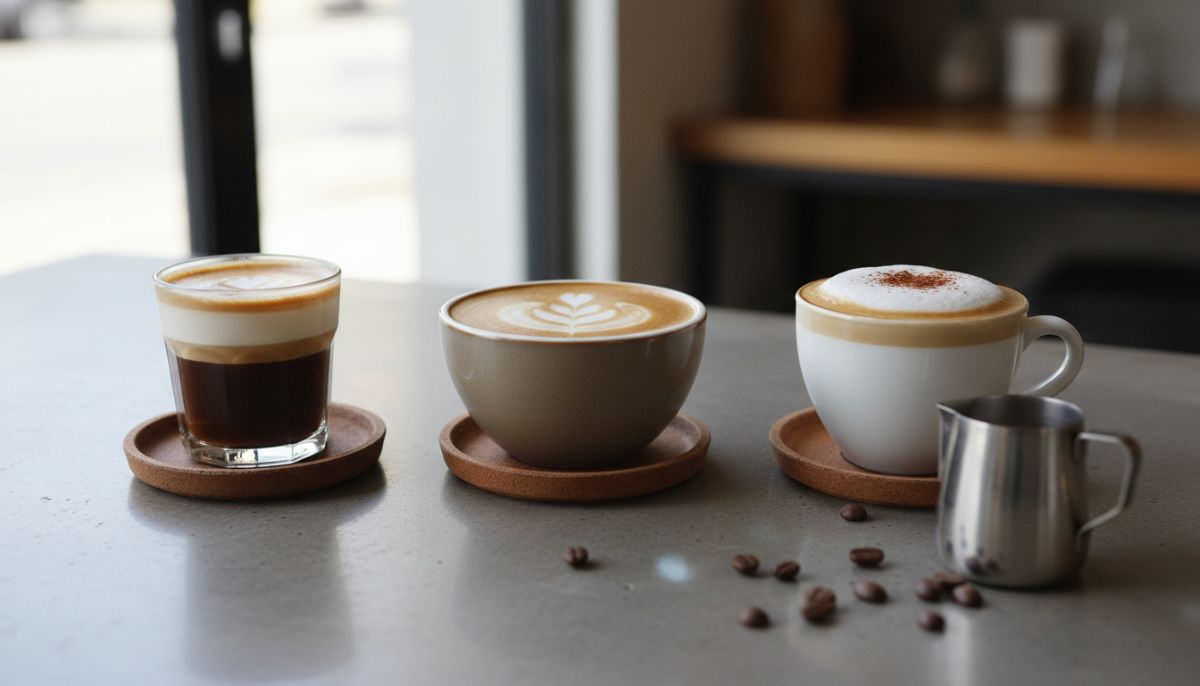
Confused by the coffee menu? We break down the exact ratios, foam textures, and caffeine content of the Flat White, Cortado, and Cappuccino. Discover which drink fits your taste profile.
Key Takeaways
- The Cortado: A balanced 1:1 ratio of espresso to steamed milk. Minimal foam, served in a Gibraltar glass to highlight the coffee’s character.
- The Flat White: A specialty coffee staple featuring silky microfoam and a strong espresso base (often ristretto). The best choice for latte art and mouthfeel.
- The Cappuccino: Defined by texture and expansion. Traditional recipes follow the rule of thirds (espresso, milk, foam), offering the airiest experience.
The Modern Coffee Menu: Ratios Define the Drink
Walking into a third-wave coffee shop can feel like entering a chemistry lab. The difference between a Flat White, Cortado, and Cappuccino isn’t just about cup size; it is a precise science of extraction ratios, milk temperature, and aeration levels. Understanding these variables allows you to order with confidence and even replicate these drinks at home.
This guide moves beyond the generic descriptions found elsewhere. We analyze the cross-section of each drink, the sensory experience, and the technical skills required to craft them.
The Cortado: The Balanced Realist
Originating from Spain (from the verb cortar, meaning “to cut”), the Cortado is the bridge between pure espresso and milk drinks. It is designed to cut the acidity of the espresso without masking its flavor profile.
The Ratio and Vessel
The Cortado follows a strict 1:1 ratio. A standard serving consists of a double shot of espresso (approx. 2 oz) cut with an equal amount of steamed milk (2 oz). The total volume is roughly 4 to 4.5 oz.
Unlike the other drinks, the Cortado is traditionally served in a Gibraltar glass—a small, faceted tumbler. The glass lacks a handle, encouraging you to wait until the drink cools to a palatable temperature, which actually improves flavor perception. Because the ratio is so tight, your extraction must be perfect. If you are struggling with taste, you may need to revisit how to dial in your espresso ratios.
Texture and Mouthfeel
The milk in a Cortado is steamed but not heavily texturized. It should have a very thin layer of foam, just enough to seal the heat. The result is a drink that feels thinner than a Flat White but packs a significantly stronger coffee punch per sip.
The Flat White: The Velvet Modernist
The Flat White is the darling of the specialty coffee world. While its origin is fiercely debated between Australia and New Zealand, the consensus on its modern construction is clear: it is about the integration of milk and espresso.
Origin and The Ristretto Factor
In the Australian style, a Flat White is typically a double shot of espresso with steamed milk. However, the New Zealand influence often introduces a Ristretto base—a shorter, more concentrated shot that emphasizes sweetness and body over acidity. This creates a robust coffee flavor that cuts through the milk effectively.
The Microfoam Difference
The defining characteristic of a Flat White is microfoam. This is wet, velvety milk texturing where air bubbles are so small they are invisible to the naked eye. When poured, the milk should resemble wet paint. This texture is mandatory for pouring intricate designs. If you are looking to improve your pouring skills, check our guide on beginner latte art.
Visual Cross-Section:
- Top Layer: 0.5cm of silky, integrated microfoam (crema is fully incorporated).
- Body: Homogenized mixture of liquid milk and espresso.
- Cup Size: Ceramic tulip cup, 5 oz to 6 oz.
Achieving this texture requires mastering the vortex in your pitcher. For a deep dive into technique, read our comparison on wet vs. dry microfoam.
The Cappuccino: The Textural Classic
The Cappuccino has suffered from an identity crisis due to second-wave chains (like Starbucks) serving 20oz bowls of soup-like coffee. However, the traditional or “Third Wave” Cappuccino is a compact, texture-heavy beverage.
Traditional vs. Modern
The classic Italian definition follows the Rule of Thirds: 1/3 espresso, 1/3 steamed milk, and 1/3 foam. This creates a distinct separation of layers. However, modern specialty cafes often serve a “wet cappuccino,” which is similar to a Flat White but with a significantly deeper foam depth (1cm to 1.5cm).
The Sensory Experience
A Cappuccino is lighter and airier than its counterparts. The initial sip is foam-heavy, followed by the rich liquid underneath. It is often dusted with chocolate in Australia and Europe, though purists argue this masks the bean quality. Due to the high air content in the foam, a 6 oz Cappuccino contains less liquid milk than a 6 oz Flat White, making it slightly less caloric.
Comparative Analysis: At a Glance
| Feature | Cortado | Flat White | Cappuccino |
|---|---|---|---|
| Espresso Ratio | 1:1 (Equal parts) | 1:2 (Espresso dominance) | 1:1:1 (Thirds rule) |
| Total Volume | 4 – 4.5 oz | 5 – 6 oz | 5 – 6 oz |
| Foam Depth | Minimal (< 2mm) | Microfoam (0.5cm) | Thick Foam (1cm+) |
| Vessel | Gibraltar Glass | Ceramic Tulip Cup | Ceramic Bowl Cup |
| Flavor Profile | Intense, balanced | Sweet, velvety, rich | Textural, airy |
Dietary Considerations and Caffeine
Caffeine Content
Contrary to popular belief, all three drinks generally contain the same amount of caffeine if ordered in a specialty cafe, as they all start with a double shot (approx. 18-20g of ground coffee). The Cortado will taste the strongest due to less dilution, but the caffeine intake is identical.
Calories and Milk Types
The Cortado is the lowest calorie option simply due to volume (only ~2oz of milk). The Flat White and Cappuccino are higher, with the Flat White being the most caloric density-wise because liquid milk is denser than foam. If you are experimenting with oat or almond alternatives, the Flat White is the most forgiving, whereas the Cortado requires a milk that won’t curdle against the high heat and acidity of the espresso. For tips on non-dairy options, see our guide on mastering plant-based milks.
Home Brewing Tips
Replicating these drinks at home depends heavily on your equipment. A Cortado is the easiest to pour but the hardest to extract perfectly, as the espresso has nowhere to hide. A Flat White requires a machine with sufficient steam power to create a rolling vortex for microfoam.
If you are using a machine with a single boiler, you may struggle to transition from brewing to steaming quickly enough to keep the espresso crema intact. This is where the debate of single boiler vs. heat exchanger vs. dual boiler becomes relevant. For the Cappuccino, ensure you stretch the milk (introduce air) for longer before submerging the wand to create that thick, marshmallow-like texture.
Conclusion
Choosing between a Flat White, Cortado, and Cappuccino comes down to what you value in your cup. If you want a quick, intense hit of coffee where the milk merely takes the edge off, choose the Cortado. If you crave a luxurious, velvety mouthfeel and sweet integration, the Flat White is your best bet. If you enjoy the tactile sensation of drinking through foam and a lighter body, stick with the Cappuccino.
Frequently Asked Questions
In terms of caffeine content, they are usually identical as all three typically contain a double shot of espresso. However, the Cortado tastes the strongest because it is the most concentrated, having the least amount of milk dilution (1:1 ratio).
The main difference is texture and foam depth. A Flat White has a thin layer (0.5cm) of velvety microfoam mixed throughout the drink, whereas a Cappuccino has a much thicker, airier layer of foam (1cm+) on top.
No. A Latte has a ratio of roughly 1:4 or 1:5 (espresso to milk) and is much milkier. A Cortado has a 1:1 ratio, preserving the dominant flavor of the espresso.
The Flat White is widely considered the best canvas for latte art due to its microfoam texture. The milk is glossy and wet, allowing for high-contrast patterns compared to the bubbly, stiff foam of a traditional dry cappuccino.
The Cortado is traditionally served in a Gibraltar glass (roughly 4.5 oz). The glass allows the barista to check the ratio visually, and the lack of a handle encourages the drinker to wait for the beverage to cool to an optimal drinking temperature.