
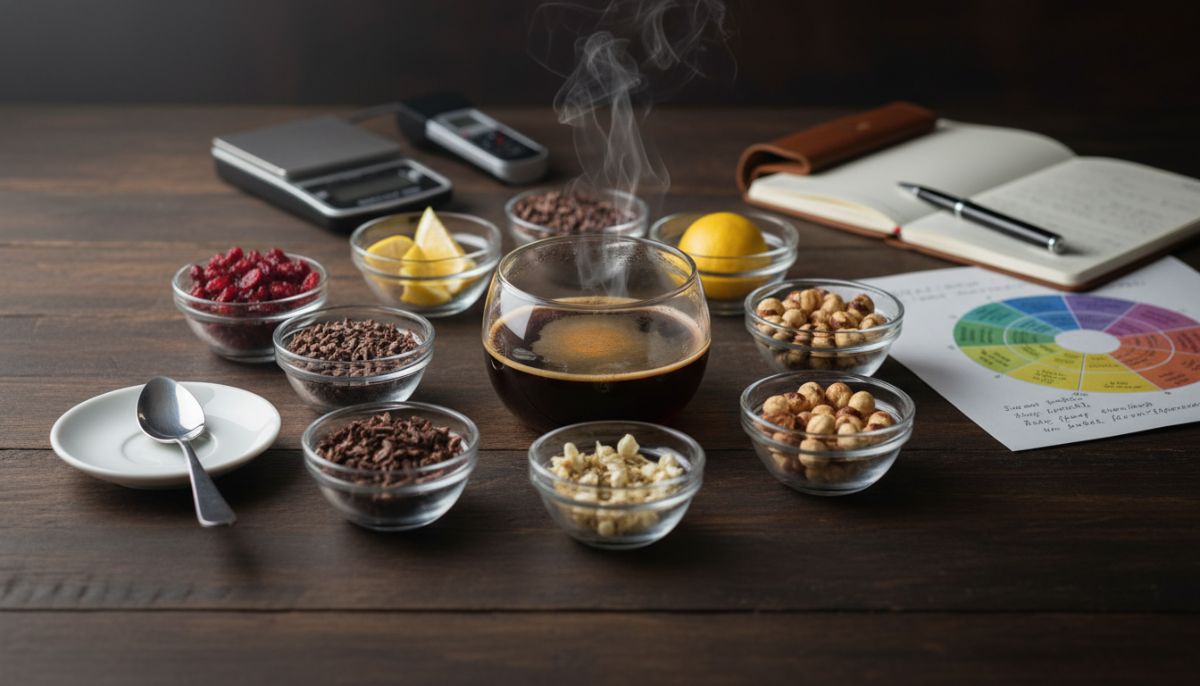
Master the art of sensory analysis with this comprehensive guide. Learn to identify coffee flavor notes, distinguish organic acids, and train your palate using Q-Grader techniques and home calibration exercises.
Key Takeaways
- Taste vs. Flavor: Taste happens on the tongue (sweet, sour, salt, bitter, umami), while specific flavor notes (blueberry, jasmine) are perceived through retronasal olfaction.
- Calibration is Critical: Use sugar solutions and diluted grocery acids to benchmark your sensory perception before tasting expensive beans.
- Temperature Matters: Coffee reveals different attributes as it cools; assess aroma while hot, acidity while warm, and body while cool.
- Comparative Tasting: Always taste two contrasting coffees side-by-side (triangulation) to highlight differences in terroir and processing.
Many enthusiasts drink coffee daily but struggle to identify the specific “notes of jasmine” or “hint of blueberry” printed on the bag. This gap between consumption and perception is not a biological failure; it is a lack of vocabulary and calibration. Professional Q-Graders—the sommeliers of the coffee world—are not born with golden tongues. They follow a rigorous, standardized training regimen to link sensory inputs with specific terminology.
Developing a sophisticated coffee palate moves you from binary judgments (good/bad) to analytical appreciation (structured/balanced/complex). This guide translates professional sensory science into actionable steps for the home enthusiast.
The Biology of Flavor: Aroma vs. Taste
To identify specific notes, you must understand the mechanism of flavor. The tongue is a blunt instrument, capable of detecting only five basic tastes: sweetness, acidity (sourness), bitterness, saltiness, and umami. If you hold your nose and drink coffee, you will likely perceive only bitterness and perhaps generic acidity.
The nuance—the lemon zest, dark chocolate, or stone fruit—comes from the olfactory bulb. This occurs via retronasal olfaction: when you swallow, volatile aromatic compounds travel from the back of the mouth up to the nose. This combination of gustatory (tongue) and olfactory (nose) input creates “flavor.”
Exercise: Retronasal Activation
- Take a sip of coffee.
- Pinch your nose shut immediately.
- Swallow the coffee.
- Release your nose and exhale sharply through it.
- The sudden rush of aroma you perceive is the flavor profile. Practice this to separate “mouth sensation” from “aromatic flavor.”
Building the Lexicon: Essential Technical Terms
Q-Graders use a specific lexicon to describe coffee. Mastering these three pillars is mandatory for accurate analysis.
1. Acidity
In coffee, acidity is not a negative sourness; it is the “brightness” or “sparkle” of the cup. It is prized in high-quality Arabica. You must distinguish between the organic acids found in coffee:
- Citric Acid: Sharp, intense, and citrus-like (Lemon, Lime, Grapefruit). Common in high-altitude washed coffees.
- Malic Acid: Round, crisp, and lingering (Green Apple, Pear, Stone Fruit).
- Phosphoric Acid: Sparkling and tingling (Cola, Tropical Fruit). Common in Kenyan coffees.
2. Body and Mouthfeel
Body refers to the physical weight and texture of the coffee on the tongue. It is distinct from flavor.
- Light Body: Tea-like, watery, delicate.
- Medium Body: Juice-like, silky.
- Heavy Body: Creamy, syrupy, coating.
For context on how equipment affects texture, specific grinders can highlight or diminish these traits. See how flat vs. conical burrs change your flavor profile.
3. Finish (Aftertaste)
The finish is the duration and quality of the flavor remaining after swallowing. A high-quality coffee has a long, pleasant finish. A short, drying, or astringent finish suggests defects or poor roasting.
Home Calibration: The 30-Day Training Curriculum
You cannot effectively use the SCA (Specialty Coffee Association) Flavor Wheel without calibration. Use this curriculum to standardize your sensory inputs.
Phase 1: The Acid Test (Days 1-7)
Train your tongue to isolate organic acids using grocery store references. Mix the following in 200ml of warm water:
- Citric Reference: 1 tsp Lemon Juice.
- Malic Reference: 1 tsp Apple Cider Vinegar (or dissolve a Granny Smith apple slice).
- Phosphoric Reference: Since pure phosphoric acid is hard to source, compare flat Cola (which contains phosphoric acid) against the other two solutions.
Taste them side-by-side. Memorize the sensation on the sides of your tongue versus the back.
Phase 2: Sweetness Calibration (Days 8-14)
Coffee sweetness is subtle. Calibrate your threshold using water-sugar ratios.
- Cup A (Control): Plain filtered water.
- Cup B (Low): 200ml water + 1g sugar (0.5% solution).
- Cup C (High): 200ml water + 4g sugar (2% solution).
This exercise helps you detect the natural sweetness in a well-extracted brew, which prevents the sourness associated with under-extraction. If your coffee lacks sweetness entirely, consult our guide on troubleshooting under-extraction.
Phase 3: The Shopping List Strategy (Days 15-30)
To identify notes, you need contrast. Do not buy one bag at a time. Buy two contrasting profiles to cup side-by-side.
| Objective | Coffee A | Coffee B |
|---|---|---|
| Acidity Type | Washed Ethiopian Yirgacheffe (Citric/Floral) | Washed Colombian or Kenyan (Malic/Phosphoric) |
| Processing | Washed Process (Clean, High Acidity) | Natural Process (Berry, Heavy Body) |
| Roast Impact | Light Roast (Enzymatic/Fruit) | Medium-Dark Roast (Sugar Browning/Caramel) |
Understanding the impact of processing is vital. Read more on how to adjust for these beans in our Washed vs. Natural Process guide.
The Mechanics of Cupping
Cupping is the industry-standard method for evaluating coffee. It removes brewing variables like channeling or technique. You need a cupping spoon (or a deep soup spoon) and two bowls of coffee.
The Slurp
The infamous “slurp” is functional, not performative. You must aspirate the coffee to spray it across the entire palate and force vapors up the retro-nasal passage simultaneously.
- Fill the spoon.
- Bring it to your lips.
- Inhale sharply and forcefully while taking the liquid in. It should make a loud noise.
Temperature Profiling (Cool-Down Analysis)
Q-Graders evaluate coffee at three distinct temperatures. Do not rush.
- Hot (70°C / 160°F): Assess Balance and Aroma. Acidity is often masked here.
- Warm (60°C / 140°F): The Sweet Spot. Acidity and Sweetness are most prominent.
- Cool (40°C / 100°F): Assessment of Body and Defects. As the cup cools, good coffee holds its structure; poor coffee becomes disjointed or muddy.
Using the SCA Flavor Wheel Correctly
Do not look at the wheel immediately. This creates bias (e.g., “It’s an Ethiopian, so I must taste blueberry”). Follow this order:
- Inner Circle (General): Is it Fruity? Floral? Nutty?
- Middle Circle (Specific): If Fruity, is it Berry, Citrus, or Dried Fruit?
- Outer Circle (Precise): If Citrus, is it Lemon, Lime, or Grapefruit?
If you get stuck at the “Fruity” stage, that is a success. Precision comes with time and utilizing sensory kits like Le Nez du Café.
Overcoming Palate Fatigue
Tasting multiple coffees saturates your sensors. Olfactory fatigue (nose blindness) sets in quickly. To reset:
- Smell your own skin: The scent of your own forearm neutralizes the olfactory bulb.
- Drink sparkling water: The carbonation cleanses the palate better than still water.
- Eat a plain cracker: Unsalted crackers absorb lingering coffee oils.
Additionally, water quality significantly impacts flavor perception. High mineral content can flatten acidity. Ensure your water chemistry is optimized by reviewing our guide on water chemistry and scale.
From Tasting to Brewing
Once you can identify that a coffee is “high citric acidity” or “heavy body,” you can manipulate your brewing to accentuate or mask these traits. For instance, if a bean is too acidic, you might increase the extraction yield. Ensure your beans are fresh to maximize these volatile compounds; check our guide on reading roast dates to ensure you aren’t tasting stale coffee.
Conclusion
Developing a coffee palate is a discipline of memory and vocabulary. It requires drinking with intention rather than passivity. By understanding the biological mechanics of taste, calibrating your tongue with reference standards, and utilizing comparative cupping, you will unlock a dimension of coffee previously reserved for professionals.
Frequently Asked Questions
You can use common grocery items to calibrate your palate. Mix sugar solutions of varying concentrations to learn sweetness levels, and use lemon juice (citric acid) and apple cider vinegar (malic acid) diluted in water to learn to distinguish acidity types.
Taste occurs on the tongue and identifies basic sensations like sweet, sour, bitter, salty, and umami. Aroma occurs in the nose. ‘Flavor’ is the combination of the two, perceived largely through retronasal olfaction when you swallow.
Temperature changes the solubility of compounds and the sensitivity of your taste buds. Hot coffee emphasizes aroma and balance, warm coffee highlights acidity and sweetness, and cool coffee reveals mouthfeel, body, and potential defects.
Start from the center and work your way out. First identify the broad category (e.g., Fruity), then move to the sub-category (e.g., Citrus), and finally narrow it down to the specific note (e.g., Grapefruit). Avoid looking at the wheel before tasting to prevent bias.
Citric acidity is sharp, quick, and intense, similar to a lemon. Malic acidity is rounder, lingers longer, and feels more like the crispness of a green apple or pear.