
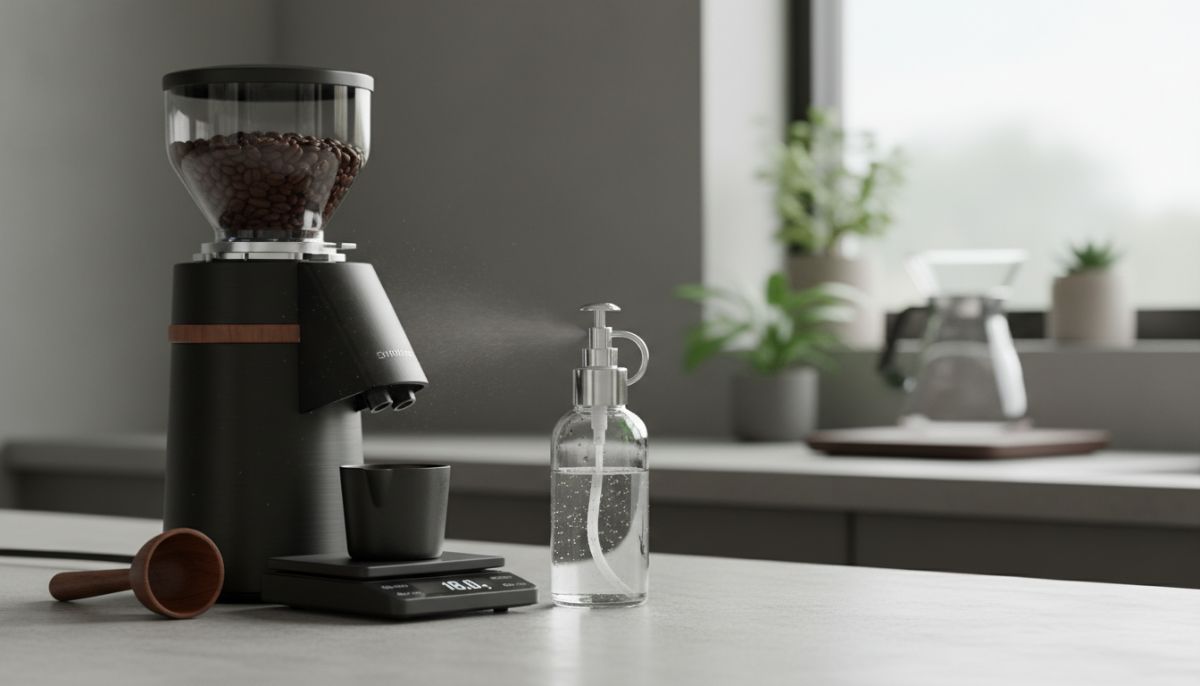
Discover the Ross Droplet Technique (RDT). Learn how a simple spray of water eliminates static, reduces retention, and improves dosing consistency without rusting your burrs.
Key Takeaways
- The Solution to Static: The Ross Droplet Technique (RDT) involves adding a minute amount of water to coffee beans before grinding to dissipate static electricity.
- Retention Killer: RDT significantly reduces coffee grounds retention, ensuring your output weight matches your input weight.
- Material Matters: While safe for most stainless steel burrs, caution is required with uncoated high-carbon steel to prevent oxidation.
- Workflow Specific: This technique is designed exclusively for single-dosing workflows, not for filling bean hoppers.
If you have ever ground fresh coffee beans only to find the chute clogged with clumps or your countertop covered in chaff, you have encountered the triboelectric effect. Friction generates static electricity, causing coffee particles to cling to grinder internals and repel each other. The solution to this mess is not a more expensive grinder, but a simple physics hack known as the Ross Droplet Technique (RDT).
What is the RDT Method?
The Ross Droplet Technique (RDT) is a coffee preparation method named after David Ross, a user on the Home-Barista.com forum who popularized the concept in 2005. The technique is deceptively simple: you apply a tiny amount of moisture—usually a single spray of water—to your coffee beans immediately before grinding.
This moisture acts as a conductor. Dry coffee beans are insulators; when they are crushed against burrs at high speeds, electrons are transferred, creating a static charge. By introducing a microscopic layer of water, you increase the electrical conductivity of the beans, allowing the charge to dissipate rather than build up. The result is a fluffy mound of grounds that falls vertically into your dosing cup or portafilter without sticking to the chute.
The Science: Why Grinders Create Static
To understand why RDT works, you must understand the environment inside your grinder. When beans pass through the burrs, the friction generates heat and static via the triboelectric effect. This is particularly aggressive in two scenarios:
- Low Humidity Environments: Dry air prevents charge dissipation.
- Darker Roasts: While lighter roasts are harder and denser, darker roasts are more brittle and often create more fines and chaff, which are highly susceptible to static cling.
Without RDT, this static charge causes “retention”—ground coffee that stays inside the grinder rather than ending up in your basket. This throws off your ratio. If you weigh 18 grams in but only get 17.5 grams out, your extraction formula is compromised. RDT bridges this gap, often achieving near-zero retention.
How to Perform RDT Correctly
Executing the RDT method requires precision. Using too much water can gum up your grinder; using too little will not solve the static issue.
The Spray Bottle Method (Preferred)
- Weigh Your Dose: Measure your single dose of beans into a small vessel.
- Spray Once: Use a small atomizer (spray bottle) filled with filtered water. Aim for a fine mist. Administer exactly one spray onto the beans.
- Shake: Cover the vessel with your hand and shake the beans to distribute the moisture evenly.
- Grind Immediately: Pour the beans into the grinder and grind.
The Wet Spoon Method (Alternative)
If you do not have an atomizer, you can run the handle of a teaspoon under a faucet, shake off the excess drops, and stir your weighed beans with the damp handle. This transfers just enough moisture to mitigate static without soaking the beans.
Safety Analysis: Will RDT Rust My Burrs?
The most common objection to RDT is the fear of rust. Coffee burrs are expensive, and deliberately introducing water seems counterintuitive. However, the risk depends entirely on the metallurgy of your burrs.
Stainless Steel Burrs
Most modern consumer and commercial grinders use stainless steel burrs. These are highly resistant to corrosion. The amount of water used in RDT (approximately 0.1g or less) is negligible and evaporates almost instantly due to the heat generated during grinding. For stainless steel, RDT is safe for daily use.
Carbon Steel Burrs
High-carbon steel burrs are favored for their sharpness and particle distribution profile, but they are more susceptible to oxidation. If you use uncoated carbon steel burrs, proceed with caution. While many users utilize RDT with carbon steel without issues, long-term exposure can lead to surface oxidation or rust if the grinder sits idle for long periods with moisture inside.
If you possess high-end carbon steel burrs (often found in premium hand grinders or specific flat burr sets), ensure you grind immediately after spraying and clean your burrs regularly. If you are unsure about your burr type, consult our guide on flat vs. conical burrs to identify your equipment.
Electronic Safety
Crucial Warning: Never spray water directly into the grinder chute or hopper. Always spray the beans in a separate container. Spraying into the grinder risks getting moisture into the motor housing or electronics, which can cause short circuits or permanent damage.
RDT vs. WDT: Clearing the Confusion
Novice home baristas often confuse RDT with WDT. They are distinct steps in the workflow:
- RDT (Ross Droplet Technique): Applied before grinding to reduce static and retention.
- WDT (Weiss Distribution Technique): Applied after grinding to de-clump the coffee bed and ensure even density.
RDT ensures you get all your coffee into the basket; WDT ensures that coffee is prepared for even extraction. For a deep dive on distribution tools, read about the science of puck prep.
Single Dosing vs. Full Hopper Workflows
RDT is strictly a technique for single dosing. You should never spray a full pound of beans and dump them into a hopper. The moisture will not evaporate quickly in a closed hopper environment, leading to mold growth and spoilage of your expensive beans. If you use a hopper-based grinder, you cannot effectively use RDT unless you switch to single-dosing loading.
Troubleshooting Common RDT Issues
The “Gunk” Buildup
If you notice a thick, mud-like paste building up in your grinder’s exit chute, you are using too much water. The goal is to dampen the surface humidity of the bean, not to wet it. Switch to a finer mist atomizer or use the spoon method.
Persistence of Static
If RDT is not working, your environment may be exceptionally dry, or your atomizer may not be dispensing enough moisture. Verify that the mist is actually coating the beans. Additionally, ensure your grinder’s grounds bin or catch cup is not made of plastic that generates its own static charge; metal or glass catch cups are superior.
Conclusion
The RDT method is a rare example of a “zero-cost” upgrade that tangibly improves your coffee workflow. By neutralizing static electricity, it keeps your counter clean and ensures that the dose you weigh is the dose you brew. While it requires a change in workflow to single-dosing, the benefits in consistency and cleanliness make a small spray bottle an essential tool for any serious home barista.
Frequently Asked Questions
RDT stands for Ross Droplet Technique. It is a method of adding a tiny amount of water to coffee beans before grinding to reduce static electricity and retention.
For stainless steel burrs, the risk is negligible as the small amount of water evaporates quickly. However, uncoated high-carbon steel burrs are more prone to rust and require caution.
You only need a single spray from a fine-mist atomizer or a drop of water stirred in with a spoon. The beans should look slightly damp, not wet.
No. RDT is only for single dosing. Adding moisture to a large volume of beans sitting in a hopper can lead to mold growth and bean spoilage.
RDT itself does not alter the flavor of the coffee. However, by improving dose consistency and reducing retention (old stale grounds mixing with fresh ones), it leads to better tasting, more consistent extractions.