
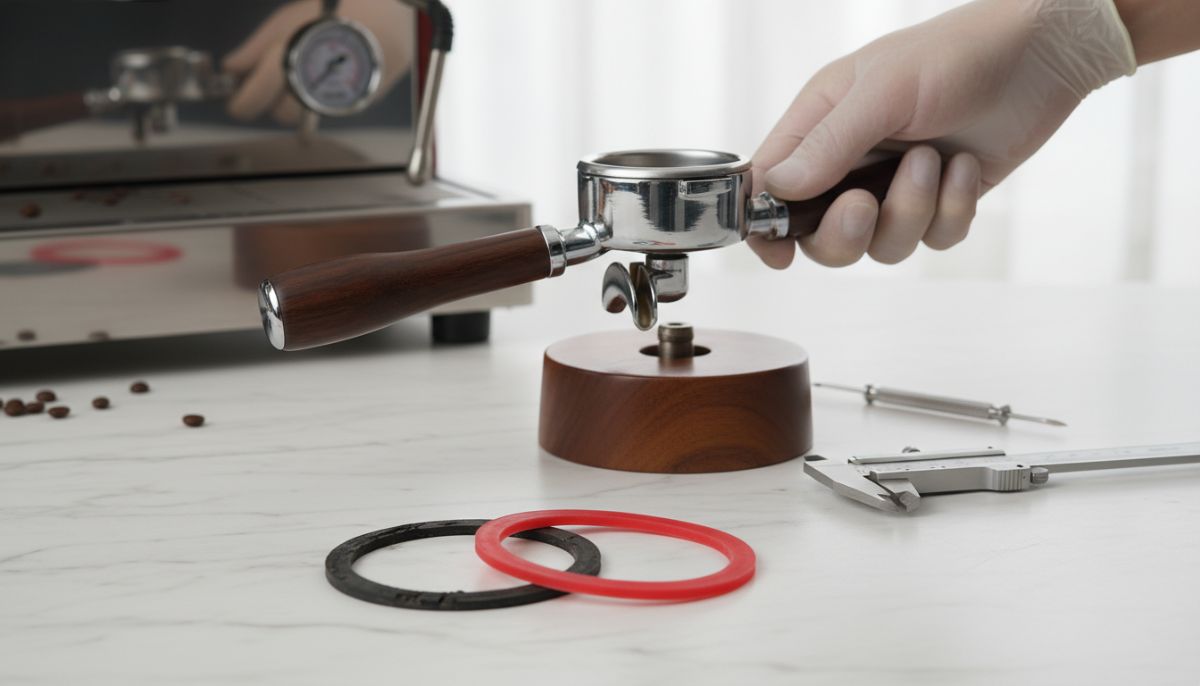
Is your portafilter leaking or locking too far? Discover why upgrading from stock rubber to a silicone group gasket is the best low-cost maintenance hack for your espresso machine. We cover sizing (8mm vs 8.5mm), durability, and installation.
Key Takeaways
- Durability: Silicone gaskets last significantly longer than rubber (EPDM) and do not bake onto the group head.
- Sizing Matters: Choose 8mm for standard E61 setups; upgrade to 8.5mm if your portafilter locks past the 6 o’clock position.
- Tactile Feel: Silicone offers a softer, smoother lock-in due to a lower Shore hardness rating.
- Taste Neutrality: Unlike degrading rubber, food-grade silicone releases no odor or taste into your shot.
Introduction
The humblest part of your espresso machine is arguably the most critical for safety and consistency: the group gasket. This simple ring seals the high-pressure environment required to brew espresso. Yet, most stock machines from manufacturers like Rocket, Rancilio, and Gaggia ship with hard, black rubber gaskets (EPDM).
Over time, these rubber seals fail. They leak, smell, and eventually fuse to the metal of the group head. The modern solution is a simple, low-cost upgrade: the silicone gasket. This guide analyzes the technical differences between silicone and rubber, helps you determine the correct thickness (8mm vs. 8.5mm), and explains how this small change improves your daily workflow.
The Problem with Stock Rubber (EPDM)
Standard gaskets are made from Ethylene Propylene Diene Monomer (EPDM) rubber. While cheap to manufacture, EPDM has poor thermal stability over long periods. In an espresso machine, the group head is constantly heating and cooling.
This thermal cycling causes the rubber to vulcanize further, turning it from a flexible seal into a brittle, hard plastic. The consequences are clear:
- Leaks: Water escapes around the portafilter ears during extraction, messing up your dose and yield accuracy.
- Degradation: The rubber cracks and crumbles. Old gaskets often require chiseling out in pieces.
- Odor: As rubber degrades under heat, it can impart a faint "burnt tire" smell/taste to the water passing through the shower screen.
Why Silicone? The Material Science
Food-grade silicone does not cure or harden at the temperatures generated by an espresso machine. It remains elastic indefinitely. This elasticity is measured by Shore Hardness (or Durometer).
- Stock Rubber: Often starts at a Shore A hardness of 70-80 and hardens to 90+ (like a shopping cart wheel) over months.
- Silicone: Typically maintains a Shore A hardness of 60-70 (like a car tire tread).
This softer rating provides a distinct tactile advantage. When you lock in the portafilter, the engagement is smooth and cushioned. It requires less torque to achieve a watertight seal, reducing wear on your wrist and the machine’s brass components.
Sizing Guide: 8mm vs. 8.5mm
One of the most confusing aspects of buying a silicone gasket, particularly for E61 groupheads, is selecting the correct thickness. The two standard sizes are 8mm and 8.5mm.
The 6 O’clock Rule
Your portafilter handle should ideally lock in directly perpendicular to the machine (the 6 o’clock position). This isn’t just aesthetic; it ensures the ears are fully engaged without over-tightening.
- Choose 8mm (Standard): If your machine is new (under 2 years old) or your portafilter ears show minimal wear. This is the factory standard for brands like Rocket, ECM, and Profitec.
- Choose 8.5mm (Compensatory): If your machine is older, or if your portafilter handle currently locks way past 6 o’clock (towards 5 or 4 o’clock). As the brass cam inside the group head wears down, a thicker gasket compensates for that metal loss, returning your handle to the correct alignment.
Note: If you use precision baskets like VST or IMS, the rim thickness is often slightly different than stock baskets. An 8.5mm gasket can sometimes make locking in a VST basket difficult on a brand new machine. Stick to 8mm in that case.
Decoding Colors: Cafelat and Others
Brands like Cafelat have popularized color-coded silicone gaskets. While colors help with branding, they often denote thickness or compatibility.
- Red (E61): Typically 8mm. The standard replacement.
- Blue (E61): Typically 8.5mm. For older E61 groups.
- Green (Gaggia): Specifically designed for the Gaggia Classic ecosystem.
- Yellow (E61): Often 8mm but softer (lower shore rating).
Always verify the thickness in millimeters rather than relying solely on color, as generic manufacturers may use different codes.
Installation: Removing a "Baked" Rubber Gasket
If you have neglected your cleaning and maintenance routine, your old rubber gasket is likely fused to the group head. Removing it requires care to avoid scratching the brass surface.
- Cool Down: Ensure the machine is fully cold.
- Remove the Screen: Unscrew the shower screen. If the gasket is stuck, the screen might not drop even after the screw is removed.
- The Screw Method: If the gasket is rock hard, carefully drive a small wood screw halfway into the rubber. Use pliers to pull the screw (and the gasket) downward.
- Clean the Channel: Once removed, use a plastic brush or a chopstick with a microfiber cloth to clean the groove. Any old rubber debris will prevent the new silicone gasket from sealing.
- Install Silicone: Push the new gasket (flat side up, usually) and shower screen back in. Use the portafilter (minus the basket) to gently push it into place evenly.
Thermal Properties and Taste
A common myth is that silicone acts as an insulator, preventing the group head from heating the portafilter. While silicone has lower thermal conductivity than compressed rubber, the difference is negligible in practice. The thermal mass of the group head dominates the temperature stability equation.
Regarding taste, silicone is chemically inert. Unlike EPDM, which breaks down and off-gasses, silicone ensures that the water profile hitting your coffee remains pure. This is essential when dialing in delicate roasts where you want to taste the bean notes, not your machine parts.
Conclusion
Upgrading to a silicone gasket is the highest ROI maintenance task you can perform. For roughly $8-$15, you eliminate leaks, improve the tactile feel of your workflow, and prevent the headache of chiseling out baked rubber in the future. Whether you are running a high-end dual boiler or a trusted Gaggia Classic, this swap is mandatory for the serious home barista.
Frequently Asked Questions
Unlike rubber gaskets which should be replaced every 6-12 months, high-quality silicone gaskets can last 2-3 years or more depending on daily usage. They generally do not harden, but eventually, the constant compression may reduce their thickness.
Yes, for the better. Silicone is food-grade, odorless, and tasteless. Old rubber gaskets degrade and can impart a burnt rubber smell or taste to the brew water. Silicone remains neutral.
If your machine is new or the portafilter locks in at the 6 o’clock position (perpendicular to the machine), use 8mm. If your machine is older or the handle locks too far to the right (5 or 4 o’clock), use an 8.5mm gasket to correct the angle.
It can be very difficult if the rubber has baked onto the metal. It turns into hard plastic and often shatters. You may need an awl or a screw to carefully pry it out without scratching the soft brass of the group head.
No. While E61 gaskets fit many machines (Rocket, ECM, Profitec, Lelit), brands like Breville, Rancilio, and La Marzocco have proprietary sizes. Always buy a gasket specifically listed for your machine model.