
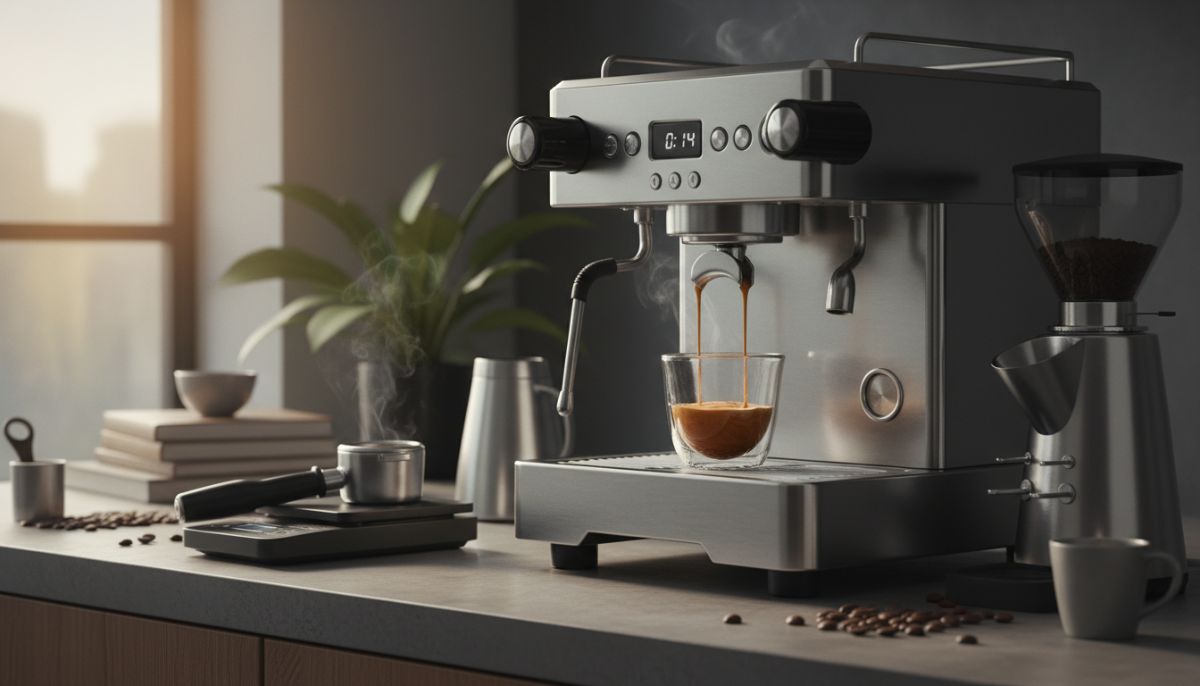
Discover the science behind the Turbo Shot—a 15-second espresso technique that defies tradition to deliver higher extraction yields and sweeter coffee. Learn the recipe, required gear, and how to dial it in.
Key Takeaways
- Speed & Grind: A Turbo Shot uses a coarser grind and finishes in just 15 seconds, challenging the traditional 30-second rule.
- The Science: Coarser grinds reduce flow resistance and channeling, allowing water to contact all coffee particles evenly, resulting in higher Extraction Yield (EY).
- Pressure Profile: Lower pressures (6 bar) are preferred to prevent puck compression, but standard machines can adapt this technique.
- Flavor Profile: Expect high clarity, intense sweetness, and reduced bitterness, with a lighter body (lower TDS) compared to traditional shots.
For decades, the "God Shot" of espresso was defined by rigid parameters: 9 bars of pressure, fine grounds, and a 25–30 second extraction time. In recent years, data-driven coffee science has dismantled this dogma. Enter the Turbo Shot: a method popularized by researchers Christopher Hendon and Michael Cameron, and widely adopted by the Decent Espresso community.
The Turbo Shot flips the script. By grinding coarser, lowering pressure, and aiming for a lightning-fast 15-second extraction, baristas can achieve higher Extraction Yields (EY) and consistently tastier coffee. This guide explains the physics behind the phenomenon and provides a practical recipe to execute it in your kitchen.
The Science: Why Faster Can Mean Better
Traditional espresso wisdom dictates that to extract more flavor, you must grind finer to increase surface area. While theoretically true, there is a point of diminishing returns. As you grind finer, the bed of coffee becomes dense and resistant to water pressure. This resistance often leads to channeling—where water finds the path of least resistance, bypassing clumps of coffee entirely while over-extracting others.
Research published by Cameron and Hendon revealed that traditional espresso shots often sacrifice evenness for texture. By grinding coarser, you significantly reduce the hydraulic resistance of the puck. This allows water to flow uniformly through the entire bed of coffee. While the individual particles have less surface area, the uniformity of the flow means that nearly 100% of the coffee is participating in the extraction. The result is a shot that is more consistent and has a higher total Extraction Yield, often pushing past 24% EY without the astringency usually associated with over-extraction.
To fully grasp how uneven water flow destroys flavor, you must focus on mitigating channeling. The Turbo Shot is essentially a systemic solution to this problem.
The Turbo Shot Flavor Profile
Before you dial in, you must understand the sensory goal. A Turbo Shot is distinct from a traditional heavy, syrupy ristretto.
- Clarity & Sweetness: High EY translates to a very sweet, ripe fruit profile. The reduction in localized over-extraction means less dry bitterness.
- Acidity: The fast flow preserves sparkling acidity, making this method exceptional for light roasts.
- Mouthfeel (Texture): This is the trade-off. Turbo shots have lower Total Dissolved Solids (TDS), meaning the body is thinner, similar to a very strong filter coffee or an immense Americano.
If you are struggling with harsh flavors in your current routine, this method can help you banish the bitterness effectively.
The Recipe: Parameters for Success
Executing a Turbo Shot requires discarding your muscle memory for 30-second extractions. Here are the baseline parameters.
1. The Ratio: 1:3
Turbo shots utilize a longer ratio to wash out the soluble compounds quickly. You need enough water solvent to compensate for the reduced contact time.
Target: 15g Dose → 40g–45g Yield.
For a deeper dive into these variables, read our guide on mastering the espresso ratio.
2. The Grind: Coarse
Set your grinder significantly coarser than your standard espresso setting. It should feel closer to fine drip or Aeropress saltiness than powdered sugar. If you use a grinder with flat burrs tailored for unimodal distribution, you will see the best results, as fewer fines lead to cleaner flow.
3. The Time: 12–19 Seconds
Ignore the timer anxiety. A shot finishing in 14 seconds is not a mistake; it is the goal. If it runs longer than 20 seconds, your grind is too fine.
4. The Pressure: 6 Bar (Ideal)
Lower pressure is crucial for the "textbook" Turbo Shot. At 9 bars, high-velocity water can compress a coarse puck, causing it to seal shut or channel violently. At 6 bars, the water flows gently through the coarse matrix.
Equipment: Do You Need a $4,000 Machine?
While the Turbo Shot was pioneered on the Decent DE1 (a tablet-controlled machine capable of precise pressure profiling), you do not need one to experiment.
- Machines with Flow Control: If you own an E61 machine, you can manually restrict flow to simulate lower pressure. Learn more about how to utilize this in our flow control guide.
- Modding Stock Machines: Owners of Gaggia Classics or similar units can often adjust their OPV (Over-Pressure Valve) spring to 6 bars.
- Standard 9-Bar Machines: You can pull a Turbo Shot at 9 bars. It requires slightly more care in puck prep. You may need to updose slightly to increase resistance naturally or accept a slightly more turbulent flow. The flavor improvement is often still noticeable.
- Baskets: Basket geometry matters. Fast-flow baskets like the VST allow the necessary flow rate without clogging. We recommend reading about stock vs. precision baskets to choose the right filter.
Step-by-Step Execution
- Prep: Clean your basket. Dose 15g of light roast coffee.
- Grind: Adjust your grinder 2–3 macro steps coarser than usual.
- Distribute: Use WDT (Weiss Distribution Technique) vigorously. With coarse grounds, air pockets are a risk.
- Tamp: Apply standard pressure.
- Brew: Engage the pump. Watch the flow. It will start fast and look like a heavy rain shower, not a mouse tail.
- Stop: Cut the shot at 40g–45g output. Check the timer. If it hit 15s, taste it.
Troubleshooting: Turbo vs. Gusher
A common fear is that a fast shot is just a "gusher" (a failed shot due to channeling). Here is how to distinguish them:
- The Gusher: Uneven flow. One side of the basket is blonding instantly, while the other is dark. Taste is sour, grassy, and astringent.
- The Turbo: Fast but even flow across the entire basket bottom. The cone forms quickly and stays uniform. Taste is sweet, tea-like, and vibrant.
If the shot tastes hollow or watery, you may have gone too coarse or the roast is too light for such a short contact time. Try increasing the temperature or the yield (go to 1:3.5).
Conclusion
The Turbo Shot is not just a trend; it is a scientific correction to espresso brewing. By prioritizing flow uniformity over pressure resistance, it unlocks extraction ceilings that traditional brewing cannot reach. While it sacrifices body, the gain in sweetness and clarity makes it an essential technique for any home barista obsessed with light roasts and flavor optimization.
Frequently Asked Questions
A Turbo Shot is significantly sweeter and has higher flavor clarity with less bitterness. However, it has a thinner body and less texture than a traditional 9-bar espresso due to lower Total Dissolved Solids (TDS).
Yes. While 6-bar pressure is ideal, you can simulate a Turbo Shot on standard machines by dosing lower (15g), grinding coarser, and aiming for a 1:3 ratio in 15-20 seconds. Modifying the OPV spring on a Gaggia to 6 bars yields even better results.
No. A bad fast shot (‘gusher’) channels unevenly and tastes sour or astringent. A Turbo Shot uses a coarse grind to ensure even water flow across the whole puck, resulting in high extraction and a sweet taste despite the speed.
The standard Turbo Shot recipe calls for a 1:3 ratio. For example, a 15g dose of coffee should yield approximately 40g to 45g of liquid espresso.
A coarser grind reduces the hydraulic resistance of the puck, allowing water to flow through evenly without finding ‘channels’. This uniformity is what allows for high extraction yields in such a short time.