
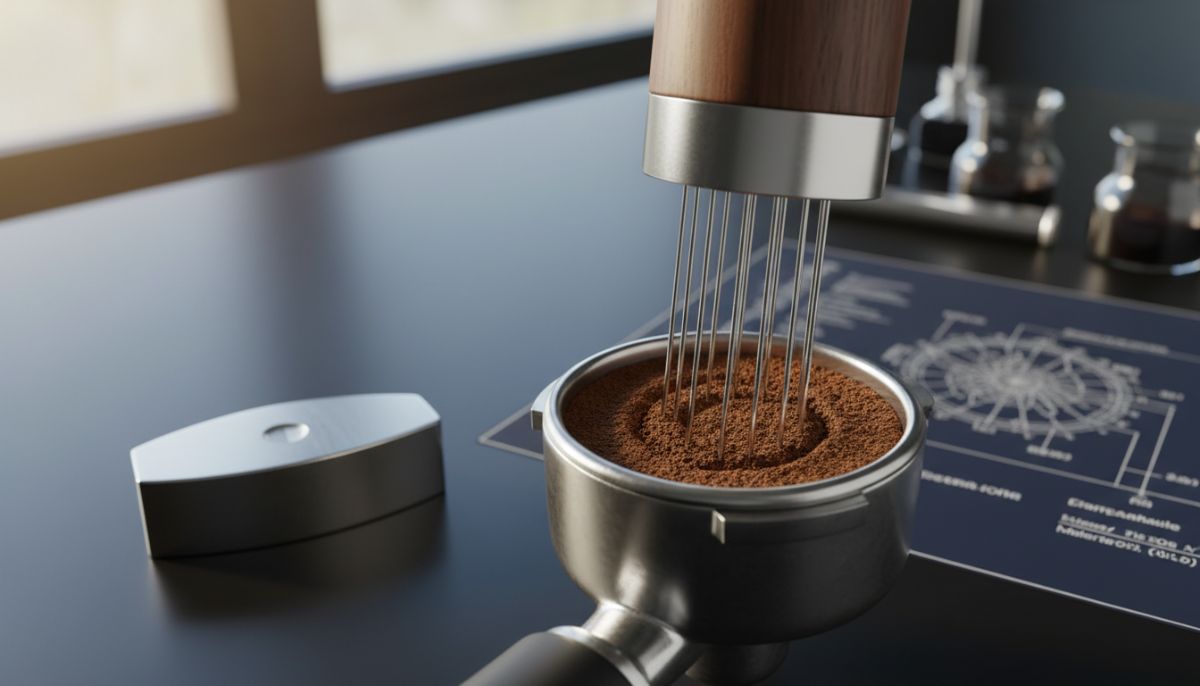
Discover why the Weiss Distribution Technique (WDT) is replacing wedge distributors. We analyze the physics of localized compression, optimal needle gauges, and how to achieve higher extraction yields.
Key Takeaways
- Homogeneity vs. Polish: Spinning levelers create a visually flat surface but often cause uneven density deep within the puck (localized compression), leading to channeling.
- The WDT Advantage: Needle distribution breaks up clumps and homogenizes the entire coffee bed, enabling higher extraction yields and consistent flow rates.
- Needle Precision: The optimal needle thickness is between 0.30mm and 0.40mm. Anything thicker (like paperclips) acts as a plow, creating furrows rather than fixing density.
- Deep vs. Surface: Effective WDT requires reaching the bottom of the basket (Deep WDT), not just raking the top layer.
For years, the gold standard of espresso puck preparation was the “spinning leveler” or wedge distributor. These heavy, machined tools promised a perfectly flat coffee bed with zero skill required. However, the rise of data-driven coffee science has revealed a hard truth: what looks perfect on the surface often hides a disaster underneath.
The Weiss Distribution Technique (WDT)—using fine acupuncture needles to rake the coffee grounds—has transitioned from a niche hobbyist hack to an essential step in modern espresso workflow. This shift is not a trend; it is a correction based on the physics of extraction and fluid dynamics.
The Physics of Failure: Why Spinning Levelers Don’t Work
To understand why spinning levelers often degrade shot quality, we must look at the concept of localized compression. A wedge distributor works by pushing coffee grounds sideways to fill gaps and create a level surface. However, it does not redistribute the mass of the coffee evenly throughout the basket.
If your grinder outputs a mound of coffee in the center of the basket (a common distribution pattern), the spinning leveler compresses that center mound down before it pushes grounds to the edges. This results in a puck that is perfectly flat on top but has significantly higher density in the center and lower density at the perimeter.
When water hits this puck under 9 bars of pressure, it seeks the path of least resistance. It flows rapidly through the low-density edges (channeling) and struggles to penetrate the high-density center. This phenomenon is frequently misdiagnosed. Baristas often debate levelers vs. tampers, but the science shows that while a leveler creates a flat surface, it fails to create a uniform density.
Visualizing the Internal Structure
Macro-photography and puck dissection reveal that spinning levelers often leave “air pockets” or low-density zones beneath the polished surface. In contrast, a puck prepared with proper WDT shows a uniform aggregate structure from top to bottom. This structural integrity is critical for avoiding the “sprinting” shots where flow accelerates uncontrollably halfway through the extraction.
The WDT Solution: Homogenization Over Aesthetics
The Weiss Distribution Technique, named after John Weiss, solves the root cause of uneven extraction: clumping and uneven density. By using fine needles to rake through the coffee bed, you break up agglomerates (clumps) caused by static electricity and grinder retention. More importantly, you mechanically redistribute the grounds to ensure that every cubic millimeter of the basket contains the same mass of coffee.
This process is distinct from superficial raking. To be effective, the technique must be Deep WDT. This involves inserting the needles all the way to the bottom of the filter basket and moving them in overlapping circles while slowly drawing them up. This re-homogenizes the entire bed, erasing the density errors created by the grinder’s chute.
For those questioning if this extra step is measurable, the data is clear. The science of puck prep indicates that WDT consistently produces higher Total Dissolved Solids (TDS) and Extraction Yields compared to tapping or spinning alone. A higher yield generally correlates with a sweeter, more complex cup and less sourness.
Needle Anatomy: Why Thickness Matters
One of the most common user pain points is attempting WDT with the wrong tools. Early advice suggested toothpicks or paperclips. This is detrimental to the shot. A standard paperclip is approximately 1.0mm thick. In the context of espresso fines (which measure in microns), a 1.0mm object acts as a plow. It pushes coffee aside, leaving deep furrows that actually induce channeling.
For optimal results, you must use acupuncture needles or stainless steel printer cleaning needles within a specific gauge range:
- 0.25mm – 0.30mm: The gold standard for precision. These slide through the coffee with zero resistance, breaking clumps without moving the mass too aggressively. They are fragile and require care.
- 0.35mm – 0.40mm: The most durable and practical balance. Excellent for “Deep WDT” as they have enough rigidity to move grounds near the bottom of the basket without bending.
- Above 0.50mm: Too thick. These begin to act like the paperclip, creating voids rather than fixing them.
Workflow Integration and Equipment
Integrating WDT does not have to destroy your workflow speed. With a proper setup, it adds less than 10 seconds to the routine. Here is the optimal sequence for a high-consistency shot:
- Grind and Dosing: Grind into a dosing cup or directly into the portafilter using a dosing funnel. A funnel is mandatory for WDT to prevent grounds from spilling over the edge during aggressive stirring.
- RDT (Optional but Recommended): If your grinder produces high static, the Ross Droplet Technique (a spray of water on beans) is essential before grinding to prevent stubborn clumps.
- Deep WDT: Insert the tool to the bottom. Stir in small circles, working around the perimeter and then the center.
- Surface Rake: Slowly lift the tool to the surface and rake gently to level the top layer.
- Tap: A single vertical tap on the counter collapses any air voids left by the needles.
- Tamp: Apply vertical pressure. Because the bed is now homogenous, the tamp will compress the puck evenly.
This workflow is particularly crucial when using naked portafilters, as they provide immediate visual feedback on your distribution quality. If you see tiger striping and a single stream forming quickly, your WDT was successful. If you see sprays or multiple streams, you likely have density issues.
Grinder Quality and Roast Levels
The necessity of WDT scales with your equipment and bean choice. High-end large flat burr grinders (e.g., 98mm) produce very fluffy grounds that require minimal intervention. However, many entry-level conical burr grinders produce dense, clumpy grounds due to retention and static. In these scenarios, WDT is the great equalizer, allowing cheaper grinders to punch above their weight class.
Furthermore, flat vs. conical burrs act differently regarding fines production. Conical burrs often produce a bimodal distribution that packs tightly. WDT helps ensure those fines don’t migrate to one spot and clog the flow. Regarding roast levels, light roasts are denser and harder to extract. They require finer grinding, which increases the risk of clumping. Therefore, WDT is arguably mandatory for modern light roast espresso to achieve high extraction yields without channeling.
Conclusion
The shift from wedge distributors to WDT is a victory for function over form. While spinning levelers look impressive on a countertop, they physically cannot achieve the uniform density throughout the puck that a simple needle tool can. By understanding the mechanics of localized compression and utilizing the correct needle gauge (0.3mm-0.4mm), you can eliminate channeling, increase extraction yield, and unlock the true flavor potential of your coffee beans.
Frequently Asked Questions
No. While spinning levelers create a flat surface, they often cause localized compression, leading to uneven density and channeling. WDT homogenizes the entire coffee bed for superior extraction.
The optimal thickness is between 0.30mm and 0.40mm. Needles thicker than 0.5mm act as plows and create furrows, while needles thinner than 0.25mm can be too flexible for deep distribution.
No. Paperclips and toothpicks are generally 1.0mm or thicker. They are too wide for espresso grounds and will push coffee aside, creating channels rather than eliminating them.
Yes. By eliminating channeling and ensuring even water flow, WDT allows for higher extraction yields. This typically results in higher sweetness, reduced sourness, and a more balanced flavor profile.
Deep WDT involves stirring the grounds all the way at the bottom of the basket to break up clumps and fix density issues. Surface WDT only rakes the top layer for aesthetics and does not solve flow issues deep in the puck.