
Ready to move past the basic heart? Master the mechanics of the tulip push and the rosetta wiggle with our intermediate latte art guide. Troubleshoot texture, flow, and symmetry.
The Plateau Beyond the Heart
You have poured a thousand hearts. Some were lopsided, some looked like onions, but eventually, you nailed it. The symmetry is there. The contrast is sharp. Now, you stare at the milk pitcher and wonder: what comes next? This is the moment where the hobby barista transforms into an artist. Moving from the static pour of a heart to the dynamic movements of tulips and rosettas is not just about practice. It is about physics. It requires understanding fluid dynamics, wrist mechanics, and the subtle difference between a "wiggle" and a "push."
Many give up here. They get stuck creating undefined blobs because they treat every design like a heart. This guide strips away the mystery. We are breaking down the specific motions required to stack layers for a tulip and create the mesmerizing leaves of a rosetta.
Key Takeaways
- Texture is King: detailed art requires "wet paint" microfoam, slightly thinner than what you use for cappuccinos.
- The Motion Gap: Rosettas rely on a pendulum wrist motion (oscillation), while tulips rely on a stop-and-go arm motion (stacking).
- Flow Rate Control: High flow sinks the milk; low flow lays the design on top.
- The Cut-Through: The final stroke determines the symmetry and shape of your leaves or stacks.
The Prerequisites: Texture and Crema
Before you attempt a three-tiered tulip, look at your canvas. If your espresso has no crema, the milk will simply mix in, turning the drink beige. A solid extraction is vital for contrast. You need a thick, syrupy base to support the milk. To ensure your espresso base is solid, you need to understand how to dial in your espresso ratios effectively.
Then, there is the milk. Thick, pillowy foam is great for a dry cappuccino, but it is the enemy of detailed latte art. You need microfoam that resembles glossy wet paint. If the milk is too stiff, it will plop into the cup and refuse to flow. If it is too thin, it will wash out the design. Understanding the difference between wet vs. dry microfoam is the single most important step before attempting complex pours.
The Rosetta: Mastering the Pendulum
The rosetta is the classic fern-like design. It looks intimidating, but it is mechanically simple. It relies on a consistent side-to-side oscillation of the wrist.
The Setup
Tilt your cup at a 45-degree angle. This creates a deeper pool of espresso, allowing you to bring the pitcher spout closer to the surface without spilling. Start your pour high (about 2-3 inches) into the center of the dark crema. This is the "incorporation" phase. You want the milk to dive underneath the espresso, not sit on top.
The Wiggle
Once the cup is about half full, lower the pitcher. Get the spout as close to the surface as possible without touching it. This proximity is crucial. Now, begin the pour. Do not move your whole arm. Use your wrist to rock the pitcher side-to-side like a pendulum. The milk should start flowing in snake-like ripples away from the spout.
The Draw Back and Cut
As the ripples form, slowly pull the pitcher backward toward the rim of the cup while maintaining that side-to-side wiggle. This creates the stem and leaves. When you reach the edge, stop wiggling. Lift the pitcher up (to stop the paint) and slice a thin stream of milk right through the center of your design. This is the "cut-through," and it pulls the leaves into that iconic fern shape.
Did You Know?
The "Monk’s Head" is the foundational pattern for both hearts and rosettas. It creates the white canvas that you manipulate. If you cannot pour a solid white circle, you cannot pour a rosetta.
The Tulip: The Art of Stacking
While the rosetta is about continuous flow and wiggling, the tulip is about patience and interruption. It is a "stop-and-go" design.
The Mechanics of the Push
Start with your incorporation phase, just like the rosetta. Lower the pitcher to the surface. Pour a small blob of milk into the center. Here is the trick: stop pouring. Tilt the pitcher back. You now have a white circle (a Monk’s Head) in the cup.
Move the pitcher spout slightly back, behind the circle you just poured. Pour again. As the new milk flows, "push" it gently into the first circle. The force of the new milk wraps the first circle around it, creating a crescent shape. Stop pouring again.
Stacking Layers
Repeat this process. Pour, push, stop. Pour, push, stop. Each time you push, you are creating a new layer. A basic tulip has three stacks, but pros can fit ten or more. Finish the design with a final cut-through, just like the rosetta, to pull the stacks into a floral shape. If you are struggling with the basic shape, you might need to revisit the mechanics of going from a blob to a heart.
Comparing the Mechanics
Understanding the physical differences between these two pours helps you switch gears mentally before you steam your milk.
| Feature | Rosetta | Tulip |
|---|---|---|
| Primary Motion | Continuous wrist oscillation (Wiggle) | Interrupted arm movement (Push & Stop) |
| Flow Rate | Consistent, medium flow | Variable (fast push, full stop) |
| Pitcher Spout | Round spouts favor thick lines | Sharp spouts offer better layer definition |
| Difficulty | Harder to control symmetry | Harder to control cup placement |
Equipment Matters: Spout Selection
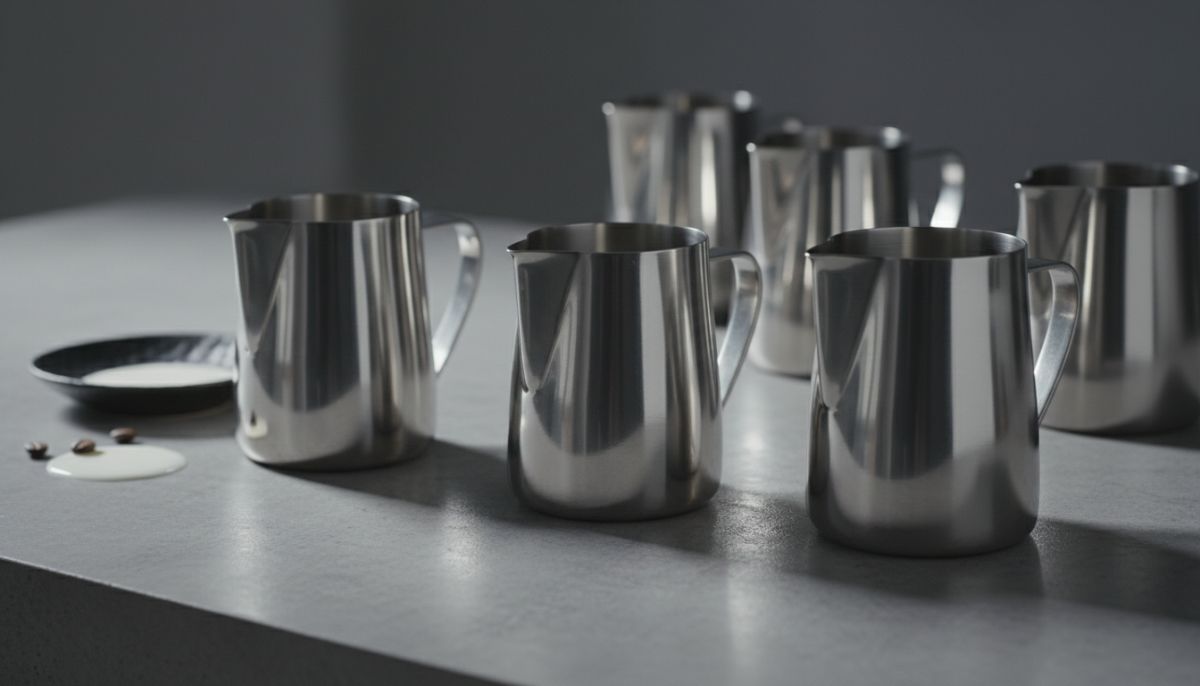
Can you pour a rosetta with any pitcher? Technically, yes. But your equipment dictates your learning curve. Pitchers generally come with either round or sharp spouts. A round spout encourages a wider, flowier stream of milk, which is forgiving for hearts and thick rosettas. A sharp spout produces a narrower stream, allowing for high-definition lines in intricate tulips.
If you are serious about complex designs, you might want to investigate how different milk pitcher shapes influence fluid dynamics. Using a sharp spout for a rosetta requires a much faster wiggle to avoid looking messy, while a round spout makes stacking a tight tulip difficult.
Pros and Cons of Sharp Spouts
- Pros: Incredible detail, allows for fine lines in rosettas, easier to cut through cleanly.
- Cons: Unforgiving of shaky hands, requires faster flow control, harder to get thick, marshmallow-y hearts.
Troubleshooting Common Pain Points
Even with the right motion, things go wrong. Here is why your art might look like a nebulous blob.
The "Wash Out"
If your design looks cloudy or lacks sharp contrast against the brown crema, you likely poured from too high up during the drawing phase. Height equals penetration. To lay milk on top of the crema, you must be dangerously close to the surface. It often feels like the spout is going to dip into the coffee.
The Crooked Pour
Symmetry issues usually stem from your body position, not your hands. If you are standing at an angle to the counter, your "straight" pour is actually diagonal relative to the cup handle. Square your shoulders to the counter. Hold the cup by the handle (or bottom) directly in front of your sternum. This alignment fixes 90% of crooked stems.
Oat and Almond Challenges
Trying to pour detailed art with alternative milk is playing the game on hard mode. The protein structures in plant milks are weaker, meaning the microfoam degrades faster. To succeed here, you need to steam the milk to a slightly lower temperature (around 130°F-140°F) to prevent the proteins from curdling. For specific tips on non-dairy pouring, check out our guide on mastering plant-based milks.
Practice Without Waste
The biggest barrier to learning is the cost of milk. Gallons of milk down the drain add up fast. Professionals use the "Soap Drop" method. Put a single drop of dish soap into a pitcher of cold water. Steam it exactly like milk. The soap creates a foam structure almost identical to microfoam. You can practice your rolling technique and texture identification without wasting dairy. While you cannot drink it, you can pour it into a cup with soy sauce and water (to mimic espresso) to practice your wiggles and stacks.
Conclusion
Pouring a perfect rosetta or a stacked tulip is not magic. It is a series of mechanical steps performed with confidence. The transition from intermediate to expert is built on muscle memory. Your first fifty tulips will look like onions. Your first rosettas will look like ferns that survived a hurricane. That is part of the process. Keep your texture wet, your spout low, and your movements deliberate.
Frequently Asked Questions
Sinking usually happens because you are pouring from too high up. Gravity accelerates the milk, causing it to punch through the crema rather than floating on top. Lower your pitcher spout until it is almost touching the surface of the coffee when you start your design.
While you can use any pitcher, a round spout is often easier for beginners learning rosettas. It creates a wider stream that forms thick, curvy leaves naturally. Sharp spouts require a faster wiggle rate to avoid looking messy.
If you notice your design drifting off-center, adjust the angle of the cup, not the pitcher. It is much easier to slightly rotate the hand holding the cup to realign with the stream than to awkwardly twist your pouring wrist.
Yes, but oat milk generally requires less air during the steaming process than dairy. Aim for a thinner, glossier texture and pour quickly, as oat milk foam separates from the liquid faster than cow’s milk.