Is the Weber Workshops Blind Shaker a revolution or just expensive noise? We analyze the data, taste tests, and workflow realities to see if shaking beats the WDT tool for espresso extraction.
Key Takeaways
- Extraction Yield (EY) Boost: Data indicates the Blind Shaker consistently achieves higher extraction yields compared to standard WDT, primarily due to better homogenization of fines and boulders.
- Workflow Trade-offs: While shaking is faster, it introduces significant static issues. Without the Ross Droplet Technique (RDT), retention on the shaker walls can ruin the dose.
- Taste Profile: Higher extraction does not always equal better taste. The shaker can highlight acidity and clarity in light roasts but may increase astringency in darker roasts.
- Build Quality Matters: Genuine Weber Workshops shakers utilize specialized coatings to minimize retention; cheap clones often suffer from peeling finishes and higher static buildup.
In the world of high-end coffee, the pursuit of the “God Shot” often leads to new gadgets that promise to break the extraction ceiling. Recently, the Weber Workshops Blind Shaker has dominated the conversation, largely driven by data released by coffee educator Lance Hedrick. The claim is bold: shaking your coffee grounds produces a statistically significant increase in Extraction Yield (EY) compared to the industry-standard Weiss Distribution Technique (WDT).
But does a higher number on a refractometer translate to a better experience in the cup? For the home barista, is the workflow shift worth the cost and the potential mess? This guide investigates the mechanics, the taste results, and the practical reality of ditching your needles for a shaker.
The Science: Homogenization vs. De-Clumping
To understand why the Blind Shaker is disrupting the status quo, we must look at how coffee grounds behave inside a portafilter. When you grind coffee, especially with high-end flat vs. conical burrs, you create a mixture of “boulders” (larger particles) and “fines” (microscopic dust).
The WDT Method
The WDT tool uses thin needles to rake through the coffee bed. Its primary function is de-clumping. By breaking up static clumps, it prevents large air pockets that lead to channeling. However, WDT does not necessarily homogenize the vertical distribution of particles. In fact, aggressive raking can sometimes segregate particles or create furrows if the technique is flawed.
The Blind Shaker Method
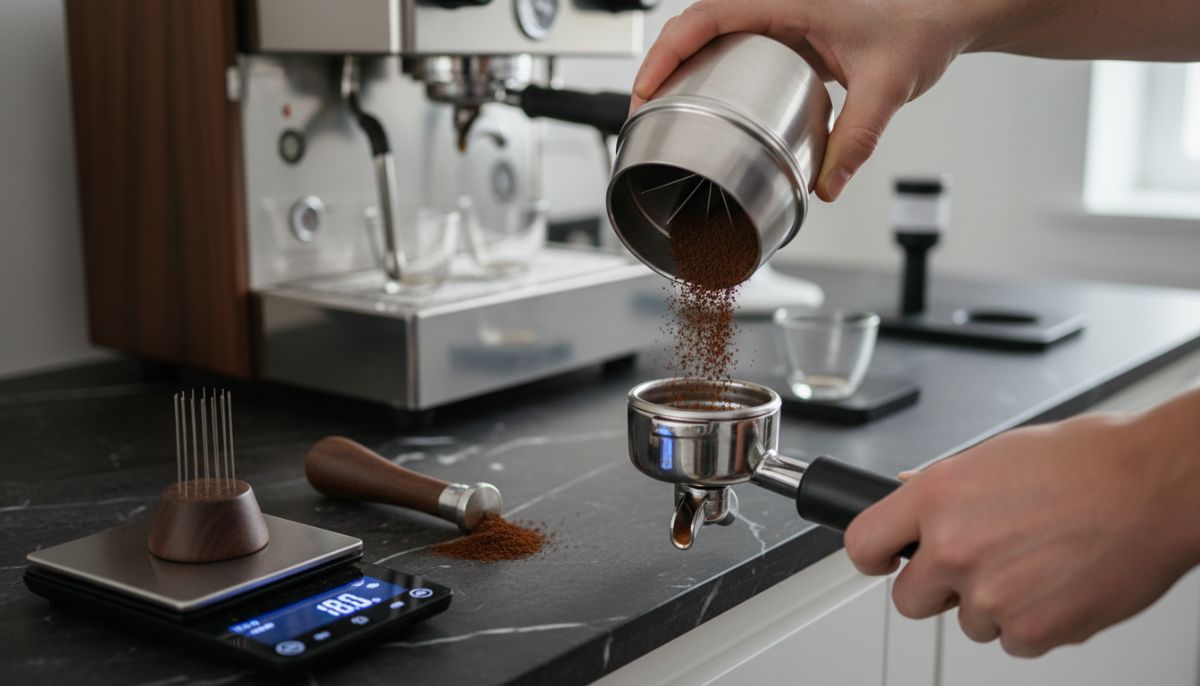
Shaking operates on a different principle: geometric distribution. When you vigorously shake the grounds in a contained environment, the forces acting on the particles encourage a more uniform mixture of fines and boulders throughout the entire dose. When the plug is pulled and the coffee falls into the basket, it lands in a state of higher homogeneity.
This homogeneity reduces the risk of localized micro-channeling, allowing water to flow more evenly through the puck. The result is a measurably higher Total Dissolved Solids (TDS) and Extraction Yield.
Taste Test: Is Higher Extraction Always Better?
This is the most critical user pain point: Can you actually taste the difference?
The data suggests the Blind Shaker raises the extraction ceiling. If you are brewing light roast, high-altitude specialty coffee, this is desirable. These beans often struggle to reach their full potential, and the shaker can unlock higher sweetness and clarity.
However, for medium to dark roasts, the WDT method might actually be superior precisely because it extracts less efficiently. Pushing extraction too high on a dark roast often pulls out harsh, ash-like flavors. If you are struggling to fix over-extracted bitterness, adding a high-efficiency tool like the Blind Shaker will only exacerbate the problem.
The Static Nightmare: Workflow Realities
While the extraction data is compelling, the daily workflow reveals a glaring issue: static electricity.
Coffee grounds are prone to static, causing them to cling to the walls and lid of the shaker. If you have to bang the shaker against the portafilter to dislodge stuck grounds, you re-introduce segregation and density inconsistencies, negating the benefits of shaking.
The RDT Solution
To use a Blind Shaker effectively, the Ross Droplet Technique (RDT) is mandatory. You must spray your beans with a fine mist of water before grinding to neutralize static. Without this step, the mess is significant, and the retention makes the workflow frustrating compared to a simple dosing funnel and WDT.
For those managing a single dosing workflow, adding RDT is a minor step. But for high-volume settings, the extra time required to manage static and clean the shaker between shots can be a bottleneck.
Weber Workshops vs. Cheap Clones
The authentic Weber Blind Shaker comes with a premium price tag, leading many to search for “dupes” on Amazon or AliExpress. Is the brand name worth it?
- Coating and Material: The Weber version uses a specialized smooth finish designed to minimize retention. Many cheap clones use standard anodized aluminum or paint that holds onto coffee oils and fines aggressively.
- Durability: There are reports of knockoff shakers having their internal coatings chip or peel over time, which is a health hazard.
- Fit and Finish: The tolerance of the center plug is crucial. If the plug is loose, grounds get trapped in the mechanism. Precision machining justifies the cost for the genuine article.
The Verdict: Should You Switch?
The Blind Shaker is not a magic bullet that fixes bad coffee, but it is a valid tool for specific users.
Stick to WDT if:
- You drink medium-to-dark roasts and enjoy a traditional body/texture.
- You want a simple, low-maintenance workflow without managing water sprays (RDT).
- You are on a budget and cannot justify the cost of a precision-machined shaker.
- You are already using precision baskets and are satisfied with your results.
Switch to the Blind Shaker if:
- You exclusively brew light roasts and are chasing maximum extraction and clarity.
- You struggle with channeling despite perfecting your WDT technique.
- You suffer from Repetitive Strain Injury (RSI) or wrist issues; shaking is often more ergonomic than the repetitive stirring motion of WDT.
- You are willing to perform RDT every single time to ensure the shaker remains clean.
Ultimately, the Blind Shaker proves that puck preparation is science, not just art. It offers a higher ceiling for those willing to put in the work, but for the average morning routine, the trusty WDT remains the king of convenience.
Frequently Asked Questions
For light roasts, yes. The increased homogenization and extraction yield often result in higher clarity and sweetness. However, for dark roasts, the increased extraction can lead to bitter or astringent flavors.
It is not recommended. Without RDT, static electricity causes significant retention of fines on the shaker walls. Knocking the shaker to dislodge them ruins the distribution you just created.
Generally, yes. The authentic Weber shaker features a high-quality coating that reduces retention and sticking. Cheap clones often have poor finishes that increase static and may chip or peel over time.
Yes, if used correctly. The shaking action replaces the need to rake the grounds with needles. Doing WDT after shaking would actually undo the homogenization benefits of the shaker.
The shaking process itself is faster (about 3-5 seconds). However, the overall workflow may be slower due to the requirement of RDT and the need to keep the shaker dry and clean.