
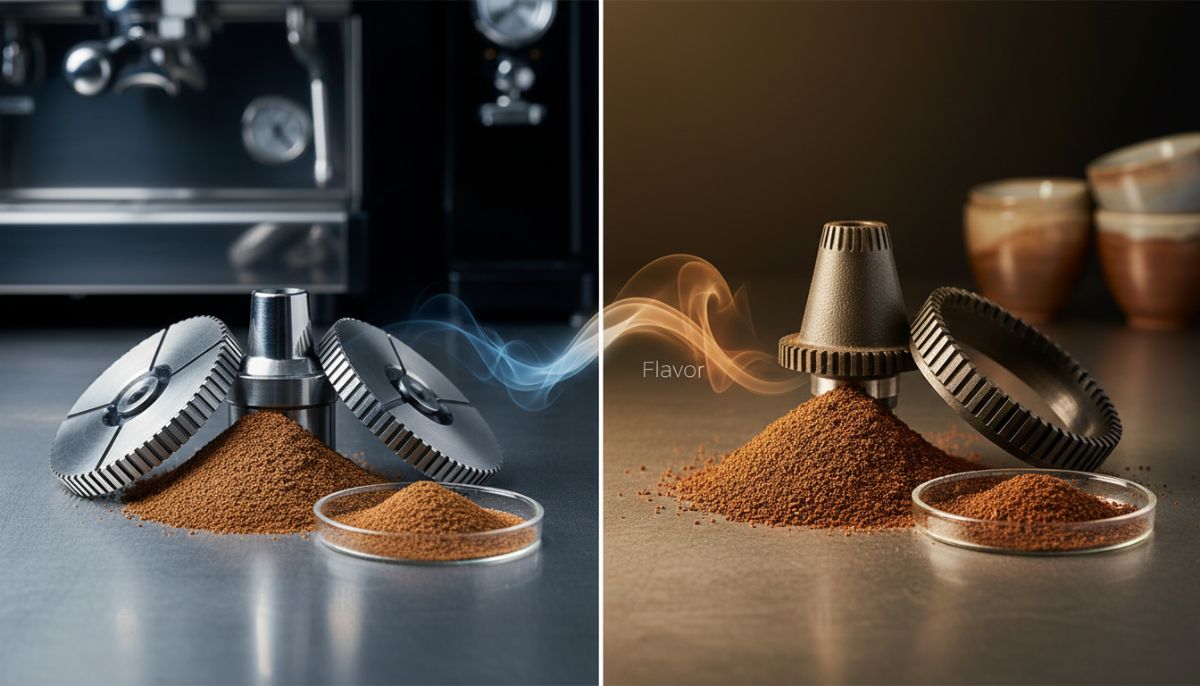
Confused by the debate between conical and flat burrs? We break down the sensory science, flavor differences, and which grinder geometry suits your specific roast preference.
For the uninitiated, the world of coffee grinders seems simple: beans go in, grounds come out. But for the enthusiast chasing the perfect extraction, the geometry of the steel crushing those beans is a subject of intense debate. The showdown between conical and flat burrs is not just about mechanics; it is a battle for the soul of the cup.
Many home baristas find themselves paralyzed by choice. Does a large flat burr justify the price tag? Is a conical burr truly more forgiving? This guide moves beyond the marketing jargon to explore the actual sensory differences—the taste, texture, and mouthfeel—that define these two technologies.
Key Takeaways
- Flavor Clarity vs. Body: Generally, flat burrs excel at separating individual flavor notes (clarity), while conical burrs produce a thicker, syrupy mouthfeel (body).
- Particle Distribution: Conical burrs create a "bimodal" distribution (fines and boulders), helping texture. Flat burrs aim for "unimodal" uniformity, aiding high extraction.
- Roast Pairing: Light roasts often shine with large flat burrs; medium-to-dark roasts benefit from the texture of conical burrs.
- Forgiveness: Conical grinders are often easier to dial in, making them ideal for traditional espresso lovers.
The Geometry of Taste: How Shape Changes Flavor
To understand why the coffee tastes different, one must look at how the beans are broken down. The difference lies in the physics of the cut.
Conical burrs use a cone-shaped inner burr spinning inside a stationary ring. Gravity feeds the beans into the gap, where they are crushed and ground. This process naturally produces two distinct peaks of particle sizes, known as a bimodal distribution. You get the target grind size, but you also get a specific amount of "fines" (tiny dust-like particles) and "boulders" (slightly larger chunks). These fines restrict water flow, creating the heavy, creamy texture espresso drinkers love, but they can muddy delicate floral notes.
Flat burrs consist of two identical rings sitting parallel to each other. Centrifugal force pushes the beans outward through teeth that shear and slice the coffee rather than crushing it. High-quality, well-aligned flat burrs produce a unimodal distribution. The particles are incredibly uniform in size. With fewer fines to clog the flow, water can pass through the puck more evenly, allowing for higher extraction yields without bitterness. This highlights the "high notes"—the acidity and fruitiness—of the bean.
Did You Know?
The size of the burr matters as much as the shape. Larger burrs (64mm, 83mm, or 98mm) generally have a longer grinding path, which can further reduce heat transfer and improve particle uniformity compared to smaller counterparts.
Sensory Analysis: The Flavor Profile Showdown
If we performed a blind triangulation test with the same bean brewed on two different grinders, what would the palate detect? The differences are often described in terms of separation and texture.
The Conical Cup
Coffee ground on a high-end conical grinder (like the Niche Zero or a classic Mazzer Robur) tends to punch with bass notes. The sensory experience is integrated. You might taste "chocolate" or "caramel," but distinct fruit notes might blend into that sweetness. The texture is often described as thick, coating the tongue. For those who enjoy traditional Italian espresso or use medium-dark roasts, this is often the preferred profile.
The Flat Cup
A shot pulled from a precision flat burr grinder (like the DF64 or Lagom P64) presents a different landscape. It is akin to increasing the treble and clarity on a sound system. If you are learning how to identify flavor notes like a Q-Grader, a flat burr makes it easier. You don't just taste "fruit"; you taste "stewed strawberry" versus "fresh raspberry." The body is lighter, sometimes tea-like, but the sweetness is perceived as cleaner.
Roast Styles and Grind Pairing
The roast level of your beans is arguably the biggest factor in deciding which burr is right for you. The grinder should complement the bean’s potential.
- Light Roasts: These beans are dense and hard to extract. They require high uniformity to avoid sourness while pushing extraction high to get sweetness. Flat burrs are the champion here. If you struggle with taming light roasts, swapping to a flat burr can sometimes be the missing link.
- Medium to Dark Roasts: These are more soluble. A hyper-uniform flat burr might expose harsh, ashy flavors in a dark roast. The fines produced by a conical burr help buffer this, rounding out the shot and emphasizing the rich, comfort-food flavors associated with darker profiles.
The Myth of “Flat vs. Conical”: Modern Complexity
Ten years ago, the line was clear: Flat for filter, Conical for espresso. Today, that line is blurred. Modern burr geometries have complicated the debate.
Innovations like the SSP Multi-Purpose (MP) burrs or "Cast Lab Sweet" burrs allow flat grinders to mimic some characteristics of conicals or push clarity to extreme levels. Furthermore, variable RPM (Revolutions Per Minute) grinders allow users to change the speed of the burr. Lowering the RPM can reduce the production of fines, altering the flavor profile significantly. For a deeper dive into how speed changes taste, check out our guide on grinder RPM profiling.
Workflow and Consistency
Beyond taste, the user experience differs. Conical burrs are widely considered more "forgiving." Because of the bimodal particle distribution, the fines help restrict flow, making it easier to pull a decent shot even if your puck prep isn’t perfect. If you aren’t using advanced techniques like the WDT method, a conical grinder might save your morning routine from channeling disasters.
Flat burrs, conversely, are ruthless. Poor alignment or bad distribution becomes immediately obvious in the cup. This brings us to a critical technical point: Alignment. A cheap flat burr grinder that is poorly aligned (where the burrs aren’t perfectly parallel) will perform worse than an average conical grinder. Before investing in a high-end flat grinder, it is worth understanding how to shim your grinder to ensure you are actually getting the benefits of the geometry.
Data Comparison: Popular Home Grinder Archetypes
To visualize the differences, let’s look at two titans of the home market that represent these categories: The Niche Zero (Conical) and the DF64 (Flat).
| Feature | Conical Archetype (e.g., Niche Zero) | Flat Archetype (e.g., DF64 with SSP) |
|---|---|---|
| Burr Size/Type | 63mm Conical | 64mm Flat |
| Flavor Profile | High Body, Blended, Sweet | High Clarity, Acidity, Separation |
| Particle Distribution | Bimodal (Two peaks) | Unimodal (Uniform) |
| Sweet Spot | Medium-Dark Espresso | Light Roast Espresso & Filter |
| Dialing In | Forgiving / Easy | Requires Precision |
| Noise Pitch | Lower, rumbling | Higher, whining |
Pros and Cons Breakdown
Conical Burrs
- Pros:
- Superior mouthfeel and texture.
- Quieter operation (generally lower RPM).
- Low retention (great for single dosing).
- Forgiving on puck preparation.
- Cons:
- Muddies flavor notes in complex light roasts.
- Difficult to achieve high clarity for pour-over brewing.
Flat Burrs
- Pros:
- Exceptional flavor separation and clarity.
- Higher extraction yields possible.
- Versatile (with modern burr swaps like SSP).
- Better consistency for light roasts.
- Cons:
- Often louder and more expensive.
- Requires perfect alignment to function correctly.
- Unforgiving; requires excellent distribution skills.
The Verdict
There is no single "best" grinder, only the best grinder for your palate. If you drink traditional cappuccinos, enjoy chocolatey espresso blends, and value a simplified workflow, a conical burr is likely your best match. However, if you are chasing the floral notes in a Geisha, prefer drinking espresso straight, or enjoy switching between espresso and filter coffee, a large flat burr grinder is the tool of choice.
Ultimately, the grinder is the gatekeeper of flavor. Choosing the right key unlocks the potential of your beans.
Frequently Asked Questions
Conical burrs are generally better for beginners because they are more forgiving. The bimodal particle distribution helps restrict water flow, making it easier to dial in a shot even if your puck preparation isn’t perfect.
Yes. Flat burrs produce a more uniform grind size (unimodal), which leads to higher extraction and greater flavor separation (clarity). Conical burrs create more fines, which contributes to a thicker body and blended flavor profile.
Yes, you can, but it may not be ideal for all palates. Conical burrs produce fines that can clog paper filters and slow down draw times, potentially leading to muddy or bitter flavors in filter coffee compared to the clean cup produced by flat burrs.
Flat burr grinders require tighter manufacturing tolerances to ensure the burrs are perfectly parallel (aligned). They also typically require more powerful motors to generate the torque and speed needed to shear the beans, driving up the cost.
The Niche Zero uses 63mm conical burrs (specifically the Mazzer Kony burrs), which is why it is famous for its high body, low retention, and chocolate-forward flavor profile.