
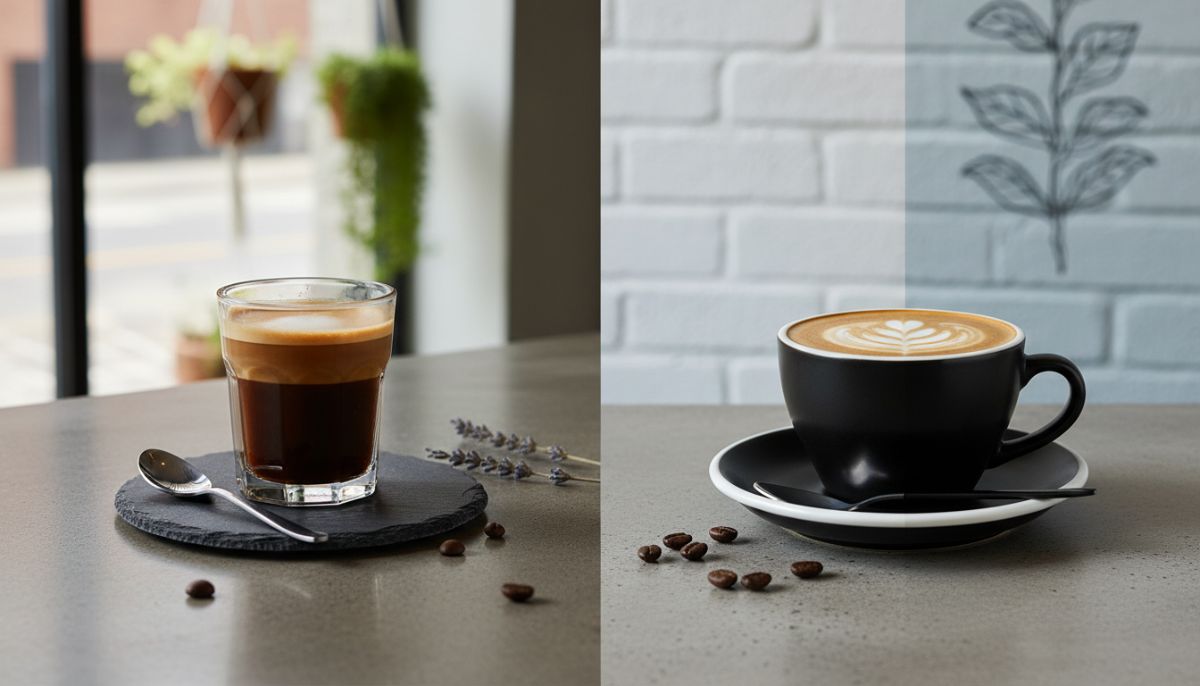
Confused by the coffee menu? Discover the critical differences between a Cortado and a Flat White, including origins, milk-to-espresso ratios, and texture profiles.
Key Takeaways
- The Ratio Rule: A Cortado strictly follows a 1:1 ratio of espresso to milk, while a Flat White typically ranges from 1:2 to 1:3.
- Texture Matters: Flat Whites rely on silky, wet microfoam (paint-like texture), whereas Cortados use steamed milk with very little foam.
- Serving Style: Cortados are traditionally served in a small glass (Gibraltar), while Flat Whites are served in ceramic cups to support latte art.
Walk into any third-wave coffee shop today, and you are likely to encounter a menu that looks more like a geometry test than a list of beverages. Among the most commonly confused orders are the Cortado and the Flat White. Both are small, strong, and milk-based, but asking a barista for one when you expect the other can lead to a very different sensory experience.
While they share DNA—espresso and steamed milk—the difference lies in the nuances of proportion, texture, and origin. This guide breaks down exactly what sets these two cafe favorites apart so you can order (or brew) with confidence.
The Cortado: Ideally Balanced
The Cortado hails from Spain, derived from the verb cortar, meaning “to cut.” The intention behind this drink is simple: the milk is there merely to cut the acidity and intensity of the espresso, not to mask it.
The Ratio
The defining characteristic of a Cortado is its strict 1:1 ratio. If you pull a double shot of espresso (roughly 2 ounces or 60ml), you add exactly 2 ounces of steamed milk. The result is a 4-ounce beverage that packs a punch.
The Texture and Vessel
Texture is secondary in a Cortado. The milk should be hot and steamed, but it does not require the heavy aeration used for cappuccinos or the meticulous microfoam of a Flat White. Traditionally, it is served in a 4.5 oz glass tumbler often called a Gibraltar glass.
The choice of vessel isn’t just aesthetic; it impacts the drinking experience. Glass retains heat differently than ceramic and allows you to see the visual balance of the ingredients. For a deeper dive into how serving vessels change perception, read our guide on how cup shape and material affect espresso taste.
The Flat White: Ideally Textured
The Flat White originated in the antipodes (Australia and New Zealand both claim it), born from a desire for a strong coffee that still had the creamy mouthfeel of a latte, without the stiff, dry foam of an old-school cappuccino.
The Ratio
A Flat White is generally larger than a Cortado, typically totaling 5 to 6 ounces. It usually consists of a double shot of espresso (sometimes a ristretto) topped with about 3 to 4 ounces of milk. This creates a ratio closer to 1:2 or 1:3. While it is still espresso-forward, the milk plays a much more significant role in the flavor profile compared to the Cortado.
The Microfoam
This is where the Flat White shines. The milk must be stretched into a glossy, velvety microfoam. This “wet” foam is poured freely into the espresso, folding the crema into the milk for a consistent, silky texture from the first sip to the last. Achieving this texture requires precise technique. If you are struggling to get that wet paint consistency, check out our tutorial on milk texturing and the secret to cafe-quality microfoam.
Head-to-Head: The Main Differences
1. Flavor Intensity
Because the Cortado has less milk dilution, the espresso flavor is significantly bolder. It is the drink of choice for those who want to taste the roast profile of the beans clearly but want the sharp edge taken off. If you are using lighter roasts that are naturally more acidic, the Cortado is excellent for balancing that brightness. Conversely, the Flat White is sweeter and creamier, making it a better canvas for comfort.
2. Preparation Difficulty
Brewing a Cortado at home is relatively forgiving regarding milk texture. As long as the milk is hot and the ratio is correct, you have a Cortado. However, because the espresso is so prominent, your shot preparation must be flawless. You need to ensure you know how to dial in your espresso ratios perfectly, or the drink will taste harsh.
The Flat White, on the other hand, demands steaming mastery. You need a machine with sufficient steam power to create a vortex that breaks down large bubbles. Many entry-level machines struggle here. If you are finding your texture inconsistent, it might be a hardware limitation—read our comparison of prosumer vs. appliance grade machines to see if you are ready for an upgrade.
3. Presentation
The Flat White is the artist’s canvas. Because of the microfoam, it is the standard vessel for latte art. The Cortado can have art, but the small surface area of the glass makes it challenging. If you want to practice pouring rosettas on your Flat White, choosing the right tool is essential. Learn more about choosing the right spout for latte art to improve your pour.
Which One Should You Order?
Order a Cortado if you want a slow-sipping drink that highlights the nuance of the coffee bean with just a whisper of dairy sweetness.
Order a Flat White if you crave a luxurious mouthfeel and a comforting, sweet coffee that still offers a caffeine kick stronger than a latte.
Ultimately, both drinks rely on the same fundamental requirement: high-quality fresh beans and precise extraction. Without a solid espresso base, neither milk nor ratio can save the drink.
Frequently Asked Questions
A Cortado tastes stronger. While both typically contain a double shot of espresso, the Cortado is diluted with less milk (1:1 ratio) compared to the Flat White (1:2 or 1:3 ratio).
The Cortado is traditionally served in a Gibraltar glass (roughly 4.5 oz). This originates from its Spanish roots and allows the drinker to see the equal balance of milk and espresso.
Yes, but specifically microfoam. A Flat White has a layer of velvety, wet foam integrated into the drink. A Cortado typically has very little to no foam, consisting mostly of steamed liquid milk.
No. A Latte is much larger (usually 8-12 oz) and contains significantly more milk, making the coffee flavor much milder than both a Cortado and a Flat White.