
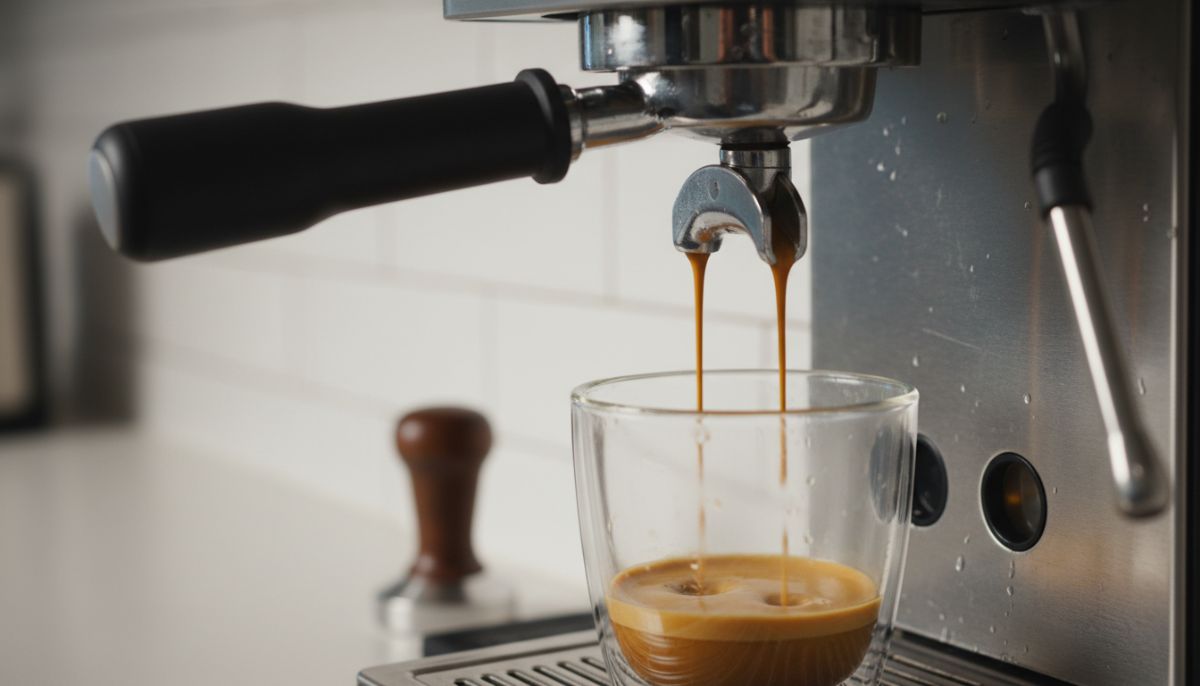
Is your espresso tasting sour and bitter despite perfect timing? The culprit might be invisible puck fractures. Learn how to identify hidden cracks, prevent tamping suction, and fix internal channeling for a sweeter, more consistent extraction.
Key Takeaways
- Invisible fractures occur inside the coffee bed and are not always visible on the surface, leading to uneven extraction.
- Tamp suction is a common, overlooked cause; lifting a tamper too quickly creates a vacuum that cracks the sealed puck.
- Taste is the ultimate diagnostic tool: a shot that tastes both sour (underextracted) and bitter (overextracted) usually indicates channeling.
- Fixes involve physics: modifying pre-infusion ramp rates and refining distribution techniques can prevent the coffee bed from shattering under pressure.
There is a specific kind of heartbreak known only to the home barista. You weigh your dose to the decigram. You distribute the grounds with surgical precision. You tamp level. The shot timer hits 28 seconds, the ratio is a perfect 1:2, and the crema looks thick and tiger-striped. But when you take that first sip, your face twists.
It is sharp. It is astringent. It tastes like battery acid mixed with burnt toast. How can a shot look so right on paper but taste so wrong in the cup?
The likely answer is an invisible puck fracture. Unlike the geysers that spray your countertop, these structural failures happen deep within the coffee cake, hidden from view. The water finds a path of least resistance—a crack—and rushes through it, over-extracting the grounds along the fissure while leaving the rest of the puck dry and sour. Diagnosing this requires moving beyond basic timing and looking at the physics of your extraction.
The Anatomy of an Invisible Fracture
To fix the problem, one must understand what is happening inside the basket. When we talk about channeling 101, we often visualize visible holes on the surface. However, internal fractures are more insidious. They are structural weaknesses in the compressed lattice of coffee grounds.
Imagine the puck as a concrete dam. If the concrete has a hairline fracture deep inside, the water pressure (9 bars is roughly 130 PSI) will exploit that weakness instantly. In espresso, high-pressure water widens these microscopic cracks within milliseconds. The result is a high-speed river of water tunneling through the puck, bypassing the majority of your expensive coffee.
Why Your Puck Cracks: The Physics of Resistance
Why does a perfectly prepared bed of coffee suddenly fail? It usually comes down to two forces: suction and shock.
1. The Vacuum Effect (Tamp Suction)
This is the most common error among intermediate baristas. You tamp down firmly, polishing the surface to perfection. Then, you pull the tamper straight up. Because most precision tampers fit the basket snugly to prevent edge channeling, pulling them out quickly creates a piston effect.
This upward suction lifts the entire puck slightly off the bottom of the basket or, worse, lifts the top half of the puck while the bottom stays put. This creates a horizontal fissure or cracks the seal you just worked so hard to create. You won’t see it because the top surface still looks smooth, but the structural integrity is gone.
2. Thermal and Hydraulic Shock
Water hitting a dry puck is a violent event. If your machine engages the pump at full power instantly, the sudden slam of water can shatter the puck before it has time to swell and offer resistance. This is why pressure profiling and soft pre-infusion are so critical. They allow the water to gently saturate the grounds, acting as a shock absorber before the main pressure builds.
Diagnosing Without X-Ray Vision
Since you cannot see inside the portafilter during extraction, you must rely on secondary indicators. Here is how to play detective.
The Taste Paradox
The most reliable symptom of an invisible fracture is the presence of both sourness and bitterness in the same cup.
- Sourness: Comes from the dense parts of the puck that the water avoided (underextraction).
- Bitterness/Astringency: Comes from the grounds along the fracture where water flowed too fast and too heavily (overextraction).
The Flow Rate Tell
Watch the stream of espresso. A healthy shot starts slow, accelerates slightly, and then holds a steady, syrupy cone. A channeled shot often exhibits a sudden, unexplained acceleration in the middle of the extraction. The resistance breaks, the fracture opens, and the flow rate spikes. If your shot blondes (turns pale yellow) prematurely, you have a breach.
The Bottomless Portafilter Exam
Using a naked portafilter is essential for spotting these issues. While invisible fractures don’t always spray, they often show up as “dead spots”—areas on the bottom of the basket where no coffee is coming out. This suggests the water is diverting elsewhere through a hidden channel.
Data Breakdown: Types of Puck Failure
Not all channeling is created equal. Understanding the difference helps you choose the right fix.
| Failure Type | Visual Symptom | Primary Cause | The Fix |
|---|---|---|---|
| Side Channeling | Donut extraction (flow only from edges) | Poor tamper fit or curved basket base | Precision tamper or better basket |
| Internal Fracture | Dead spots, sudden flow acceleration | Tamp suction or pressure shock | Slower tamp release, longer pre-infusion |
| Pinhole Channel | Spraying / Spurting | Clumps in grind or poor distribution | Deep WDT method |
Step-by-Step Fixes for Invisible Flaws
Once you suspect a fracture, how do you fix it? The solution lies in refining your workflow to treat the coffee bed gently.
1. Deep Weiss Distribution Technique (WDT)
Many baristas only rake the top surface of the coffee to make it look flat. This is cosmetic, not functional. You must break up clumps at the bottom of the basket where the resistance is highest. Use fine needles (0.3mm to 0.4mm) and stir all the way to the filter floor. This homogenizes density and prevents localized weak spots. Read more on the science of puck prep and WDT to master this.
2. The Tamper Twist-and-Pull
To eliminate the vacuum effect, never yank the tamper out. After compressing the coffee, gently twist the tamper as you slowly lift it. This breaks the seal and allows air to enter the basket edges, equalizing pressure so the puck stays firmly seated.
3. Check Your Headspace
Headspace is the distance between the top of the coffee puck and the shower screen. If this space is too large, water accumulates and gains momentum before smashing into the coffee, causing craters. If it is too small, the shower screen presses into the dry coffee, fracturing it before the water even arrives. Aim for a coin’s thickness of clearance. See our guide on headspace and dosing for the exact measurements.
4. Puck Screens
A puck screen is a stainless steel mesh placed on top of the tamped coffee. It acts as a shield, dispersing the water evenly and preventing the direct impact of the pump from drilling holes into the bed. It is one of the most effective tools for preventing fractures.
Did You Know?
The “solids” in your espresso are actually migrating fines. During extraction, microscopic coffee particles (fines) detach and move downward. If they migrate evenly, they create resistance. If a fracture exists, these fines wash out instantly, leading to a thin, watery body and that distinct dusty taste.
Pros and Cons of Using Puck Screens to Prevent Fractures
Is adding another tool to your workflow worth it? Here is the breakdown.
Pros
- Impact Protection: drastically reduces surface erosion from water hitting the puck.
- Even Saturation: helps distribute water across the entire bed width instantly.
- Cleanliness: keeps the group head remarkably clean, reducing maintenance.
Cons
- Workflow: it is a hot piece of metal you have to fish out of the knock box.
- Thermal Mass: if not preheated, it can drop your brew temperature by 2–3°C.
- Headspace: requires you to dose slightly less coffee to accommodate the screen’s thickness.
Post-Mortem: The Knock Box Analysis
Finally, inspect your trash. After pulling a shot, gently knock the spent puck out. It should come out as a solid, firm brownie. If it falls apart into wet sludge, or if you see visible dark holes, you have a problem. Try slicing the puck in half cross-sectionally. You might see a lighter-colored vein running through the dark coffee—that is the fossilized remains of your channel, confirming the water took a shortcut.
Conclusion
Diagnosing invisible puck fractures requires patience and a shift in perspective. It is not always about buying a better grinder; often, it is about the physics of your hand movements and the hydraulics of your machine. By eliminating tamp suction, smoothing out your pressure introduction, and ensuring deep distribution, you can heal these invisible wounds. The reward is a shot that tastes as good as it looks—rich, balanced, and free of that sour-bitter confusion.
Frequently Asked Questions
This is a classic sign of channeling or a fractured puck. The water flows too quickly through cracks (causing over-extracted bitterness) while ignoring the dense areas (causing under-extracted sourness).
Yes. Lifting the tamper quickly creates a vacuum (suction) that can pull the puck away from the basket walls or crack the internal structure, leading to invisible channeling.
Use the Deep WDT method to distribute grounds evenly, release the tamper slowly with a twist to prevent suction, and use a puck screen to disperse water impact.
While not strictly mandatory, a bottomless portafilter is the best diagnostic tool. It allows you to see ‘dead spots’ or uneven flow patterns that are impossible to detect with a spouted portafilter.
You usually can’t see it on the surface. However, if you slice a spent puck in half, you may see a lighter-colored vein or fissure running through the cake, indicating where water rushed through.