
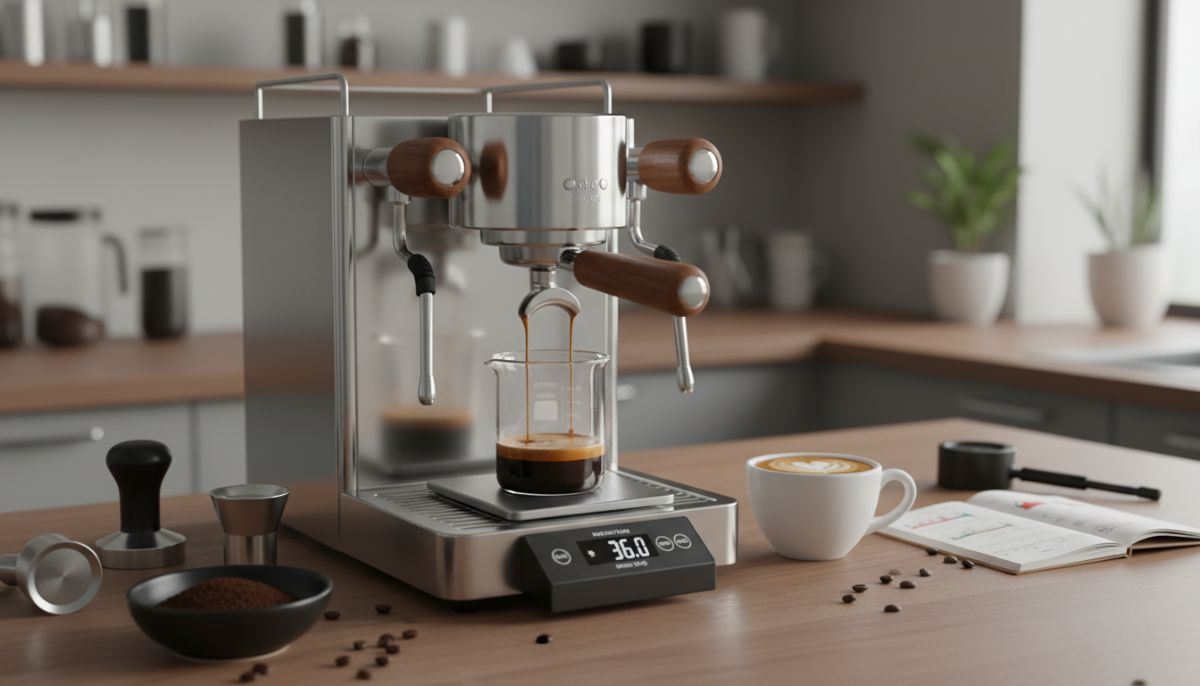
Is the 1:2 rule ruining your light roast? Stop brewing sour shots and ashy dark roasts. Discover how to adjust your espresso ratio based on roast level for better flavor clarity and texture.
The 1:2 Rule is Just a Starting Point, Not a Law
There is a persistent myth in the home barista community. It goes something like this: weigh 18 grams of coffee, extract 36 grams of liquid, and do it all in 25 to 30 seconds. If it tastes bad, you blame your tamping or your grinder. But here is the hard truth. If you are strictly adhering to a 1:2 ratio for every single bag of beans you buy, you are likely drinking suboptimal coffee.
Coffee beans are not uniform. A dense, high-altitude Ethiopian light roast behaves completely differently under pressure than a porous, oil-slicked dark roast blend. Sticking to a single recipe for both is like trying to bake a delicate soufflé at the same temperature you roast a chicken. It just doesn’t work.
To truly master dialing in espresso, you need to treat the brew ratio as your primary volume knob for flavor, adjusting it specifically to the roast level of your beans.
Key Takeaways
- Light Roasts: Require higher ratios (1:2.5 to 1:3) to extract stubborn acidity and sweetness.
- Dark Roasts: Shine with shorter ratios (1:1 to 1:1.5) to maximize body and minimize bitterness.
- Workflow: Lock in your dose first. Change your yield (ratio) second. Adjust grind size last.
- Texture vs. Clarity: There is always a trade-off. Longer shots have more clarity but thinner body; shorter shots have thick texture but muddled flavors.
Why Roast Level Dictates Your Ratio
To understand ratio, we have to talk about solubility. This is the scientific term for how easily water can dissolve the flavor compounds in your coffee grounds.
Dark roasts are highly soluble. The cellular structure of the bean has been broken down significantly by heat. They give up their flavor easily. If you run too much water through them (like a 1:2.5 ratio), you extract the good stuff plus the dry, ashy, bitter compounds found at the end of extraction.
Light roasts are stubborn. They are dense and less soluble. If you cut the shot short at a 1:2 ratio, the water hasn’t had enough contact time or volume to pull out the complex sugars and fruit notes. The result? A shot that tastes essentially like a lemon battery—sharp, sour, and undrinkable. This is often misdiagnosed, leading people to grind finer, which causes channeling, making the sourness even worse.
The New Ratio Cheat Sheet: Where to Start
Forget the universal standard. Use this chart as your new baseline when you open a fresh bag of beans.
| Roast Level | Target Ratio | Recipe Example (18g Dose) | Flavor Goal |
|---|---|---|---|
| Dark / Italian | 1:1 to 1:1.5 | 18g in → 18-27g out | Syrupy body, chocolate, reduced bitterness. |
| Medium | 1:1.75 to 1:2.2 | 18g in → 32-40g out | Balance between texture and clarity. |
| Light / Nordic | 1:2.5 to 1:3 | 18g in → 45-54g out | High clarity, floral notes, fruit acidity. |
Did You Know?
The concept of the “Ristretto” (restricted shot) is essentially a low-ratio shot (1:1). In Italy, this is often preferred for darker blends containing Robusta, as it concentrates the caffeine and oils while leaving behind the harsh woody flavors that appear later in the brew.
The Workflow: How to Dial In Without Wasting Coffee
Most people adjust their grinder first. That is a mistake. Grinding is the hardest variable to replicate perfectly. Instead, follow this hierarchy of variables to save beans and sanity.
1. Lock Your Dose
Choose a dose that fits your basket (usually 18g to 20g). Do not change this. If you change the amount of coffee in the basket, you change the resistance, flow rate, and ratio all at once. Keep the input weight constant using a smart scale accurate to 0.1g.
2. Pick Your Yield (The Ratio)
Look at your beans. Are they oily and dark? Aim for 27g out (1:1.5). Are they light brown and matte? Aim for 45g out (1:2.5). Pull the shot and taste it. Don’t worry about the time yet.
3. Taste and Troubleshoot
Here is where you make decisions. Forget the numbers on the screen for a second.
- Sour/Salty? You are under-extracted. You need to pass more water through the puck. Increase your ratio (e.g., go from 1:2 to 1:2.5).
- Bitter/Dry/Ashy? You are over-extracted. Stop the shot sooner. Decrease your ratio (e.g., go from 1:2 to 1:1.5).
4. Adjust Grind (Only for Resistance)
Once you find the ratio that tastes best, then look at the time. If that perfect 1:2.5 light roast shot took 50 seconds and tasted a bit astringent, coarsen the grind to get it closer to 30-35 seconds. Conversely, for light roasts, do not fear fast shots. The modern “turbo shot” technique actually encourages grinding coarser and pulling fast (15-20 seconds) to reduce channeling and increase sweetness.
Advanced Tweak: Temperature’s Role
Ratio does the heavy lifting, but temperature is the fine-tuning knob. Generally, higher temperatures increase extraction, while lower temperatures decrease it. If you are struggling with a light roast even at a 1:3 ratio, ensure your machine is set between 94°C and 96°C. For dark roasts, drop it down to 88°C–90°C to avoid burning off the volatile oils. Machines with temperature stability make this significantly easier to manage.
Pros & Cons of Lengthening Your Ratio
Moving from a standard 1:2 to a 1:3 (Lungo style) has distinct advantages and disadvantages depending on your palate.
Pros of High Ratios (1:3)
| Cons of High Ratios (1:3)
|
Final Thoughts
Dialing in isn’t about hitting a magical number that a YouTuber told you to hit. It is about balancing the specific bean you have in the hopper. If you are drinking a dark roast, don’t be afraid to pull it short and thick. If you are exploring a washed Ethiopian light roast, let it run long and fast. Your palate is the final judge, not the timer.
Frequently Asked Questions
Light roasts are less soluble than dark roasts. A 1:2 ratio often doesn’t provide enough water to dissolve the sweet and complex compounds, leaving you with only the early-extracting acids. Try extending the ratio to 1:2.5 or 1:3.
Dark roasts extract very quickly. To avoid bitter, ashy flavors, use a shorter ratio (Ristretto style) between 1:1 and 1:1.5. This maximizes body and chocolate notes while cutting off the flow before bitterness sets in.
Always adjust your ratio first. Once you have locked in your dose, changing the ratio (yield) has the biggest impact on flavor balance (sour vs. bitter). Only adjust grind size afterwards to refine the flow rate and texture.
You must use a scale. Weigh your ground coffee dose (Input). Then, place a cup on the scale and weigh the liquid espresso as it brews (Output). The ratio is Input:Output.
A Turbo Shot is a modern technique for light roasts that uses a coarser grind, a lower pressure (often 6 bar), and a fast extraction time (15-20 seconds) with a longer ratio (1:2.5+). It aims to reduce channeling and increase extraction evenness.