
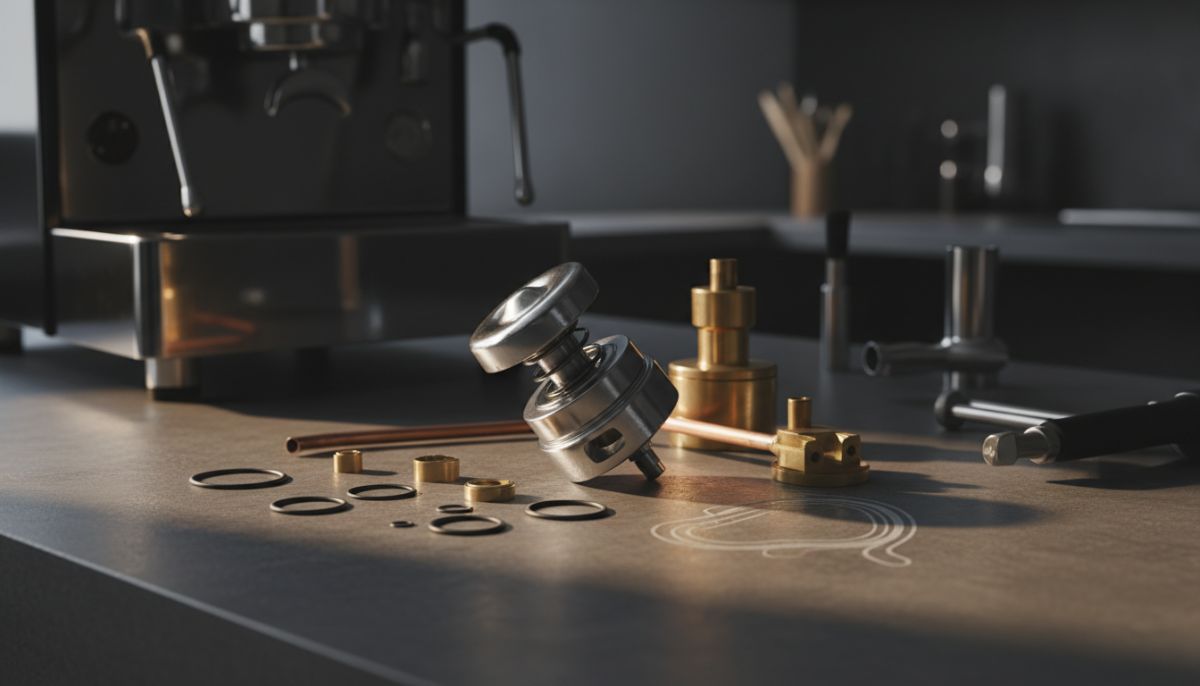
Discover the engineering genius behind the Faema E61 grouphead. Learn how this 1961 invention revolutionized espresso temperature stability and pre-infusion.
Key Takeaways
- Historical Significance: Invented in 1961 by Faema, the E61 replaced lever-operated machines with a pump-driven system, setting the standard for modern espresso.
- Thermal Stability: The heavy brass construction and thermosyphon system actively circulate hot water to keep the brewing temperature consistent.
- Automatic Pre-infusion: A mechanical system within the grouphead gently wets the coffee puck before full pressure is applied, reducing channeling.
- Maintenance Heavy: While durable, the E61 requires regular lubrication and cleaning to prevent the internal cam and valves from wearing out.
If you walk into a specialty coffee shop or browse high-end home espresso setups, you will almost certainly recognize it. It is that protruding, polished chrome nose extending from the front of the machine. It looks heavy, industrial, and unmistakably classic.
This is the E61 grouphead.
For over 60 years, this component has been the gold standard for espresso machine manufacturing. Despite the influx of saturated groups and electrically heated heads in recent years, the E61 remains the king of the prosumer market. But why has a piece of technology from the Kennedy era survived the digital age?
The answer lies in a perfect storm of thermal mass, mechanical simplicity, and forgiving extraction dynamics. To understand your machine, you must understand the E61.
The History: The Eclipse of 1961
Before 1961, espresso was largely defined by the lever machine. The barista had to manually pull a spring-loaded lever to generate pressure. While effective, it was physically demanding and inconsistent.
Enter Ernesto Valente and the Faema company. They sought to revolutionize the workflow by utilizing a motorized volumetric pump to generate the necessary 9 bars of pressure. However, they needed a grouphead that could manage this pressure while maintaining thermal stability without the massive boiler being directly attached to the group (as it was in lever machines).
Valente launched the Faema E61 in 1961. The name is rumored to be a nod to the total solar eclipse that occurred in Italy that same year (Eclisse 61). It was an instant game-changer. It allowed for continuous delivery of water at a constant temperature and pressure, separating the physical exertion of the barista from the quality of the extraction.
The Mechanics: How the Thermosyphon Works
The defining feature of the E61 is its thermal stability, achieved through a brilliant engineering concept called the thermosyphon.
In standard home machines, the grouphead can cool down between shots, sucking heat away from the brew water and resulting in sour espresso. The E61 solves this with mass and circulation.
The Circulation Loop
The grouphead is connected to the machine’s boiler (or heat exchanger) by two copper pipes: an inlet and an outlet. Because hot water is less dense than cool water, the hot water from the boiler naturally rises through the top pipe into the hollow chamber of the brass grouphead.
As the water sits in the heavy brass head (which acts as a massive heat sink), it transfers its heat to the metal. As the water cools, it becomes denser and sinks back down through the bottom pipe into the boiler to be reheated.
This continuous loop ensures the grouphead is always hot and ready to brew. This feature is particularly prominent in many Heat Exchanger and Dual Boiler machines that dominate the prosumer market today.
However, this system relies heavily on unrestricted flow. If scale builds up in the narrow pipes (specifically the “mushroom” inside the group), the loop stalls, and the group goes cold. This is why understanding water chemistry and scale is critical for E61 owners.
The Cam and Valves: The Anatomy of a Pull
The lever on the side of an E61 group is not just a switch; it is a mechanical actuator. Inside the group, there are three primary valves stacked vertically, controlled by an eccentric cam connected to the lever.
- Rest Position (Lever Down): The top valve is closed (blocking water from the boiler). The bottom exhaust valve is open, ensuring no pressure remains in the portafilter.
- Mid-Position (Lever Middle): The exhaust valve closes, and the inlet valve opens slightly. This allows line pressure (or passive water flow) to enter the puck without engaging the pump.
- Brew Position (Lever Up): The pump engages. The inlet valve is fully open. The exhaust valve is tightly sealed.
The Secret Weapon: Automatic Pre-infusion
One of the main reasons the E61 produces such delicious espresso is its inherent pre-infusion capability. Pre-infusion is the process of gently soaking the coffee puck before hitting it with full pressure.
Inside the E61, there is a distinct chamber with a spring-loaded piston (often called the pre-infusion chamber). When you lift the lever, water rushes into the group to hit the coffee. However, before the pressure can build up to 9 bars, the water must first fill this secondary chamber and compress the spring.
This momentary delay allows the water to wet the coffee grounds at a lower pressure. This swelling of the puck settles the grounds and heals minor cracks in the coffee bed.
By smoothing out the puck before the full force of the pump hits, the E61 significantly reduces the risk of channeling. If you are struggling with sprinters or bald spots in your extraction, you can learn more about fixing uneven water flow in our dedicated guide.
Temperature Stability vs. PID Control
While the E61 is famous for stability, it is a passive stability. It relies on the thermal mass of 4kg of brass. Modern technology has introduced active stability via PID controllers.
Can an E61 have a PID? Absolutely. Many modern machines combine the classic group with a digital controller on the boiler. However, because the grouphead is exposed to the air, there is always a slight temperature offset between the boiler and the coffee puck.
While the heavy brass dampens temperature fluctuations, it also means the machine takes longer to heat up (typically 20-30 minutes). If you are curious about how digital precision compares to mechanical mass, read our article on PID controllers and temperature stability.
Maintenance: The Cost of Mechanical Beauty
The E61 is robust, but it is not maintenance-free. The metal-on-metal friction of the cam moving against the valve pins requires lubrication. Over time, the chemical detergents used to clean coffee oils will strip away this lubricant.
If your lever feels “squeaky” or provides rough resistance when you lift it, it is crying out for maintenance. You will eventually need to disassemble the top section (a simple task with a wrench) and apply food-safe silicone grease to the cam.
The Importance of Backflushing
Because the E61 has a three-way valve system that sucks waste water back through the group to the exhaust pipe, coffee oils and grounds can accumulate inside the lower section of the group.
Regular backflushing with a blind basket is non-negotiable. However, be aware that excessive chemical backflushing accelerates the need for re-lubrication. For a balanced schedule, refer to our comprehensive cleaning manifesto.
Is the E61 Still the Best Choice?
In an era of Decent espresso machines and saturated groups that heat up in five minutes, is the E61 obsolete? Not at all.
The E61 offers a tactile experience that buttons and touchscreens cannot replicate. It provides a forgiving pressure profile that makes it easier for home baristas to pull excellent shots, even if their puck prep isn’t 100% perfect. It is easily repairable, parts are universally available, and it carries an aesthetic gravitas that defines the “home cafe.”
Whether you are pairing it with a classic Italian grinder or experimenting with modern precision tools, the E61 remains a reliable workhorse. Speaking of precision, ensuring you have the right basket inside that portafilter can further enhance the E61’s performance—check our comparison on stock vs. precision baskets to see if an upgrade is worth it.
Final Thoughts
The Faema E61 is more than just a lump of chrome. It is a brilliant example of hydraulic engineering that solved the biggest problems of espresso extraction: temperature and pressure consistency. While it requires patience to heat up and care to maintain, the reward is a rich, syrupy shot of espresso that connects you directly to the history of coffee.
Frequently Asked Questions
Due to the massive amount of brass (thermal mass), an E61 grouphead typically takes 20 to 30 minutes to fully heat up and stabilize for optimal espresso extraction.
Yes. Using chemical cleaners (backflushing) strips the internal lubricant. If the lever feels stiff or squeaky, you should disassemble the cam assembly and apply food-safe silicone grease.
The thermosyphon continuously circulates hot water from the boiler through the grouphead, ensuring the metal remains hot and the brewing temperature stays consistent during the shot.
Yes, the standard E61 design includes a mechanical pre-infusion chamber that allows water to wet the puck at low pressure before the pump reaches full 9-bar pressure.