Is a spinning distribution tool the secret to god-tier espresso, or just expensive jewelry for your counter? We break down the science of puck prep, levelers vs. tampers, and what actually improves extraction.
Key Takeaways
- Surface vs. Deep Distribution: Spinning levelers mostly groom the top surface, while tools like WDT address deep pockets of air and clumps.
- Tamping is Non-Negotiable: A leveler does not replace the need for tamping; it simply creates a flat surface before tamping.
- Consistency Over Perfection: Levelers excel at creating a perfectly flat bed every time, which helps with consistent leveling, even if they don’t fix density issues.
- The Verdict: For most home baristas, a WDT tool combined with a high-quality tamper offers better value and extraction results than a spinning leveler alone.
Walk into any specialty coffee shop, and you will see a mesmerizing dance of tools. There are needles, funnels, spinning metal disks, and heavy calibrated weights. For the home enthusiast, this gear acquisition syndrome (GAS) can be overwhelming. The most contentious battleground in modern puck prep is the “Great Distribution Debate.”
Do you really need that heavy, spinning distribution tool (often called a leveler)? Or is a skilled hand and a trusty tamper enough to pull the perfect shot? Let’s strip away the marketing hype and look at the physics of extraction.
The Goal: What is Perfect Puck Prep?
Before buying gear, we need to understand the objective. The goal of puck preparation is to create a coffee bed of uniform density. We want water to flow through the coffee at the same rate in every millimeter of the basket.
If one area is less dense than another, water will rush through that path of least resistance. This is called channeling. If you are struggling with sour or uneven shots, you might want to read our guide on how to spot and fix uneven water flow.
The Contender: The Spinning Distributor (Leveler)
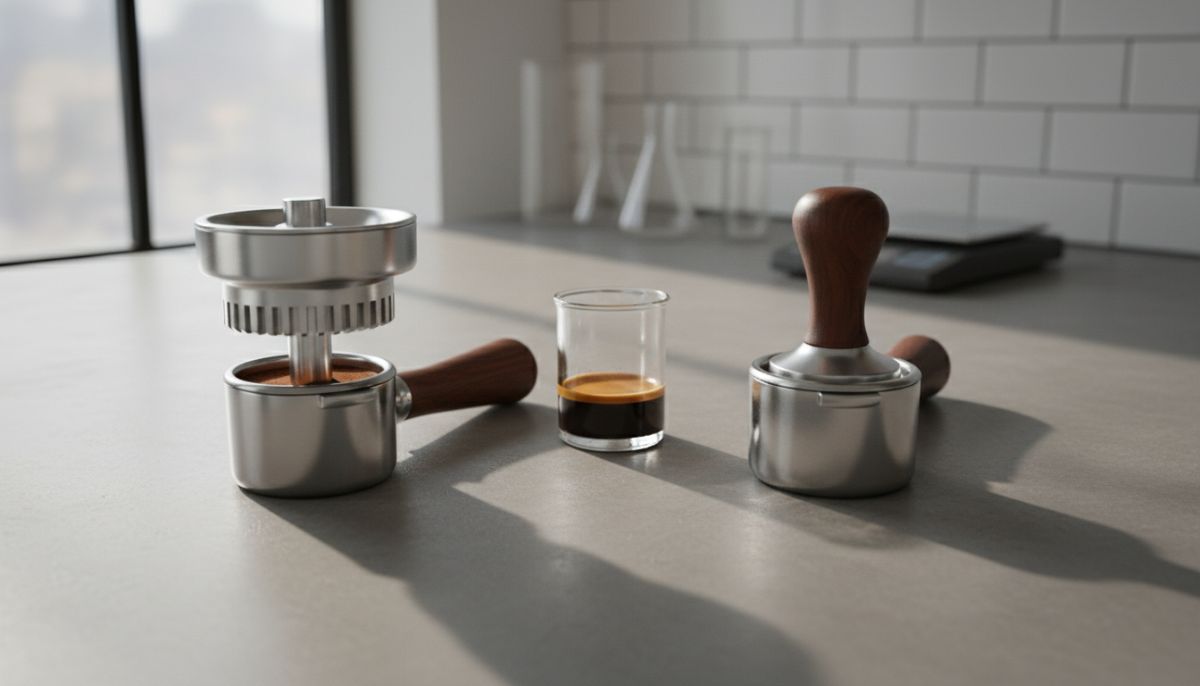
What it is: A heavy tool with a patterned base (usually resembling a fan or propeller) that sits on the rim of your portafilter. You spin it, and it redistributes the top layer of coffee.
The Pros
The primary benefit of a leveler is consistency. Humans are notoriously bad at judging whether something is perfectly level. If you tamp at a slight angle, you create a thinner bed on one side, leading to uneven extraction.
A distributor ensures that before your tamper even touches the coffee, the surface is perfectly flat. This acts as a guide, making it much harder to tamp crookedly.
The Cons (The “Pre-Tamp” Problem)
The criticism of spinning distributors is that they push coffee down rather than moving it sideways. If you have a mound of coffee in the center of your basket and you mash a distributor on top, you might compress the center more than the edges.
While the top looks pristine, the density beneath might be uneven. This “polishing a turd” effect can actually mask underlying puck issues that become obvious once you apply high pressure.
The Champion: The Tamper
What it is: A piston that compresses the air out of the coffee bed.
Why it’s essential: You cannot skip tamping. Even if your leveler is set to a deep depth, it does not compress the puck with the 20-30 lbs of force required to resist 9 bars of water pressure. The tamper creates the structural integrity of the puck.
However, tamping locks in whatever mess is in the basket. If you tamp a bed full of clumps, you are locking in channels. This is where the interaction between your grinder and your prep matters. Different grinders produce different particle geometries. To understand how your equipment plays a role, check out our comparison on flat vs. conical burrs and flavor profiles.
The Third Player: WDT (The Real Game Changer)
If the leveler grooms the surface and the tamper compresses the bed, who fixes the density inside the puck?
Enter the Weiss Distribution Technique (WDT). This involves using thin needles to rake through the coffee fluff, breaking up clumps and ensuring the grounds are evenly distributed from the bottom of the basket to the top.
Recent data suggests that WDT is far more effective at increasing extraction yield than spinning distributors. If you are on the fence about adding needles to your workflow, read our deep dive on the science of puck prep and if the WDT tool matters.
The Verdict: Workflow Combinations
So, do you need a leveler? It depends on your struggle points. Here is how to decide based on your current setup.
Scenario A: The Minimalist
Tools: WDT Tool + Good Tamper.
Verdict: This is the gold standard for taste. The WDT ensures deep distribution, and the tamper seals the deal. You save money by skipping the heavy spinning leveler.
Scenario B: The Aesthete
Tools: Leveler + Tamper.
Verdict: This creates a beautiful workflow and a clean puck. However, if your grinder produces clumps, the leveler won’t fix them. You might get pretty looking pucks that still channel.
Scenario C: The High-Precision Brewer
Tools: WDT + Leveler + Tamper.
Verdict: Overkill? Maybe. But effective. You WDT to declump, use the leveler to create a flat surface, and tamp to finish. This minimizes human error regarding leveling.
Note that if you are using high-flow specialized baskets, your prep needs to be flawless. Standard baskets are forgiving; precision baskets are not. Learn more about how filters impact this decision in our article on stock vs. precision baskets.
Cost vs. Benefit
A good tamper is a one-time investment that will last a lifetime. A cheap leveler often rattles or adjusts poorly, while expensive ones can cost as much as a grinder.
If you have limited budget, prioritize a precision tamper that fits your basket snugly (58.5mm for most commercial machines). Reducing the gap at the edge of the basket is more critical for preventing channeling than pre-leveling the grounds.
Dialing In Your Consistency
Regardless of the tool you choose, the key is repeatability. If you use a leveler today and skip it tomorrow, your shot times will fluctuate. Espresso is a game of variables.
When you are trying to find that sweet spot, you need to keep your prep identical so you can focus on adjusting grind size and ratio. For a refresher on the fundamentals, revisit our guide on how to dial in espresso ratios.
Conclusion
Do you need a leveler? No. You need a good tamper and a method to break up clumps (like WDT). However, if you struggle with tamping level, a distributor tool acts as reliable training wheels, ensuring your coffee bed is flat every single time.
Focus on deep distribution first. Once your extraction numbers are high and your taste is sweet, then you can add a leveler to polish your workflow.
Frequently Asked Questions
No. A distributor (leveler) only grooms the surface of the coffee. You still need to use a tamper to compress the coffee bed to remove air pockets and create resistance for the water pressure.
You can, but they do different things. WDT breaks up clumps deep in the basket to ensure even density. A leveler only flattens the top. For the best extraction, WDT is generally considered superior.
Channeling often starts deep within the puck. If you have clumps or uneven density at the bottom of the basket, a leveler won’t fix it. In fact, a leveler can sometimes compress the center of the puck more than the edges, causing side-channeling.
It should be set just deep enough to smooth the surface of the coffee without compressing it significantly. If you set it too deep, you begin tamping with the distributor, which is often uneven.