
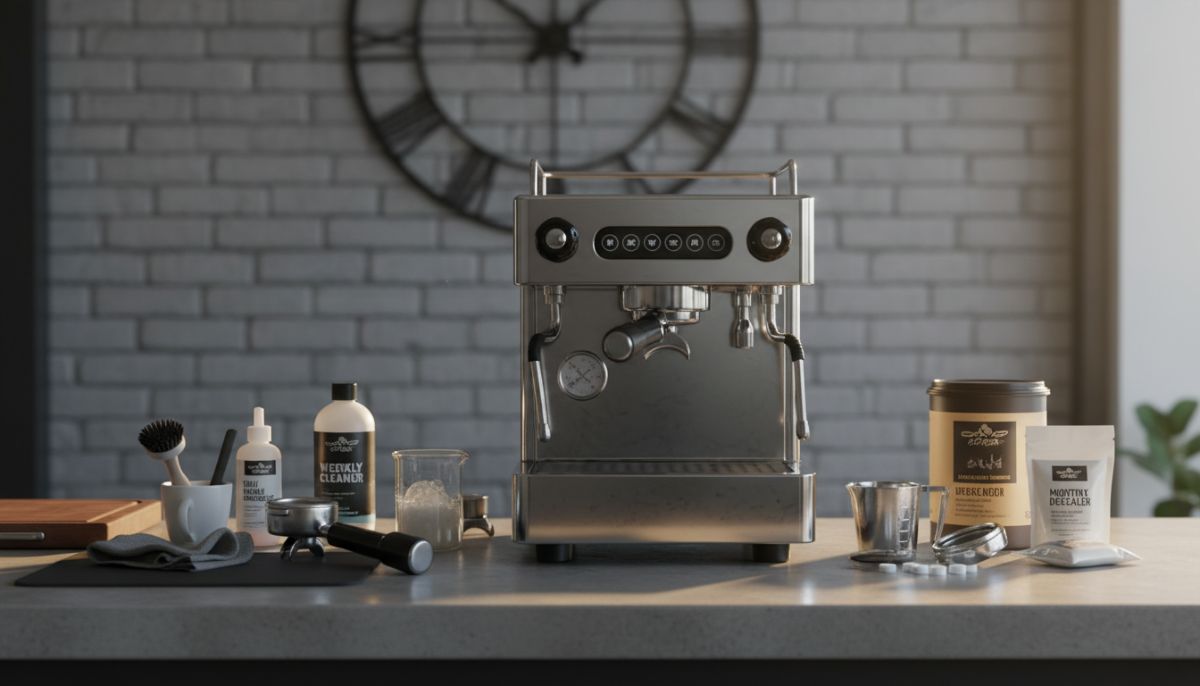
A comprehensive guide to espresso machine maintenance. Discover the essential daily, weekly, and monthly rituals that protect your investment and ensure every shot tastes perfection.
Key Takeaways:
- Daily discipline is non-negotiable: Quick purges and plain water backflushes prevent rancid oil buildup that ruins flavor.
- Water is the invisible component: Understanding your water chemistry is just as vital as cleaning to prevent scale damage.
- The grinder needs love too: A clean espresso machine is useless if your grinder is retaining stale coffee grounds.
- Preventative maintenance saves money: Routine gasket checks and descaling extend the lifespan of high-end equipment.
You have invested in high-quality beans, a precision grinder, and a beautiful espresso machine. You have spent hours perfecting your puck preparation. Yet, your morning shot tastes bitter, astringent, or oddly metallic. Before you blame the roast date or your tamping pressure, look at your equipment. When was the last time you truly cleaned it?
Cleanliness is the unglamorous backbone of exceptional coffee. Rancid coffee oils and limescale buildup are the silent killers of flavor and machine longevity. This guide—The Cleaning Manifesto—is your roadmap to keeping your setup pristine. We will break down maintenance into manageable daily, weekly, and monthly rituals so you can focus on what matters: brewing the perfect cup.
The “Why”: Flavor vs. Function
Cleaning serves two distinct purposes: preserving flavor and mechanical preservation. Coffee beans contain oils. When heated and left to sit, these oils turn rancid. If your group head is coated in old oil, every fresh shot you pull passes through a layer of sludge before hitting your cup.
Mechanically, scale buildup restricts water flow and destroys heating elements. If you are struggling to get your recipe right, a dirty machine adds variables you cannot control. Learning how to dial in espresso ratios and yield is impossible if the machine’s flow rate is compromised by blockage. Let’s get to work.
The Daily Ritual: End-of-Day Maintenance
These tasks should be performed at the end of every brewing session. They take less than five minutes but make the biggest difference in your daily cup quality.
1. The Water Backflush
Every time you stop the pump, a solenoid valve releases pressure, sucking a small amount of coffee and water back up into the group head. Over the course of a day, this builds up. Perform a “water backflush” (no chemicals) to rinse this out.
Insert your blind basket (the one with no holes) and run the pump for 10 seconds on, 10 seconds off. Repeat this 5 times. This keeps the internal pathways clear of loose grounds.
2. Scrub the Group Head
Use a dedicated group head brush to scrub the shower screen and the gasket area. Coffee grounds love to hide up around the bayonet ring (where the portafilter locks in). If these grounds harden, they can wear down your gasket and cause leaks.
3. Steam Wand Purge and Wipe
Milk residue is a bacterial breeding ground. If you leave milk to dry on the wand, it creates a crust that insulates the steam tip and reduces pressure. Worse, it can be sucked back into the boiler as the machine cools.
Always purge before and after steaming. Wipe the wand immediately with a damp cloth. If you are struggling with texture, ensure the holes in the tip aren’t blocked. Proper hygiene is the first step to mastering cafe-quality microfoam.
The Weekly Deep Clean
Once a week, you need to attack the oils that water alone cannot dissolve. This is where espresso machine detergent comes into play.
1. Chemical Backflush
Place a small amount of espresso detergent (follow the manufacturer’s instructions, usually 3 grams) into your blind basket. Run the same 10-seconds-on, 10-seconds-off cycle five times. Then, remove the portafilter, rinse it, and run the cycle again with plain water to rinse the internal valves. This dissolves the stubborn, tar-like oils inside the exhaust valve.
2. Soak the Metal
Dissolve some detergent in a bowl of very hot water. Disassemble your portafilters—pop the baskets out—and submerge the metal parts (baskets and portafilter heads) in the solution for 20 minutes. Note: Do not submerge plastic or wooden handles, as the heat and chemicals will damage them.
After soaking, scrub them with a scour pad. You will be amazed at the black residue that comes off. If your baskets are clogged, you might see flow issues. Before assuming you have a technique problem, clean your gear. Sometimes what looks like bad prep is actually a dirty screen, though knowing how to spot and fix uneven water flow is helpful for diagnosis.
The Monthly Overhaul
Monthly maintenance is about long-term health and addressing the parts of the ecosystem we often ignore.
1. The Grinder Deep Clean
We often obsess over the machine and ignore the grinder. Old coffee stuck in the chute or burrs oxidizes and ruins the fresh beans you put in the hopper. Disassemble the upper carrier and vacuum out the burr chamber. You can also use grinder cleaning pellets which are ground through to clean the burrs without disassembly.
2. Inspect the Shower Screen
Unscrew the shower screen from the group head. Even with backflushing, fines can get trapped behind the screen, affecting water dispersion. If water jets out sideways instead of raining down like a shower, it leads to channeling. Clean the screen thoroughly and hold it up to the light to ensure all holes are clear.
3. Check Your Water
Scale is the accumulation of minerals (calcium and magnesium) inside the boiler. It is the number one cause of machine failure. While descaling is a corrective measure, prevention is better.
Test your water hardness. If you are using hard tap water, you are slowly killing your machine. You must use water that is soft enough to prevent scale but has enough mineral content for flavor. Read our detailed guide on water chemistry and why tap water is a risk to understand how to balance this.
Troubleshooting via Cleaning
Sometimes, bad flavor is a diagnostic tool. If your espresso consistently tastes sour, your first instinct might be to grind finer or increase temperature. However, if the machine is dirty, the flow restriction could be causing underextraction. Always ensure the machine is clean before attempting to troubleshoot technique. If the machine is spotless and the shot is still off, then you can proceed to troubleshooting underextraction.
Conclusion
Maintenance is not a chore; it is part of the craft. By adhering to this cleaning manifesto, you ensure that the only variable in your cup is your skill and the coffee bean itself. Treat your equipment with respect, and it will reward you with delicious espresso for years to come.
Frequently Asked Questions
For home use, a chemical backflush with detergent is recommended once a week. In a high-volume commercial setting, this should be done daily at the end of the shift.
It is not recommended. Vinegar can leave a lingering taste and smell that is hard to rinse out. More importantly, the acetic acid can be too harsh for certain rubber seals and gaskets. Always use a dedicated descaling solution designed for espresso machines.
A screaming steam wand often indicates a blockage in the steam tip holes due to dried milk, or simply poor positioning. Ensure the tip is clean and purge it well. If it persists, soak the tip in warm water to dissolve milk residue.
Yes. Coffee oils stick to burrs and turn rancid, which will taint the flavor of fresh beans. Old grounds can also clog the chute, leading to retention and inconsistent dosing.