Tired of waiting for your espresso machine to heat up? Discover proven strategies to reduce idle time, from smart plug automation to active flushing routines, and learn why the ‘ready’ light is often a lie.
Key Takeaways
- The ‘Ready’ Light is Misleading: It indicates boiler water temperature, not the thermal stability of the group head or portafilter.
- Smart Plugs are Essential: Automating your startup schedule is the safest and most efficient way to ensure the machine is ready when you wake up.
- Active Flushing Works: Running ‘blank shots’ speeds up heat transfer via convection, significantly reducing wait times for E61 machines.
- Maintenance Matters: Scale buildup on heating elements acts as an insulator, slowing down recovery times.
For the home barista, few things are more frustrating than the gap between waking up and taking that first sip. You turn on your machine, but high-end equipment—specifically those utilizing E61 group heads or large boilers—requires patience. The physics of thermal mass dictates that heating water is fast, but heating heavy brass and stainless steel components takes time.
Achieving thermal stability is non-negotiable for extraction quality. If you brew before the entire hydraulic system is saturated with heat, the metal will suck energy from the brew water, resulting in sour, underextracted shots. This guide covers empirical methods to reduce that wait time and optimize your morning workflow.
The ‘Ready’ Light Lie: Water Temp vs. Metal Temp
Most consumer and prosumer machines feature a light that indicates when the boiler has reached its set temperature. Do not trust this light for brewing. It simply means the heating element has brought the water in the boiler to the target temperature. It does not mean the path from the boiler to your cup is ready.
In machines with high thermal mass, such as those with E61 group heads, heat must travel from the boiler to the group head via a thermosyphon loop. This is a passive process relying on convection. While the boiler might be ready in 10 minutes, the group head—which weighs nearly 9 pounds of brass—can take 30 to 45 minutes to fully stabilize. Brewing early leads to a massive temperature drop as the water hits the cold metal.
Strategy 1: Automation with Smart Plugs
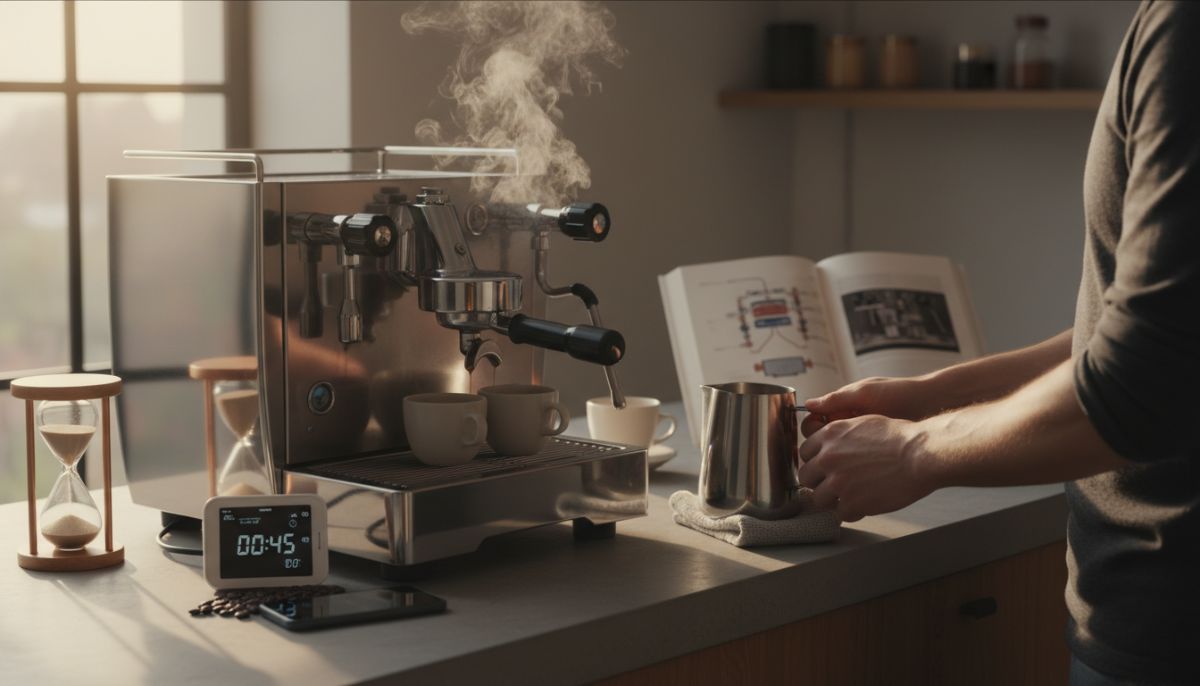
The most effective solution requires no interaction with the machine itself. A heavy-duty smart plug allows you to schedule the machine to turn on 45 minutes before your alarm goes off. This ensures the machine is fully heat-saturated by the time you walk into the kitchen.
Safety and Requirements
Not all smart plugs are suitable for espresso machines. You must verify the wattage and amperage ratings. Many dual boiler machines draw 1500W to 2000W. Ensure your smart plug is rated for at least 15A or higher to prevent overheating and fire risks. Note that this solution works best for machines with mechanical on/off toggle switches. Machines with digital standby buttons may require internal modifications or SwitchBot finger-bots to automate.
Strategy 2: Active Heating (The Blank Shot Technique)
If you cannot automate the startup, you must move from ‘passive’ heating (waiting for the thermosyphon) to ‘active’ heating. This involves forcing hot water through the cold components to transfer heat via conduction and forced convection.
- Lock in the Portafilter: Never heat a machine without the portafilter locked in the group. The portafilter is a large thermal mass that will cool your brew water if it isn’t hot.
- The Flushing Routine: Once the boiler pressure gauge indicates it is up to temp (usually 10-15 minutes), engage the pump. Run approximately 4-6 ounces of water through the group and portafilter.
- Wait and Repeat: Wait two minutes for the boiler to recover, then repeat. This cycle forces hot water through the piping and group head, actively heating the metal much faster than the passive thermosyphon loop.
This method is particularly effective for Dual Boiler or Heat Exchanger machines. However, for small single-boiler units, be careful not to deplete the boiler entirely, which can expose the heating element.
Thermoblocks vs. Boilers: Knowing Your Hardware
Your warm-up strategy depends heavily on your machine’s architecture. Thermoblock and Thermocoil machines (like many Breville models) heat water on the fly and are ready in seconds. However, the portafilter and group head still require pre-heating. For these machines, running two blank shots into your cup is mandatory to prevent heat loss during extraction.
Conversely, machines with a saturated group head often heat up faster than E61s because the group is directly connected to the boiler, removing the lag of the thermosyphon loop.
Boiler Insulation and Maintenance
If you notice your machine is taking significantly longer to heat up than it used to, you likely have a maintenance issue. Scale buildup on the heating element acts as an insulator, preventing efficient heat transfer from the element to the water. A regular descaling routine and using proper water is critical.
For hardware hackers, adding aftermarket insulation to your boiler can improve warm-up speeds and reduce energy consumption. Wrapping the boiler in melamine foam or fiberglass insulation keeps heat inside, allowing the element to cycle less frequently and reach operating temperature roughly 10-15% faster.
The Energy Debate: 24/7 vs. On-Demand
A common myth is that it is cheaper to leave an espresso machine on 24/7 than to heat it up daily. For home use, this is rarely true. The energy required to maintain 200°F (93°C) for 24 hours usually exceeds the energy cost of a single cold start.
Furthermore, leaving a machine on constantly accelerates wear on O-rings, gaskets, and plastic components due to constant heat exposure. It also increases the frequency of scale accumulation if your water chemistry isn’t perfect. Unless you are running a high-volume commercial bar, utilize a smart plug schedule rather than 24/7 operation.
Troubleshooting Slow Warm-Ups
If your machine is lagging, check these components:
- Vacuum Breaker Valve: If this sticks open, the boiler cannot pressurize, preventing the machine from reaching temperature.
- Heating Element: A failing element may still work but at reduced efficiency.
- PID Settings: If you have a PID controller, ensure the ‘P’ (Proportional) and ‘I’ (Integral) settings haven’t been altered, as this controls how aggressively the machine approaches the set temperature.
Frequently Asked Questions
Generally, no. For home machines, leaving them on 24/7 accelerates wear on gaskets and seals, increases energy costs, and poses a fire risk for vintage machines without modern safety cutoffs. A smart plug schedule is safer and more efficient.
Yes. This is called ‘active heating.’ Flushing hot water forces heat transfer via convection and conduction into the metal group head and portafilter faster than waiting for passive radiation or thermosyphon flow.
The ready light is connected to the boiler thermostat or PID. It indicates the water inside the boiler is hot. It does not account for the pounds of cold metal in the group head and portafilter that need to absorb that heat before brewing.
No. You must check the power rating. Espresso machines are high-wattage appliances (often 1500W+). Ensure your smart plug is rated for at least 15 Amps to handle the load safely.
Passively, an E61 group head takes about 30 to 45 minutes to reach total thermal stability. You can reduce this to 15-20 minutes using active flushing techniques.