
Is your espresso tasting harsh, dry, or burnt? You are likely dealing with over-extraction. Learn how to identify the signs, master the ‘Salami Shot’ technique, and prioritize your variables to pull a balanced, sweet shot every time.
Key Takeaways
- Taste First: Bitterness is distinct from sourness; it creates a dry, astringent sensation on the tongue (like unsweetened black tea).
- The Golden Rule: Do not change multiple variables at once. Adjust your ratio first, then grind size, then temperature.
- Roast Matters: Dark roasts are naturally more soluble and prone to bitterness; they require lower temperatures and shorter ratios.
- Hidden Culprit: Channeling can cause localized over-extraction, making a shot taste bitter even if it flowed quickly.
There is nothing quite as disappointing as the anticipation of a morning espresso followed by a harsh, hollow, and overwhelmingly bitter assault on your palate. It leaves your mouth feeling dry and creates an aftertaste that lingers unpleasantly.
This is the hallmark of over-extraction. Simply put, water has taken too much from the coffee puck. It has dissolved the delicious sugars and oils, but then continued to extract heavy organic compounds, tannins, and woody fibers that should have remained in the basket.
Fixing this requires a systematic approach. You cannot guess your way out of bitterness. You must diagnose, isolate, and adjust.
The Diagnosis: Is It Bitter or Sour?
Before touching your grinder, you must be certain of what you are tasting. Beginners often confuse strong, concentrated sourness (under-extraction) with bitterness.
- Sour (Under-extracted): An immediate, sharp punch to the sides of the tongue. It causes a pucker reaction, similar to biting into a lemon.
- Bitter (Over-extracted): A harsh, earthy flavor located at the back of the tongue. Crucially, it is often accompanied by astringency—a physical sensation of dryness or “sandiness” in the mouth, similar to drinking red wine or over-steeped tea.
If you are struggling to identify the difference, read our guide on troubleshooting sourness vs. bitterness to calibrate your palate before making changes.
Visual Cues of Over-Extraction
While taste is the final arbiter, your extraction flow gives you early warnings. Watch the bottom of your portafilter basket closely during the pull.
1. The Choked Shot
If the pump engages but no coffee comes out for 10+ seconds, or it drips out like thick tar, the water is struggling to pass through the puck. This excessive contact time almost always results in burnt, bitter flavors.
2. Early Blonding
As the shot progresses, the stream changes color. It starts dark brown (reddish-brown crema), moves to caramel, and eventually turns a translucent, watery yellow. This is the “blonding point.” If your stream turns blonde early but continues running to hit your target weight, you are diluting the shot with bitter water.
3. Thin Flow Rate
A healthy espresso stream looks like warm honey. An over-extracting shot often looks thin and watery, oscillating as the puck degrades.
The “Salami Shot” Technique
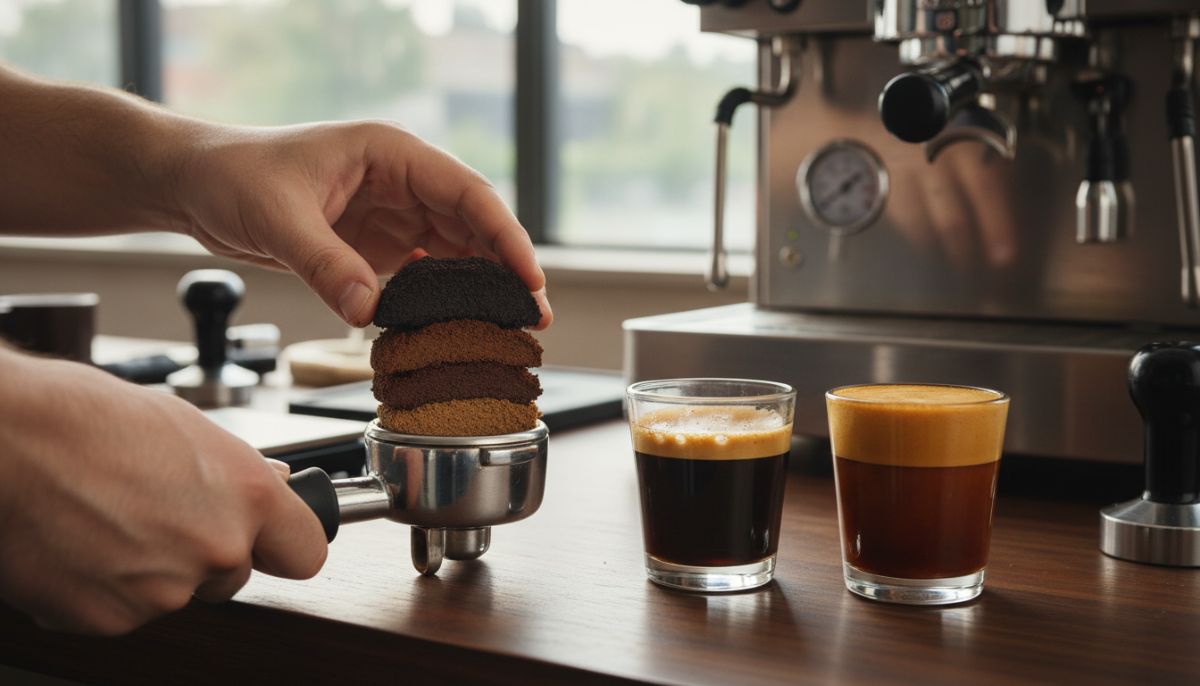
To truly understand where bitterness lives in your extraction, perform a “Salami Shot.” This splits a single extraction into three different cups to isolate flavor compounds.
- Prep: Prepare your puck as usual. Have three small cups ready.
- Start: Start the shot. Place Cup 1 under the stream for the first 10 seconds.
- Switch: Quickly swap to Cup 2 for the next 10 seconds.
- Finish: Swap to Cup 3 for the final 10 seconds. Stop the shot.
The Taste Test:
- Cup 1: Sour, acidic, salty, thick texture.
- Cup 2: Sweet, balanced, complex.
- Cup 3: Watery, bitter, dry, astringent.
Over-extracted espresso has essentially too much of “Cup 3” in the final mix. Your goal is to cut the shot before those tannins dominate.
Step-by-Step Solutions (Prioritized)
Do not change your grind, temperature, and dose simultaneously. Follow this hierarchy to fix bitterness efficiently.
1. Shorten the Ratio (Yield)
This is the easiest fix. If you are dosing 18g and extracting 45g (1:2.5 ratio) and it tastes bitter, stop sooner. The end of the shot contains the most bitterness. Try a 1:2 ratio (18g in, 36g out). If that is still bitter, try 1:1.5 (Ristretto style). This reduces the amount of solvent (water) passing through the coffee.
Learn more about the math behind this in our guide to dialing in espresso ratios.
2. Coarsen the Grind
If changing the ratio makes the shot too heavy or intense, adjust your grind. A grind that is too fine creates excessive surface area, allowing water to dissolve solids too quickly. It also slows down the flow rate, increasing contact time.
Adjust your burr grinder slightly coarser. You want to speed up the flow. If your shot took 40 seconds to pull, aim for 28–30 seconds with the coarser setting.
3. Check for Channeling (Localized Over-Extraction)
This is a common paradox: “My shot ran fast (20 seconds), but it tastes bitter. How is that possible?”
This is Channeling. If your puck prep is poor, high-pressure water finds a crack in the coffee puck and rushes through that single path. The coffee along that path gets massively over-extracted (bitter), while the rest of the puck is under-extracted. The result is a confusing mix of sour and bitter trash.
Use a WDT tool to break up clumps and ensure even density. Good distribution is not optional for modern espresso. Read about the science of puck prep to eliminate this variable.
4. Lower the Temperature
Temperature is a catalyst. The hotter the water, the more effective it is at dissolving stubborn compounds like tannins. If you have a machine with a PID controller, this is a powerful variable.
- Light Roasts: Can handle 93°C–96°C (200°F–205°F).
- Medium Roasts: 90°C–93°C (195°F–200°F).
- Dark Roasts: Drop it to 88°C–90°C (190°F–195°F).
High temperatures burn dark roasts instantly. If you brew a dark roast at 96°C, no amount of grind adjustment will fix the burnt, ash-like flavor. Stability is key here; learn why temperature stability wins over erratic thermal management.
Special Considerations: The Dark Roast Factor
Dark roasted beans have broken down cellular structures. They are highly soluble. If you treat a dark roast like a light roast, you will get bitterness every time.
For dark roasts, adopt a “gentle” approach:
- Coarser Grind: They generate more fines (dust) which clog baskets.
- Lower Temp: Keep it cool (around 90°C/194°F).
- Faster Flow: Don’t fear a slightly faster shot (e.g., 25 seconds).
Equipment: Precision Baskets and Flow
Are you using a high-flow precision basket like a VST or IMS? These baskets have more holes and require a finer grind to build pressure. However, because they allow you to grind finer, they push extraction higher (higher TDS). If your puck prep isn’t perfect, precision baskets can punish you with harshness that stock baskets might mask.
If you are a beginner struggling with bitterness, switching back to a standard basket might help until your technique improves. Compare the differences in our analysis of stock vs. precision baskets.
The Troubleshooting Flowchart
Use this logic to make your next move:
- Does it taste bitter AND feel dry? -> Yes. It is over-extracted.
- Was the shot time very long (>35s)? -> Yes. Grind Coarser.
- Was the shot time normal (25-30s)? -> Yes. Reduce Yield (Stop the shot earlier).
- Was the shot fast (<25s) but still bitter? -> Yes. This is likely Channeling. Improve Puck Prep (WDT) or check for leaks.
- Is it a very Dark Roast? -> Yes. Lower Temperature immediately.
Conclusion
Bitterness is the result of taking too much from the coffee. To fix it, you simply need to extract less. By shortening your ratio, grinding coarser, or lowering your temperature, you can balance the extraction and find the sweet spot. Trust your palate, ignore the timer if the taste tells you otherwise, and stop the shot before the blonding turns into bitterness.
Frequently Asked Questions
Bitterness is caused by over-extraction. The water has dissolved too many organic compounds, specifically tannins and plant fibers, which create a harsh, ash-like taste. This is usually due to a grind that is too fine, a water temperature that is too high, or a brew ratio that is too long.
Over-extracted espresso is bitter. It creates a drying, astringent sensation on the tongue and tastes harsh or burnt. Under-extracted espresso is sour, tasting acidic and sharp like lemon juice.
The fastest way to fix bitterness without touching the grinder is to reduce the yield. If you usually pull a 1:2 ratio (18g in, 36g out), stop the shot earlier at 1:1.5 (18g in, 27g out). Cutting the shot short prevents the final, bitter compounds from entering your cup.
Yes. Grinding finer increases the surface area of the coffee and slows down the water flow. This increases contact time and extraction efficiency, leading to higher bitterness. To reduce bitterness, try grinding slightly coarser.
Dark roasts are more soluble and contain more carbon from the roasting process. They extract very quickly. To fix this, use a lower water temperature (around 88°C–90°C) and a slightly coarser grind compared to medium or light roasts.