
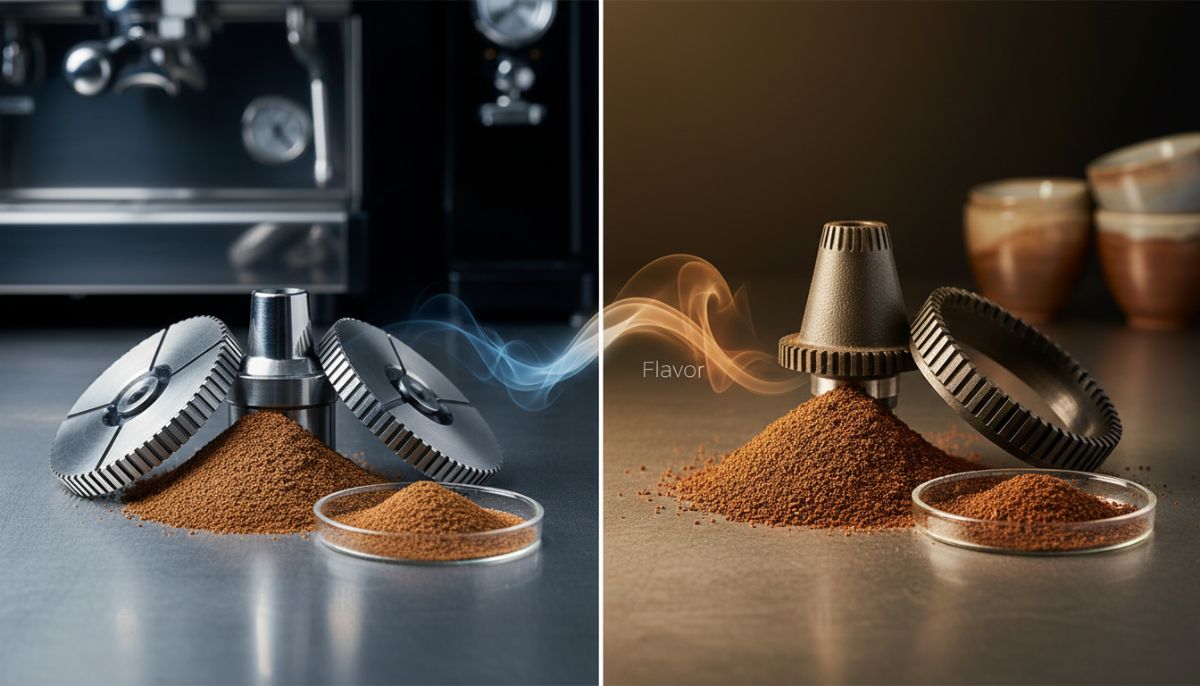
Flat vs. Conical burrs is the ultimate debate in espresso tech. Discover how grinder geometry impacts particle distribution, clarity, texture, and your final cup profile.
Key Takeaways:
- Conical Burrs: Generally produce a bimodal particle distribution, resulting in higher texture, heavier body, and a more forgiving extraction process.
- Flat Burrs: Tend toward a unimodal distribution, highlighting flavor clarity, sweetness, and acidity, but often require more precise puck preparation.
- The "Best" Choice: Depends largely on your preferred roast level (light vs. dark) and whether you value distinct flavor notes over mouthfeel.
- Workflow Impact: Flat burrs usually require higher RPMs and may retain more grounds, while conical burrs are often quieter and low-retention.
If you have fallen down the rabbit hole of home espresso, you know that the machine on your counter is only half the battle. The grinder is where the magic—or the tragedy—happens. While debates often rage about boiler types and pressure profiling, one variable silently dictates the potential of every shot you pull: the geometry of your grinder burrs.
The debate between flat and conical burrs is not just about mechanics; it is about philosophy. It asks what you value more in your morning cup: the rich, syrupy body of a traditional Italian shot, or the vibrant, fruit-forward clarity of modern third-wave espresso. Understanding how these metal disks crush coffee beans is essential for anyone looking to master their extraction.
Before you upgrade your gear, let’s break down the science of grinder geometry and how it drastically alters your espresso flavor profile.
The Basics: How Burrs Crush Coffee
At a fundamental level, all burr grinders work similarly. One burr remains stationary while the other rotates, drawing beans into the gap between them. As the beans move outward (or downward), they are crushed into progressively smaller pieces until they pass through the exit gap.
However, the path the coffee takes and the physics of the breakage differ significantly between the two styles. This difference creates distinct "particle size distributions." Even if you dial your grinder to a specific setting, not every coffee particle is the exact same size. You get a mix of boulders (larger chunks) and fines (microscopic dust). The ratio of these two determines how your water interacts with the coffee.
Before diving deep into mechanics, ensure your distinct foundation is solid. Even the best burrs cannot compensate for poor water quality. If you haven’t yet, review the basics of water chemistry and scale to ensure your canvas is clean before painting with flavor.
Conical Burrs: The Master of Texture
Conical burrs consist of a cone-shaped male burr spinning inside a hollow ring-shaped female burr. Gravity plays a huge role here, pulling the beans down through the cutting teeth. Because of this vertical design, conical burrs typically spin at a lower RPM (Revolutions Per Minute).
The Bimodal Distribution
The hallmark of a conical burr set is a bimodal particle distribution. This means the grinder produces two distinct peaks of particle sizes: a specific size of "main" grounds and a significant amount of "fines."
While "fines" are often considered the enemy in filter coffee, in espresso, they serve a vital purpose. Fines restrict water flow, creating the resistance necessary to build pressure. They also migrate to the bottom of the puck, contributing to mouthfeel.
The Flavor Profile
What does this taste like in the cup? Conical burrs excel at producing:
- Heavy Body: The fines create a thick, syrupy texture.
- Traditional Flavor: They emphasize chocolate, caramel, and nuts.
- Forgiveness: Because the fines help regulate flow, it is often easier to pull a decent shot, even if your puck prep isn’t perfect.
If you drink darker roasts or milk-based drinks like lattes, conical burrs are often the preferred choice. They cut through milk beautifully. However, if you are struggling with consistency, check your beans. Using old beans on a conical grinder can lead to flat flavors—always know how to read your coffee roast dates to ensure freshness.
Flat Burrs: The Clarity King
Flat burrs consist of two identical rings sitting parallel to each other. Beans are dropped into the center and are forced outward by centrifugal force. Because they fight gravity to push grounds out the sides, flat burrs generally require much higher RPMs to operate effectively.
The Unimodal Distribution
High-quality flat burrs strive for a unimodal distribution. This means the vast majority of the coffee particles are extremely uniform in size, with fewer fines and fewer boulders compared to conical burrs.
When the particles are uniform, water extracts from them at an equal rate. This reduces the risk of over-extracting the fines (bitterness) and under-extracting the boulders (sourness). This uniformity allows you to push extraction yields higher without hitting a wall of astringency.
The Flavor Profile
Flat burrs are the darling of the specialty coffee industry because they offer:
- Flavor Separation: You can distinctly taste the peach, jasmine, or bergamot notes in a complex bean.
- Sweetness: High extraction yields accessible via flat burrs often result in sweeter shots.
- Consistency: Once dialed in, the shots are mathematically precise.
However, this precision comes with a cost. Without the buffer of excess fines to restrict flow, flat burrs are notoriously unforgiving. If your tamping is uneven or your distribution is poor, the water will find a crack and rush through. This is why using tools like a WDT is critical. For a deeper dive, read about the science of puck prep and WDT usage.
The Workflow Trade-Offs
Beyond flavor, the physical experience of using these grinders differs.
Noise and Speed
Conical grinders are generally quieter because they spin slower. The low RPM also creates less heat friction, which protects the oils in the coffee. Flat burrs, spinning like jet engines, can be loud and may heat up the grounds in a high-volume commercial setting, though this is rarely an issue for the home barista making one or two drinks.
Retention
Flat burrs often suffer from higher retention—meaning stale grounds get stuck in the chute or around the burr carrier. This requires more frequent purging or cleaning. Regardless of which geometry you choose, old coffee oils will go rancid and ruin your profile. Make sure you incorporate burr cleaning into your monthly maintenance manifesto.
Which Grinder Geometry is Right for You?
Choosing between flat and conical burrs isn’t about which is "better"; it is about aligning your gear with your palate.
Choose Conical If:
- You exclusively drink medium to dark roasts.
- You love thick, heavy-bodied espresso (classic Italian style).
- You mostly drink milk-based beverages (cappuccinos, lattes).
- You want a quieter, lower-maintenance workflow.
- You want a grinder that is easier to dial in. If you are new to this, learning how to dial in ratios is easier with the flow-restriction help of conical fines.
Choose Flat If:
- You drink light to medium roast single-origin coffees.
- You chase "tasting notes" (fruit, florals, acidity).
- You drink straight espresso or cortados where the coffee shines.
- You are willing to perfect your puck prep technique.
- You are sensitive to "muddy" flavors and prefer a clean finish.
Troubleshooting Your Choice
Sometimes, baristas switch to flat burrs and find their shots taste sour or run too fast. This is usually because the unimodal distribution offers less resistance. You may need to grind finer than you are used to. If you encounter persistent sourness, check out our guide on troubleshooting underextraction.
Conversely, if you are using conical burrs and experiencing inconsistent flows, you might be dealing with channeling caused by an uneven distribution of those fines. Learning to spot these issues is key; refer to our article on channeling 101 to fix uneven flow.
Conclusion
The geometry of your burrs changes the architecture of your espresso. Conical burrs build a house of comfort—solid, warm, and structured. Flat burrs build a glass house—transparent, bright, and revealing.
There is no wrong answer, only a preference for how you want to experience your coffee. Assess your daily habits, your favorite beans, and your willingness to fiddle with distribution. Once you match the grinder to your taste, you will finally unlock the true potential of those beans you buy.
Frequently Asked Questions
Conical burrs are generally better for beginners. They produce more ‘fines’ (small particles) which help restrict water flow, making it easier to dial in a shot and more forgiving of imperfect puck preparation.
Not inherently. However, because flat burrs produce very uniform particles with high clarity, they can highlight acidity. If the grind is too coarse or the water too cool, this acidity can be perceived as sourness. Flat burrs typically require a finer grind setting than conical burrs.
Generally, no. Grinders are engineered specifically for one type of burr geometry due to differences in motor torque, RPM, and mounting alignment. You usually need to buy a different grinder to switch geometries.
Yes, typically. Flat burrs require a higher RPM (revolutions per minute) to expel the coffee grounds using centrifugal force, which usually results in a louder, higher-pitched operating noise compared to the slower-spinning conical burrs.