
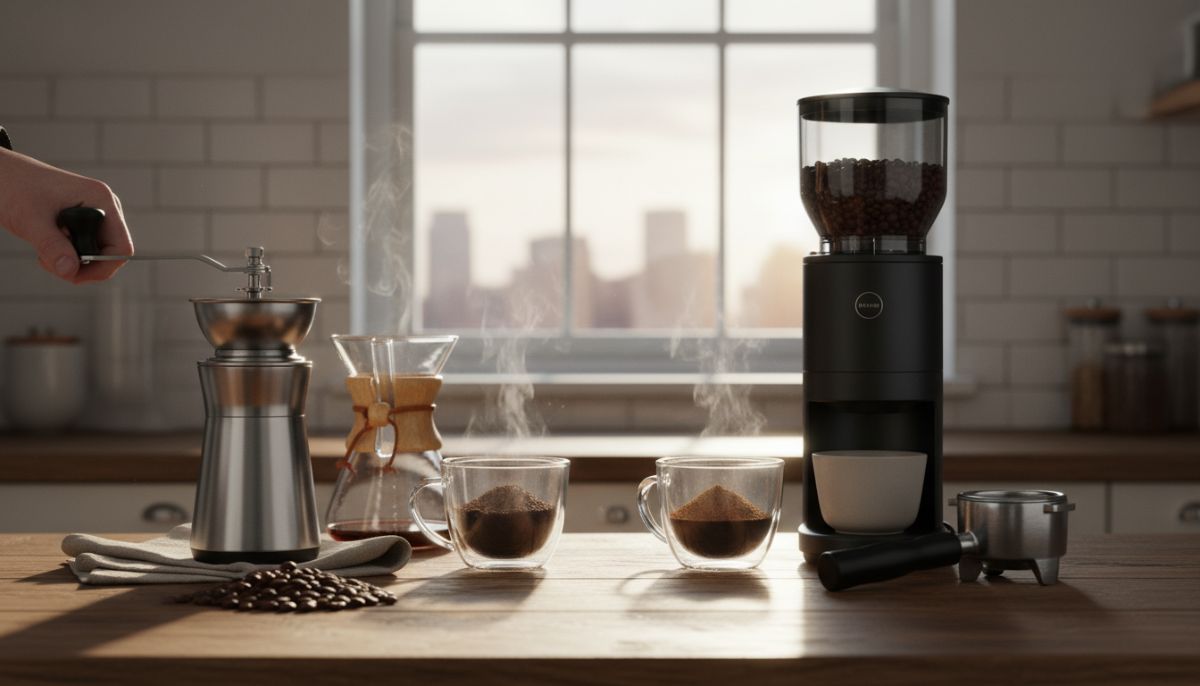
Is the workout worth the cup profile? We compare manual and electric grinders on cost, consistency, thermal stability, and workflow to help you decide.
Key Takeaways:
- Cost-to-Performance Ratio: Premium manual grinders often outperform electric grinders that cost three times as much due to superior burr stabilization.
- Thermal Stability: Low-RPM hand grinding prevents heat buildup, preserving volatile aromatics that high-speed electric motors might burn off.
- Workflow Friction: While manual grinding offers a tactile ritual, it can become tedious when dialing in new beans or serving multiple guests.
- Retention: Hand grinders generally have near-zero retention, making them ideal for single-dosing expensive specialty beans.
In the world of specialty coffee, the grinder is the single most important piece of equipment on your counter. While the espresso machine provides the pressure and temperature, the grinder dictates the texture, clarity, and sweetness of the shot. For decades, the assumption was that bigger, motorized behemoths were superior. However, a renaissance in precision machining has challenged this notion.
Today, home baristas face a polarizing choice: the convenience of a button-push electric motor or the tactile engagement of a manual hand grinder. Is the physical effort of hand grinding just a hipster affectation, or does it yield a tangible improvement in the cup? Let’s dive deep into the mechanics, flavor profiles, and workflow realities to see if manual grinding is truly worth the sweat equity.
The Value Proposition: Price vs. Particle Quality
The most compelling argument for switching to manual grinding is the cost-to-performance ratio. In an electric grinder, a significant portion of the manufacturing cost goes into the motor, the electronics, the noise insulation, and the safety certifications. In a premium hand grinder, nearly every dollar goes into the burrs, the driveshaft, and the alignment.
Consequently, a $250 hand grinder often shares the same burr geometry and cut quality as a commercial electric grinder costing upwards of $800. If you are building a setup on a budget, allocating funds to a high-end manual grinder allows you to pair it with one of the top entry-level espresso machines without sacrificing extraction quality.
By removing the motor, you aren’t paying for torque; you are paying for precision. This allows manufacturers to use high-nitrogen steel burrs and dual-bearing stabilized shafts that produce exceptionally uniform particle distributions.
Burr Geometry and Flavor Profiles
The core of the flavor debate often comes down to the burrs themselves. Most elite hand grinders utilize large conical burrs (38mm to 48mm). Conical burrs are renowned for producing a bimodal particle distribution—a mix of fines and boulders—that contributes to the heavy body and texture traditional espresso lovers crave.
While high-end electric grinders are moving toward large flat burrs for clarity and separation, finding a flat burr electric grinder that doesn’t break the bank is difficult. Hand grinders democratize access to elite conical burr profiles. However, understanding how grinder geometry changes your flavor profile is essential. If you prefer high-clarity, tea-like light roasts, a specialized flat-burr electric grinder might still be your endgame. But for rich, syrupy shots, a premium conical hand grinder is often the price-performance king.
Thermal Stability: The Low RPM Advantage
One often-overlooked factor in grinding is heat. Electric grinders, especially consumer-grade models, spin at high RPMs. This friction generates heat, which is transferred directly to the coffee grounds. Heat accelerates the off-gassing of CO2 and can volatilize delicate aromatic compounds before the water even hits the puck.
Hand grinding is inherently a low-RPM process. You are likely spinning the handle at 60 to 120 rotations per minute. This “cold grinding” process ensures that the coffee grounds remain at room temperature throughout the fragmentation process. This preservation of volatiles can result in a noticeably sweeter and more complex aroma, particularly with delicate single-origin beans.
The Workflow Reality Check
While the flavor benefits are tangible, the workflow impact is undeniable. Grinding 18 grams of light-roast beans for espresso at a fine setting requires significant physical effort. It is not just about the time; it is about the torque required to crush dense beans.
If you drink one or two espressos a day, the ritual can be meditative. It forces you to slow down and connect with the process. However, if you frequently entertain guests or need to make back-to-back lattes for a family breakfast, hand grinding quickly becomes a bottleneck.
Furthermore, the learning curve can be steep. When you are learning how to dial in espresso ratios, you might sink five or six shots in a row. With an electric grinder, this is a matter of pushing a button. With a hand grinder, it is a forearm workout that might discourage you from making that final, necessary micro-adjustment.
Retention and the Single-Dosing Era
Modern espresso theory emphasizes freshness. We obsess over roast dates and proper storage. Ideally, you want to grind exactly what you need for the shot, with zero old grounds left in the chamber (retention). Old grounds oxidize and ruin the flavor of your fresh beans.
Most electric grinders, unless specifically designed for single-dosing, have nooks and crannies where grounds accumulate. You often have to purge a few grams of coffee to clear the chute, which is wasteful. Hand grinders are the original single-dosing zero-retention tools. Because the path from burr to catch cup is a straight vertical drop, you get out exactly what you put in.
This makes hand grinders incredibly efficient for those who rotate beans frequently. You can switch from a decaf to a single-origin Ethiopian without any cross-contamination, ensuring you get the most out of your coffee regardless of the coffee roast dates.
Counter Space and Portability
For those living in urban apartments, real estate on the kitchen counter is a luxury. An electric grinder is a permanent fixture that requires a power outlet and clearance. A hand grinder, by contrast, can be tucked into a drawer or displayed on a shelf, taking up minimal footprint.
This fits perfectly into the philosophy of the compact kitchen setup. Furthermore, the portability allows you to take your espresso game on the road. Combined with a manual lever machine or a travel brewer, a good hand grinder ensures you never have to suffer through hotel coffee again.
Durability and Maintenance
Electric grinders have capacitors, switches, boards, and motors that can fail over time. A manual grinder is a simple mechanical system. With regular cleaning and occasional burr calibration, a quality hand grinder can virtually last a lifetime. There are fewer points of failure.
Maintenance is also generally simpler. Disassembling a hand grinder to brush out the burrs usually requires no tools, whereas deep cleaning an electric grinder can be a surgical procedure. If you value longevity and repairability, the manual route offers peace of mind.
Conclusion: Is the Squeeze Worth the Juice?
So, is manual grinding worth the flavor payoff? If your priority is maximizing flavor per dollar, the answer is a resounding yes. You can achieve commercial-grade particle consistency for a fraction of the price of an electric equivalent. The resulting espresso is often sweeter, cooler, and richer.
However, you must be honest with yourself about your lifestyle. If you value speed, convenience, or entertain often, the friction of manual grinding might eventually drive you back to the convenience of electric motors. Ultimately, the best grinder is the one you enjoy using enough to make delicious coffee every day.
Frequently Asked Questions
Yes, high-quality modern hand grinders with steel burrs are specifically designed to grind fine enough for espresso, often offering micro-adjustments for precise dialing in.
It typically takes between 30 to 60 seconds to grind 18 grams for espresso, depending on the bean density (roast level) and the burr size of the grinder.
At the same price point, a hand grinder usually produces better tasting coffee because the money is spent on higher quality burrs rather than a motor and electronics.
Light roast beans are denser and harder to crack, so they require more physical effort (torque) to grind manually compared to medium or dark roasts.