
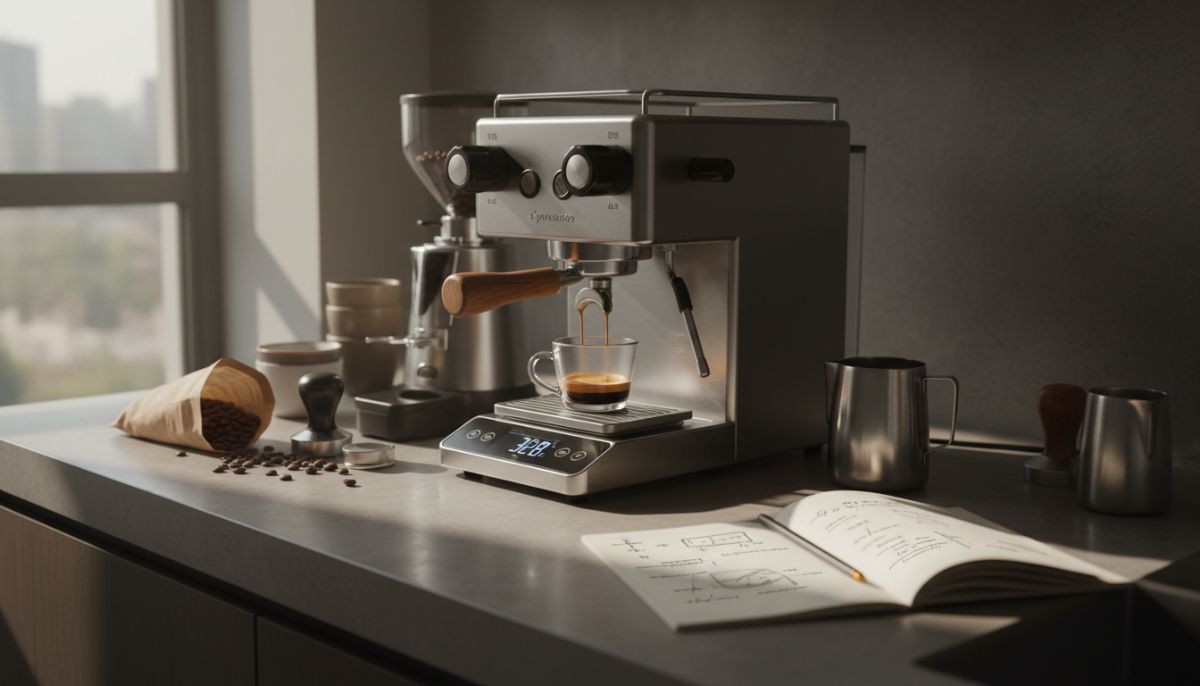
Master the art of dialing in espresso. Learn how to manipulate brew ratios, yield, and grind size to fix sour or bitter shots and achieve the perfect extraction at home.
Key Takeaways
- The Ratio Rules: A 1:2 ratio (e.g., 18g coffee to 36g liquid) is the standard starting point for modern espresso.
- Flavor Over Time: Sourness usually indicates underextraction (too fast/coarse), while bitterness signals overextraction (too slow/fine).
- Lock Your Dose: Keep your dry coffee weight constant and only change one variable—usually grind size—at a time.
- Measure Everything: Using a scale is not optional if you want consistent, repeatable results.
There is a specific moment in every home barista’s journey that changes everything. It isn’t when you buy your machine, and it isn’t when you buy your first bag of specialty beans. It is the moment you pull your first “God Shot.”
That shot is balanced, sweet, syrupy, and possesses a finish that lingers pleasantly. But replicating that shot? That is where the frustration often sets in. One day your coffee is nectar; the next, it tastes like battery acid or burnt rubber.
The solution lies in “dialing in.” This is the systematic process of adjusting variables to achieve the best flavor from your coffee. While it sounds technical, it is actually a simple scientific method based on cause and effect. In this guide, we will break down the relationship between ratios, yield, and grind size to help you master your morning brew.
The Trinity of Espresso Variables
Before you pull a handle, you must understand the three levers you can pull to change the taste of your coffee. Dialing in is simply the act of balancing these three elements.
1. Dose (The Input)
This is the weight of the dry ground coffee in your portafilter basket. Most modern double baskets are rated for 18 to 20 grams. Consistency is key here. If you change your dose, you change the resistance the water faces, which alters the entire extraction.
2. Yield (The Output)
Yield is the weight of the liquid espresso in your cup. We measure this in grams rather than volume (milliliters) because the volume varies depending on how much crema is produced. Crema is mostly gas bubbles, which weigh very little but take up space.
3. Time (The Contact)
Time is the duration of the shot, usually measured from the moment you engage the pump. While time is a crucial reference point, it is the result of your grind size and dose, not a target you should blindly chase. A bad-tasting shot that took 30 seconds is still a bad shot.
Understanding Brew Ratios
The relationship between your Dose and your Yield is called the Brew Ratio. This is your recipe. Just as a baker knows the ratio of flour to water for sourdough, a barista must know the ratio of ground coffee to liquid espresso.
The Golden Standard: 1:2
For most specialty coffees, a 1:2 ratio is the best starting point. This means for every 1 gram of coffee grounds, you aim for 2 grams of liquid espresso.
Example: 18g Dose → 36g Yield.
Ristretto: 1:1 to 1:1.5
A restricted shot. It has a heavy body and intense sweetness but less clarity. It is fantastic for milk drinks where you need the coffee to punch through the dairy.
Lungo: 1:2.5 to 1:3
A long shot. This is thinner in body but allows for higher extraction, often bringing out floral or delicate notes in lighter roasts.
Step-by-Step: How to Dial In Your Shot
Now that we understand the theory, let’s apply it. Ensure your espresso machine is fully heated, including the portafilter.
Step 1: Prep and Weigh Your Dose
Purge your grinder to ensure no stale grounds are left in the chute. Weigh out your beans to 18g (or whatever your basket is rated for). A high-quality, precision coffee grinder is essential here; if your particle size is inconsistent, dialing in becomes impossible.
Step 2: Puck Preparation
Grind your coffee into the portafilter. Distribute the grounds evenly. If the bed is sloped, water will channel through the shallow side, ruining the flavor. Use a WDT tool or distributor if you have them—these are game-changing essential barista tools for consistent extraction. Tamp firmly and evenly.
Step 3: Pull the Shot and Watch the Scale
Place your cup on a scale under the spout. Tare the scale to zero. Start the timer and the pump simultaneously. Stop the shot exactly when you reach your target yield (e.g., 36g).
Note the Time:
- Under 20 Seconds: The water flowed too fast.
- Over 35 Seconds: The water flowed too slow.
- 25–30 Seconds: You are in the ballpark.
The Taste Compass: Adjusting Grind Size
Numbers get you close, but taste gets you home. Once you have pulled a shot, taste it. Do not judge it immediately; let it cool slightly and take a sip. Your palate will tell you what to do next.
Scenario A: The Shot is Sour (Underextracted)
The Flavor: It tastes sharp, salty, lacks sweetness, and has a quick, unpleasant finish. It reminds you of biting into a lemon rind.
The Cause: The water passed through the puck too quickly, failing to dissolve enough sugars and oils.
The Fix: Grind Finer. Making the particles smaller increases the surface area and slows down the flow rate, allowing the water to extract more flavor.
Scenario B: The Shot is Bitter (Overextracted)
The Flavor: It tastes ashy, dry, astringent (like sucking on a tea bag), and hollow.
The Cause: The water spent too much time in contact with the coffee, dissolving unwanted tannins and plant fibers after the good stuff was already extracted.
The Fix: Grind Coarser. Opening up the grind allows water to flow more freely, stopping the extraction before it hits that bitter zone.
Advanced Troubleshooting
Sometimes, adjusting the grind size isn’t enough. If you are within the 25-30 second window but the espresso still tastes off, you may need to adjust the ratio.
- Increase the Yield (e.g., 1:2.2): If a shot is slightly sour but the time is correct, try letting the shot run a little longer (e.g., 40g out instead of 36g). This pulls out more sweetness.
- Decrease the Yield (e.g., 1:1.8): If a shot is slightly bitter or dry but the timing is good, cut the shot short (e.g., 32g out). This avoids the heavy tannins at the end of the extraction.
Consistency is King
Dialing in is a moving target. As your coffee beans age, they degas (release CO2), which changes how the water flows through them. You may find that a setting that worked perfectly on Monday flows too fast on Friday. You will need to make micro-adjustments to your grinder throughout the week.
Furthermore, equipment hygiene plays a massive role in flavor clarity. Old coffee oils go rancid quickly. A strict cleaning and maintenance routine ensures that you are tasting the fresh coffee, not yesterday’s residue. Backflush regularly and keep those baskets clean.
Conclusion
Dialing in espresso is a practice of patience and precision. By locking in your dose, aiming for a 1:2 ratio, and using grind size to manipulate time and taste, you can troubleshoot any bag of beans.
Remember, the “rules” are just guidelines. If a 20-second shot tastes like pure bliss, ignore the timer and enjoy the coffee. Trust your palate above all else.
Frequently Asked Questions
A 1:2 ratio is generally the best starting point. For every 1 gram of ground coffee, aim for 2 grams of liquid espresso in the cup.
Sourness typically indicates underextraction. This means the water passed through the coffee too quickly. To fix this, try grinding your beans finer or increasing the yield slightly.
Bitterness usually signals overextraction. The water stayed in contact with the grounds too long. Try grinding coarser or stopping the shot earlier (reducing yield).
Yes. Measuring by volume is inaccurate because the amount of crema varies. A scale is the only way to ensure your ratios are consistent from shot to shot.
You will likely need to make small adjustments daily or every few days as your coffee beans age and release gas, which affects flow rate.