
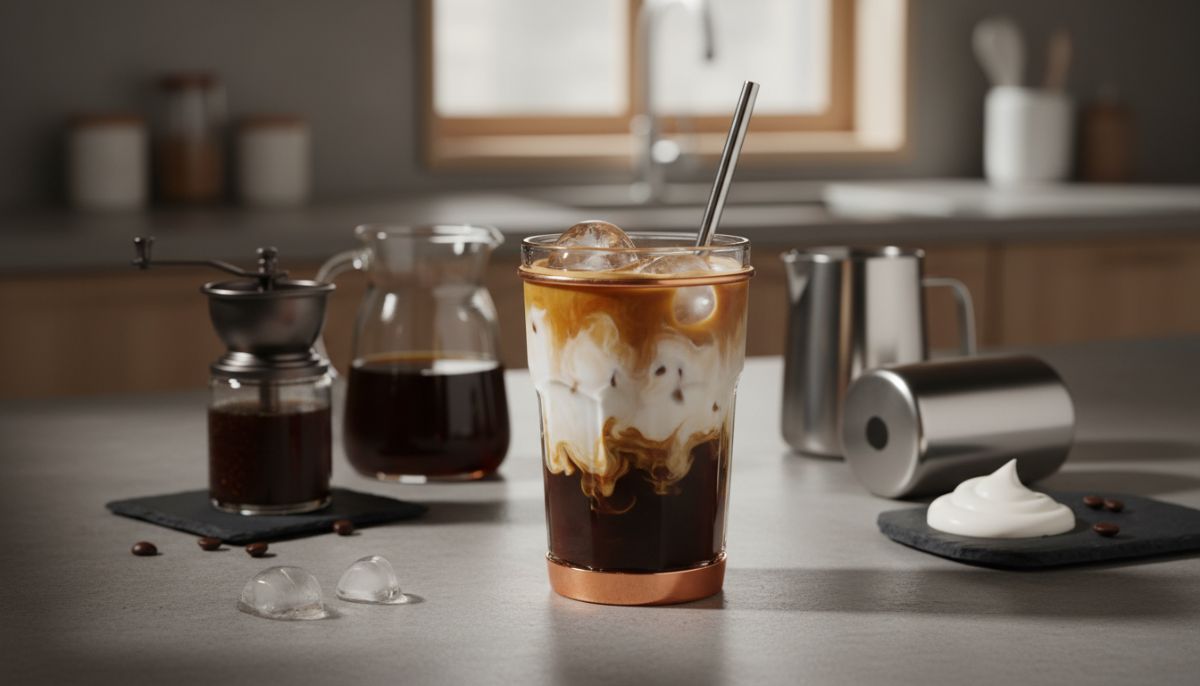
Stop settling for diluted drinks. Discover professional barista tips to make iced lattes at home that stay rich, creamy, and bold until the very last sip.
Key Takeaways
- Coffee Ice Cubes: The single most effective method to maintain flavor integrity as the ice melts.
- Espresso Ratios: Adjusting your brew ratio to be tighter (closer to 1:1.5) creates a concentrate that cuts through milk and ice.
- Temperature Management: Flash-chilling your espresso before assembly prevents immediate dilution.
- Milk Fat Matters: Higher fat content in milk creates a viscous barrier that preserves texture better than skim options.
There is nothing quite like the first sip of an iced latte on a warm afternoon. Ideally, it is a perfect balance of bold espresso, creamy milk, and refreshing chill. However, for many home baristas, the reality often falls short.
You brew your shot, pour it over ice, and watch as the ice instantly cracks and melts. By the time you add the milk, you are left with a beige, watery beverage that lacks the punch of your favorite café order. The disappointment is real, but it is also entirely preventable.
Making a café-quality iced latte at home requires a slight shift in your workflow. You cannot simply replicate your hot latte recipe and expect the same results. Physics works against you when hot liquid meets frozen water. To win this battle, you need to master temperature management and extraction intensity.
In this guide, we will break down exactly why your iced coffee tastes watered down and provide actionable strategies to fix it forever.
The Thermodynamics of Dilution
To fix watery coffee, you must first understand why it happens. When you pull a standard shot of espresso, it exits the grouphead at roughly 200°F (93°C). If you pour this directly over standard ice cubes, the thermal shock causes immediate melting.
This initial melt is the enemy. It dilutes the espresso before the milk is even introduced. Furthermore, as you sip slowly, the remaining ice continues to melt, turning the last half of your drink into coffee-flavored water.
The goal is not to stop the melting entirely—dilution is part of the drink’s balance—but to control it. You want the chill without the excess water volume.
Strategy 1: The Coffee Ice Cube Hack
This is the most popular solution for a reason: it works flawlessly. By replacing regular water ice with frozen coffee, you ensure that as the ice melts, it adds more coffee flavor rather than taking it away.
How to Make Them
Do not throw away your leftover brew from the morning. Pour it into an ice tray. If you want to get serious, brew a batch of pour-over specifically for this purpose.
For the best results, do not use weak coffee. The ice cubes should be as strong as the coffee you intend to drink. Some baristas even freeze diluted cold brew concentrate for a serious caffeine kick.
Strategy 2: Adjusting Your Espresso Recipe
If you are using the same recipe for your iced latte as you do for your hot drinks, you are setting yourself up for failure. A standard 1:2 ratio (e.g., 18g dose to 36g yield) might taste great warm, but cold temperatures suppress our perception of sweetness and body.
To counteract the numbing effect of the cold and the dilution of the ice, you need to brew a stronger, more concentrated shot.
The Updosed Ristretto
Try aiming for a ratio closer to 1:1.5. If you dose 18 grams of coffee, aim for a yield of about 27 to 30 grams. This tighter ratio results in a more viscous, intense shot that can stand up to the milk and ice.
However, be careful not to grind too fine and choke the machine. You still need an even extraction. If your flow is uneven, you will end up with sourness that stands out even more when cold. For help getting your extraction right, refer to our guide on how to dial in espresso ratios and yield.
Strategy 3: Flash Chilling the Espresso
Pouring boiling hot espresso directly onto ice is the primary cause of immediate dilution. A better approach is to bring the temperature of the espresso down before it hits your serving glass.
The Cocktail Shaker Method
Borrow a technique from bartenders. Pull your shot into a cocktail shaker or a small metal pitcher. Add two ice cubes and shake vigorously for ten seconds. Strain the liquid over fresh ice in your serving glass.
This method chills the espresso instantly. While a small amount of dilution occurs in the shaker, the liquid that enters your cup is already cold, meaning your serving ice will remain intact for much longer.
Just be aware that shaking espresso creates a massive amount of foam (similar to a “shakerato”). If you prefer a clean separation between coffee and milk, this might not be your preferred method.
Strategy 4: Cup Selection and Pre-Chilling
The vessel you drink from plays a surprisingly large role in the lifespan of your ice. A thin, single-walled glass allows heat from your hands and the room to penetrate quickly.
Consider using double-walled glass or a ceramic mug that has been kept in the freezer. Just as the anatomy of a cup and its material affect espresso taste in hot drinks, insulation is key for cold ones. Keeping the external heat out means the ice works less hard to keep the liquid cool, resulting in less melting.
Strategy 5: Check Your Puck Prep
It might seem unrelated, but if your espresso extraction is flawed, your iced latte will suffer. Channeling—where water finds the path of least resistance through the puck—results in a thin, weak shot.
If your base espresso is watery because of poor technique, no amount of coffee ice cubes will save it. Ensure you are distributing your grounds evenly. If you see spurting or uneven flow from your portafilter, you are likely experiencing channeling. Learn how to diagnose this with our article on how to spot and fix uneven water flow.
Workflow for the Perfect Iced Latte
Now that we have covered the theory, here is the step-by-step workflow to produce the best result.
Step 1: Prep Your Glass
Fill your glass to the top with ice. If you have coffee ice cubes, use them here. Pour your milk of choice over the ice until the glass is roughly three-quarters full. Leaving the milk cold in the glass helps buffer the temperature of the espresso.
Step 2: Grind and Dose
Freshness is paramount. Using beans that were ground yesterday will result in a flat, stale flavor that gets lost in the cold milk. We recommend a single dosing workflow to ensure you are grinding only what you need, exactly when you need it.
Step 3: Extract the Shot
Pull your shot of espresso. Remember to aim for a slightly tighter ratio for more body. Watch the extraction closely.
Step 4: The Pour
If you are not using the shaker method, pour the espresso slowly over the ice, not directly into the milk. Pouring over the ice helps cool the liquid slightly before it mixes. Watch as the beautiful marbling effect takes place.
Step 5: Clean Up Immediately
Sticky coffee rings dry fast in the summer heat. Knock your puck out immediately. Using a dedicated knock box keeps your station tidy and prevents you from having to run to the trash can with a dripping portafilter.
Conclusion
Preventing a watery iced latte is about respecting the ingredients. By acknowledging that ice melts and adjusting your variables—using coffee cubes, updosing your shot, and managing temperatures—you can create a drink that rivals any coffee shop.
Experiment with these variables one at a time. Start with the coffee ice cubes, as that is the easiest win. Then, try tightening your espresso ratio. Before long, you will be the master of your summer brew bar.
Frequently Asked Questions
This usually happens because hot espresso is poured directly over ice, causing rapid melting. To fix this, let your espresso cool slightly or brew it over coffee ice cubes to prevent dilution.
A standard ratio is 1 part espresso to 3 parts milk. However, because ice adds water volume, many baristas prefer a 1:2 ratio (more espresso, less milk) to keep the flavor bold.
Yes, you can. Dissolve the instant coffee in a small amount of hot water to create a concentrate, then pour it over ice and milk. It won’t have the same depth as real espresso, but it works in a pinch.
Always dissolve sugar or granular sweeteners in the hot espresso before pouring it over ice. Sugar does not dissolve well in cold liquids. Alternatively, use simple syrup.