
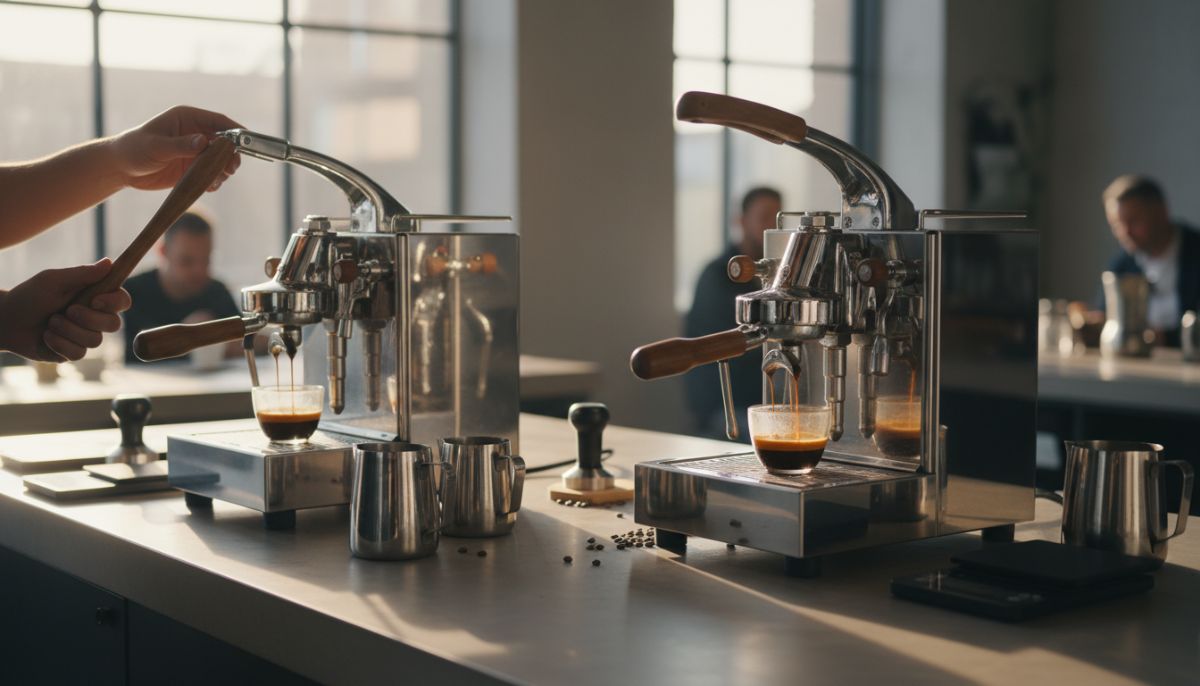
Discover the tactile world of lever espresso machines. From spring vs. direct levers to mastering pressure profiling, this guide explores how to pull the perfect manual shot.
Key Takeaways
- Total Control: Lever machines allow for real-time pressure profiling, giving you the ability to save shots that might be ruined on automatic machines.
- Spring vs. Direct: Understand the difference between the consistent decline of a spring lever and the full manual control of a direct lever.
- Tactile Feedback: The physical resistance of the lever connects you directly to the extraction process, helping you diagnose puck issues by feel.
- Simplicity & Longevity: With fewer electronic components and pumps to fail, lever machines are often built to last a lifetime.
There is a romanticism in the world of coffee that often gets lost amidst digital displays, automated volumetrics, and humming pumps. It is the connection between the barista and the bean, a relationship defined by touch, resistance, and timing. This is the domain of the lever espresso machine.
While modern pump-driven machines offer consistency and convenience, the lever machine offers something else entirely: mastery. “Pulling a shot” originated with these machines, where the barista literally pulls a lever to force water through the coffee puck. Today, we are seeing a resurgence of interest in these analog titans.
Whether you are a home enthusiast looking for the ultimate centerpiece or a purist chasing a specific flavor profile, understanding the mechanics of the lever is essential. This guide will take you through the history, the mechanics, and the technique required to master manual extraction.
The Anatomy of the Lever: How It Works
At its core, an espresso machine needs to push hot water through compacted coffee at roughly 9 bars of pressure. In a standard semi-automatic machine, an electric pump does this work. In a lever machine, that pressure is generated mechanically.
The beauty of the lever lies in its simplicity. By removing the electric pump, you remove the noise. Lever machines are whisper-quiet, providing a serene brewing experience. However, the lack of a pump means the barista (or a spring) must do the heavy lifting.
Most lever machines utilize a piston system. When the lever is raised, the piston lifts, opening a valve that lets water from the boiler fill the grouphead (pre-infusion). When the lever is lowered, the piston drives the water through the coffee. This mechanism provides a unique pressure curve that is difficult to replicate with standard pumps.
Spring Lever vs. Direct Lever
Before buying a lever machine, you must understand the two distinct categories. They offer very different experiences and require different skill sets.
Spring Piston Levers
The spring lever is the most common type found in commercial settings and high-end home machines. Here, the barista pulls the lever down to compress a heavy-duty spring. This action lifts the piston and allows water to enter the grouphead.
When the barista releases the lever, the spring expands, pushing the piston down and forcing water through the coffee. The spring delivers a consistent, declining pressure profile. It might start at 9 or 10 bars and slowly taper off to 6 bars as the shot progresses.
This declining pressure profile is highly desirable. As the coffee puck erodes during extraction, it offers less resistance. A declining pressure prevents over-extraction of bitter compounds at the end of the shot. It creates a thick, syrupy body that many espresso lovers crave.
Direct (Manual) Levers
Direct levers, like the iconic La Pavoni Europiccola, have no spring. The barista is the pump. When you lift the lever, water enters the group. When you push the lever down, you are creating the pressure.
This offers the ultimate level of control. You can ramp pressure up slowly, hold it at 9 bars, or taper it off gently. However, it also introduces the highest margin for error. Inconsistency in your physical force leads to inconsistency in the cup.
The Science of Pressure Profiling
Why go through the trouble of manual extraction? The answer lies in pressure profiling. Standard machines often hit the puck with a flat 9 bars of pressure from start to finish. Lever machines naturally allow for a “soft start” and a “gentle finish.”
This capability allows you to manipulate flavor. By extending the low-pressure pre-infusion phase, you can reduce the acidity of lighter roasts. By tapering the pressure at the end, you maximize sweetness.
However, because you are manipulating pressure, your grind consistency becomes paramount. The geometry of your coffee particles will dictate how the water flows under variable pressure. For lever enthusiasts, the choice between flat and conical burrs is a critical decision, as conical burrs often provide the texture and body that complements lever-style espresso.
Mastering the Workflow
Operating a lever machine is a dance. Here is a step-by-step breakdown of how to approach the perfect pull.
1. Temperature Management
Many home lever machines are built on heat exchanger or single boiler designs. This means temperature stability can be tricky. With direct levers, the grouphead acts as a heat sink. You may need to flush water to heat it up or turn the machine off to let it cool down if it overheats.
Temperature strips or grouphead thermometers are invaluable tools for the manual barista. You want to ensure your water is in the brewing range (usually 195°F–205°F) before you lock in the portafilter.
2. Precision Puck Prep
Lever machines are unforgiving of poor distribution. Because the water enters the group gently during pre-infusion, any weakness in the puck will be exploited when the high pressure hits. Channeling is a common enemy.
To combat this, proper puck preparation using the Weiss Distribution Technique (WDT) is essentially mandatory. You must ensure the coffee bed is perfectly uniform to provide consistent resistance against the piston.
3. The Pre-Infusion
Raise the lever. You will hear a rush of water entering the group. Hold it there. This is the pre-infusion stage. The water is wetting the puck at boiler pressure (usually 1 bar). Watch the bottom of your basket.
Once you see the first drops of espresso appear, the puck is fully saturated. This usually takes 5 to 10 seconds. This step swells the puck, healing minor cracks and preparing it for full extraction.
4. The Pull (or Release)
If using a spring lever, release the handle and let the spring do the work. If using a manual lever, apply steady, consistent force. Do not pump the lever; apply one smooth motion.
During this phase, pay attention to the flow rate. If the lever offers little resistance and sinks rapidly, your grind is too coarse. If it feels like hitting a brick wall, your grind is too fine. This tactile feedback helps in dialing in your ratios much faster than observing a liquid stream alone.
Troubleshooting the Shot
Even with practice, things go wrong. The lever machine gives you immediate feedback, but you have to know how to interpret it.
The “Sneeze”: Never unlock the portafilter immediately after a shot if the lever is still raised or if there is residual pressure. This can cause the “portafilter sneeze,” spraying hot grounds everywhere. Wait for the pressure to dissipate.
Spongy Feel: If the lever feels spongy or bouncy, there is air trapped in the grouphead. This often happens if the water level in the boiler is low or if you lifted the lever too quickly, causing cavitation. Flush the group to reset.
Spraying: If you see coffee spraying wildly from the bottomless portafilter, you are experiencing severe channeling. This is your cue to revisit your tamping technique and learn about identifying channeling to ensure a more even extraction next time.
Maintenance: The Price of Performance
One of the greatest advantages of lever machines is their durability. There are La Pavoni machines from the 1970s that are still in daily use. However, they are not maintenance-free.
The piston seals are the heart of the machine. Over time, heat and friction will dry them out. If you notice water leaking from the grouphead or a loss of pressure during the pull, it is time to lubricate or replace the gaskets.
You should follow a strict cleaning manifesto that includes keeping the piston rod clean and occasionally disassembling the group to apply food-safe silicone grease. This simple maintenance ensures your machine remains a heirloom piece rather than a landfill statistic.
Conclusion
Mastering a lever espresso machine is not the fastest way to get your morning caffeine fix, but it is arguably the most rewarding. It transforms coffee making from a push-button chore into a skilled craft.
Whether you choose the consistency of a spring lever or the total freedom of a direct manual lever, you are gaining control over variables that most machines hide away. Embrace the learning curve, respect the mechanics, and enjoy the unparalleled body and flavor that only a lever can produce.
Frequently Asked Questions
Lever machines aren’t necessarily ‘better,’ but they offer superior control over pressure profiling and often produce a shot with more body and texture. They are preferred by enthusiasts who want a tactile brewing experience.
A spring lever uses a compressed spring to generate consistent extraction pressure (usually declining from 9 bars). A manual (direct) lever relies entirely on the barista’s physical force to generate and control the pressure throughout the shot.
There is a steeper learning curve compared to automatic machines. You must manage grind size, tamp, and sometimes temperature more carefully. However, once mastered, the process becomes intuitive and highly repeatable.
A spongy feel usually indicates air is trapped in the grouphead (cavitation). This can happen if you lift the lever too fast or if the boiler water level is low. Flushing the group usually fixes this.