
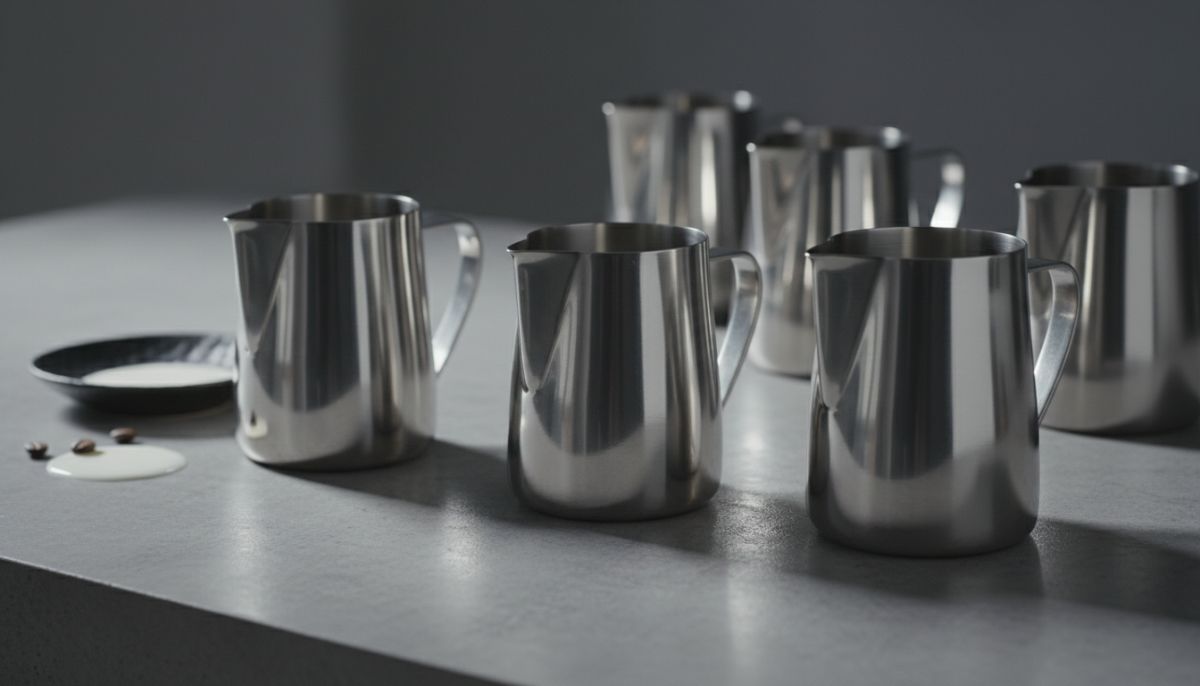
Struggling with crisp rosettas or symmetrical tulips? The secret might not be your hand, but your hardware. We break down the anatomy of milk pitchers and how spout shapes define your pouring potential.
Key Takeaways
- Spout Sharpness Defines Detail: Sharp spouts allow for fine lines and intricate patterns like rosettas, while round spouts excel at bold, symmetrical shapes like hearts and tulips.
- Flow Rate Control: The width and depth of the spout groove dictate how quickly milk exits the pitcher, directly influencing your ability to control the design’s expansion.
- Ergonomics Matter: Handle shape and pitcher weight distribution affect your wrist mobility, which is crucial for the “wiggle” motion in pouring.
- One Size Does Not Fit All: Matching pitcher volume to your cup size is essential for maintaining the correct milk-to-foam ratio.
You have dialled in your grind, your tamping is level, and your extraction is syrupy and rich. You steam your milk to the perfect temperature, yet when it comes time to pour, the result is a blob rather than a masterpiece. While technique is undeniably the biggest factor in latte art, hardware plays a massive supporting role.
The anatomy of your milk pitcher—specifically the shape of the spout—acts as the lens through which your milk flows. Just as a photographer chooses different lenses for landscapes versus portraits, a barista chooses pitchers based on the desired art style. In this deep dive, we explore the mechanics of milk pitcher design and how spout geometry impacts your pour.
The Physics of the Pour: Why Anatomy Matters
Latte art is fluid dynamics in action. It requires the controlled collision of two liquids: the espresso crema and the microfoam. To achieve high contrast and clean lines, you need to control two main variables: flow rate and proximity.
If you cannot get close enough to the crema, your milk sinks. If your flow rate is too erratic, your design washes out. The geometry of your pitcher determines how easy these variables are to manage. Before worrying about the pitcher, however, you must ensure you have the correct texture. If your milk is too bubbly or too thin, no pitcher in the world can save the pour. For a refresher on getting that paint-like consistency, read our guide on milk texturing and the difference between wet and dry microfoam.
The Spout Spectrum: Round vs. Sharp
The most defining feature of any pitcher is the spout. While there are hybrid designs, most pitchers fall into two primary categories: round spouts and sharp spouts.
1. The Round Spout (The Classic)
Classic Italian pitchers often feature a wider, rounded spout. The lip is curved and soft.
- Flow Characteristics: Round spouts generally allow for a wider, heavier flow of milk. The milk exits the pitcher in a broader stream.
- Best For: This shape is forgiving and excellent for “pushed” designs. It is the weapon of choice for hearts, rounded tulips, and stacking layers. The wider stream helps the design expand outward rapidly, creating that full, rounded aesthetic inside the cup.
- The Drawback: It is difficult to get fine detail. If you are attempting a multi-tiered swan or an intricate rosetta with 20 leaves, a round spout might feel clumsy, like drawing a fine illustration with a thick marker.
2. The Sharp Spout (The Precision Tool)
Modern third-wave coffee culture popularized the sharp, protruding spout. These pitchers often look like they have a beak.
- Flow Characteristics: The narrow channel restricts the milk flow, forcing it into a thin, precise stream. This allows you to get the spout tip incredibly close to the surface of the coffee without dumping milk too quickly.
- Best For: Intricate, line-based designs. If you want to pour a rossetta with distinct separation between the leaves, or complex designs involving drag-and-drop techniques, a sharp spout is essential. It offers high definition.
- The Drawback: It requires a steady hand. Because the stream is so thin, any jitter in your hand is magnified in the cup. It is also easier to accidentally “cut” through your design if you pour too aggressively.
The Groove and The Lip
Beyond the tip sharpness, the channel leading up to the tip—the groove—plays a vital role. A deep, long groove acts like a barrel of a gun; it straightens the trajectory of the liquid. This stabilization helps reduce turbulence as the milk leaves the pitcher.
Conversely, a pitcher with almost no groove (just a bent lip on a cup) creates a turbulent flow. This is why standard kitchen measuring jugs are terrible for latte art; the water tumbles out rather than flows.
When pouring, the stability of your crema is just as vital as the flow of your milk. A weak, thin crema will break apart under the force of the pour. To ensure your canvas is ready for the paint, consider looking into how precision baskets improve extraction to give you a thicker, more stable crema base.
Handle vs. Handle-less: The Ergonomics of Control
While the spout dictates the flow, the handle dictates your movement. The way you hold the pitcher influences your range of motion, particularly the lateral wrist flick required for rosettas.
Handle Pitchers
The traditional design. The benefit here is heat insulation; you aren’t grabbing hot stainless steel directly. However, handle placement varies. Some are large and looped, allowing for a “handshake” grip, while others are open-ended.
Key consideration: Alignment. On cheaper pitchers, the handle is not always perfectly aligned with the spout. If your handle is crooked, your art will be crooked. This is similar to the precision required in grinder calibration; even small misalignments matter. See our discussion on burr alignment to understand how mechanical symmetry impacts coffee quality.
Handle-less Pitchers
Increasingly popular in professional competitions. These pitchers are wrapped in leather or silicone to protect the barista’s hand from the heat.
- The Pro: You hold the pitcher body directly. This reduces the distance between the axis of rotation (your wrist) and the pouring point (the spout). This generally offers superior control and feedback. You can feel the vibration of the milk as you texture it.
- The Con: They can be harder to maneuver if you have small hands, as they tend to have a wider girth.
Volume and Shape: The Hidden Variables
The overall body shape of the pitcher—bell-bottomed vs. straight-walled—affects how the milk rolls during the steaming process. A bell-bottom shape encourages a vortex, making it easier to incorporate air and create silky microfoam. Straight-walled pitchers require more precise steam wand placement to achieve the same roll.
Furthermore, size matters. Using a 600ml (20oz) pitcher for a single 6oz cappuccino is inefficient and makes pouring difficult. The milk sits too low in the pitcher, forcing you to tilt it aggressively to get the milk out. This extreme angle ruins your proximity to the crema.
Steam Power Considerations
Your choice of pitcher size should also depend on your machine’s steam power. If you are using a smaller home machine with a thermoblock, steaming 600ml of milk might drain your pressure before the milk is textured. Understanding your heating system is key—compare single boiler vs. dual boiler systems to see how steam capacity limits your pitcher size choices.
Material and Weight
Standard pitchers are made of stainless steel. However, the thickness of the steel varies. Thicker steel retains heat longer but makes the pitcher heavier. A heavier pitcher dampens hand tremors (good for nervous beginners) but creates fatigue during long shifts.
Non-stick coatings (Teflon) are popular for aesthetics and cleanliness, as milk rinses off easily. However, be wary of cheap coatings that chip over time. Proper maintenance is required regardless of the coating. Neglected milk residue is a hygiene hazard and can clog your equipment. Always follow a strict cleaning routine, much like the one outlined in our cleaning manifesto.
Choosing Your Weapon
So, which pitcher should you buy? It depends on your goals.
- The Artist: If you want to pour competition-level swans and rosettas, look for a sharp spout with a defined groove. A handle-less design might offer the dexterity you need.
- The Cafe Workhorse: If you are cranking out hundreds of lattes and focus on hearts and tulips, a round spout is forgiving, fast, and consistent.
- The Beginner: Start with a standard stainless steel pitcher with a medium-sharp spout. It offers a middle ground that allows you to learn both broad and fine designs without fighting the equipment.
Conclusion
While a premium pitcher won’t fix bad milk texture or poor espresso extraction, it removes the barriers between your intention and the result. The spout shape changes the fluid dynamics of your pour, allowing you to refine your style. Whether you prefer the bold symmetry of a round spout or the intricate definition of a sharp one, understanding the anatomy of your tool is the first step toward consistent latte art.
Ready to upgrade your setup further? Once you have mastered your pour, ensure your water quality isn’t silently destroying your machine’s internals by checking our guide on water chemistry and scale buildup.
Frequently Asked Questions
For beginners, a medium-sharp or slightly rounded spout is often best. It provides a balance between control and flow rate, allowing you to practice basic hearts and tulips without the flow being too restrictive or too fast.
Yes, but it is more difficult. Round spouts produce a wider stream of milk, which makes the fine separation between the leaves of a rosetta harder to achieve. The design will likely look ‘chunky’ compared to one poured with a sharp spout.
Absolutely. You should match the pitcher size to the cup size. If the pitcher is too large for the amount of milk you are steaming, you have to tilt it too far to pour, which ruins your control and proximity to the canvas.
Handle-less pitchers allow the barista to hold the vessel closer to the spout. This shortens the distance between the pivot point (the wrist) and the pour, offering greater precision and tactile feedback on the milk’s temperature.