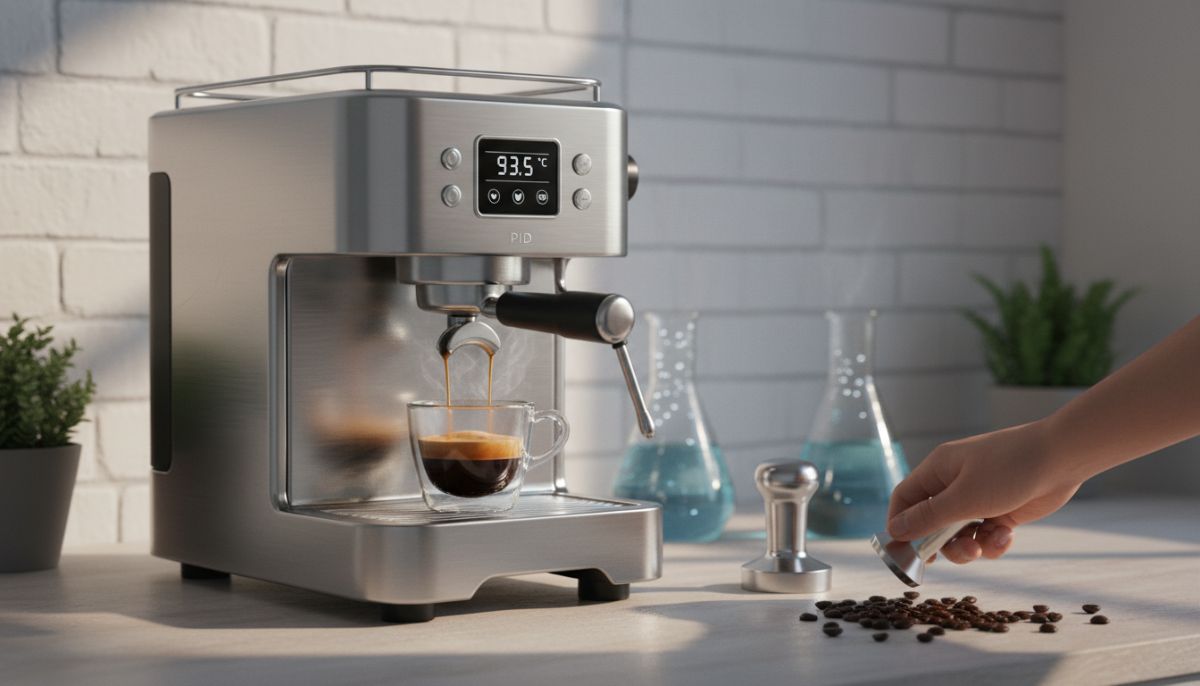
Tired of inconsistent espresso shots? Discover how PID controllers revolutionize temperature stability, eliminate temperature surfing, and unlock the true flavor potential of your coffee beans.
Key Takeaways
- Precision Control: PID controllers maintain water temperature within a fraction of a degree, unlike traditional thermostats that swing wildly.
- Consistency is King: Temperature stability is the missing link between a lucky good shot and replicable excellence.
- Flavor Profiling: Adjustable temperatures allow you to optimize extraction for different roast levels, from light to dark.
- No More Surfing: PIDs eliminate the need for complicated "temperature surfing" routines required on older machines.
You have bought high-quality beans. You have invested in a precision grinder. Your puck preparation is meticulous. Yet, despite doing everything right, your morning espresso tastes magical one day and disappointingly sour the next.
The culprit is often invisible: temperature instability.
In the world of high-end coffee, consistency is the hardest variable to master. While many home baristas focus heavily on grind size and dose, the temperature of the water hitting your coffee puck is just as critical. This is where the PID controller enters the conversation.
Often seen as a premium feature on spec sheets, the PID (Proportional-Integral-Derivative) controller is not just a fancy digital display. It is the brain that ensures your espresso machine delivers the exact thermal energy required to extract the best flavors from your coffee. Here is why temperature stability wins every time.
The Old Way: The Mechanical Thermostat
To understand the brilliance of a PID, we first need to look at what it replaces: the mechanical thermostat.
Traditional espresso machines, particularly older single-boiler models, rely on a simple bimetallic strip thermostat. Think of this like a basic light switch. When the water gets too cold, the heating element turns on at full power. When it hits the target temperature, the element turns off completely.
The problem is inertia. By the time the thermostat cuts the power, the heating element is still hot, causing the water temperature to overshoot the target. Conversely, as the water cools down, the thermostat waits until it drops significantly below the target before turning the power back on.
This creates a "sine wave" of temperature. Your boiler might be set for 200°F (93°C), but the actual water temperature could be swinging anywhere between 190°F and 210°F. If you pull a shot at the top of the wave, you burn the coffee. If you pull at the bottom, you get underextraction.
If you are struggling with inconsistency, this temperature swing is a primary suspect. Why Your Espresso Tastes Sour: Troubleshooting Underextraction often leads back to water that was simply too cold at the moment of brewing.
What is a PID Controller?
PID stands for Proportional-Integral-Derivative. While it sounds like complex calculus, its application in coffee is straightforward.
Instead of a simple on/off switch, a PID controller acts like a sophisticated cruise control for your espresso machine’s heating element. It monitors the temperature hundreds of times per second and pulses the power to the heating element in tiny increments.
The Three Pillars of Control
- Proportional (P): Handles the current error. If the temperature is far from the target, it applies more power. As it gets closer, it backs off.
- Integral (I): Handles the accumulation of past errors. If the temperature has been slightly too low for a while, the ‘I’ term ramps up the power to correct it.
- Derivative (D): Predicts future errors. It looks at how fast the temperature is changing and applies a "brake" to prevent overshooting the target.
The result is a flat line of temperature stability. If you set your machine to 201°F, a PID keeps it at 201°F, often with an accuracy of +/- 1 degree.
Why Stability Matters for Extraction
Coffee extraction is a chemical reaction. The solvent (water) dissolves compounds from the solute (coffee grounds). Like most chemical reactions, heat acts as a catalyst.
Different flavor compounds extract at different rates depending on thermal energy. Acidic, fruity notes tend to extract early, while deeper, bitter notes extract later. However, the temperature determines which compounds are most soluble.
If your temperature drops mid-shot—a common issue in machines with small boilers and no PID—the extraction energy plummets. You might start extracting the good stuff, but as the boiler refills with cold water, the temperature crashes, leaving the sweet, balancing sugars trapped in the puck.
This is why understanding your equipment is vital. When comparing Single Boiler vs. Heat Exchanger vs. Dual Boiler, you will find that while dual boilers have better inherent thermal mass, a single boiler equipped with a PID can punch well above its weight class by aggressively managing that small water volume.
The Death of “Temperature Surfing”
Before PIDs became standard on prosumer machines, home baristas had to use a technique called "temperature surfing."
This involved a ritualistic dance: flushing water to force the heating light to turn on, counting a specific number of seconds after it turned off, and then pulling the shot. It was an attempt to catch the boiler at the exact same point in its heating cycle every time.
While effective for the dedicated hobbyist, it is tedious and prone to human error. A PID removes this variable entirely. You walk up to the machine, check the display, and pull the shot. The machine does the math for you.
Dialing in Different Roasts
One of the greatest advantages of a PID is the ability to easily change the target temperature. This is crucial when you move beyond a single type of bean.
- Dark Roasts: These are more soluble and prone to bitterness. Lowering the temperature to 195°F–198°F (90°C–92°C) can reduce harshness and ashiness.
- Light Roasts: These are dense and difficult to extract. Raising the temperature to 203°F–205°F (95°C–96°C) helps extract more sweetness and acidity, preventing sourness.
This flexibility is a massive advantage when learning How to Dial In Espresso. By treating temperature as a variable—just like grind size and ratio—you gain total control over the flavor profile.
The Hidden Enemy: Scale and Sensors
It is important to note that a PID is only as good as the information it receives. The temperature probe (thermocouple) sits inside the boiler. If that probe is coated in limescale, it insulates the sensor, causing a delay in readings.
When the sensor is slow to react, the PID receives "old news," leading to overheating or temperature drops. This is why water quality is non-negotiable.
Using improper water can lead to scale buildup that cripples even the most advanced electronics. For a deep dive on this, read our guide on Water Chemistry: Why Tap Water is Killing Your High-End Machine. Protecting your sensor ensures your PID remains accurate for years.
Is a PID Worth the Investment?
If you are in the market for a new machine or considering modding an old Gaggia Classic or Rancilio Silvia, the answer is an emphatic yes.
The cost difference between a non-PID and a PID model has shrunk significantly in recent years. The value it adds—in terms of consistency, workflow speed, and unnecessary frustration—pays for itself quickly. You stop fighting the machine and start focusing on the coffee.
Conclusion
Great espresso is about removing variables. You weigh your beans to fix the dose. You use a WDT tool to fix distribution. You use a tamper to fix the bed density. Why would you leave temperature to chance?
A PID controller brings professional-grade stability to the home kitchen. It transforms temperature from a guessing game into a precise tool for flavor shaping. By ensuring that the water hitting your coffee is exactly the temperature you intended, you create the consistency required to truly master the art of espresso.
Frequently Asked Questions
PID stands for Proportional-Integral-Derivative. It is a control loop mechanism that uses three different values to maintain a precise target temperature with minimal fluctuation.
Yes, indirectly. A PID ensures temperature consistency. Consistent temperature prevents sour (under-extracted) or bitter (burnt) shots, allowing you to replicate your best shots every time.
Many popular single-boiler machines like the Gaggia Classic Pro or Rancilio Silvia can be modified with aftermarket PID kits. However, this often voids the warranty and requires some electrical knowledge.
A standard starting point is 200°F (93°C). However, you should adjust based on roast level: 195°F-198°F for dark roasts and 203°F-205°F for light roasts.
A thermostat functions like a simple on/off switch with wide temperature swings (hysteresis). A PID pulses power rapidly to maintain a specific temperature with very little variance.