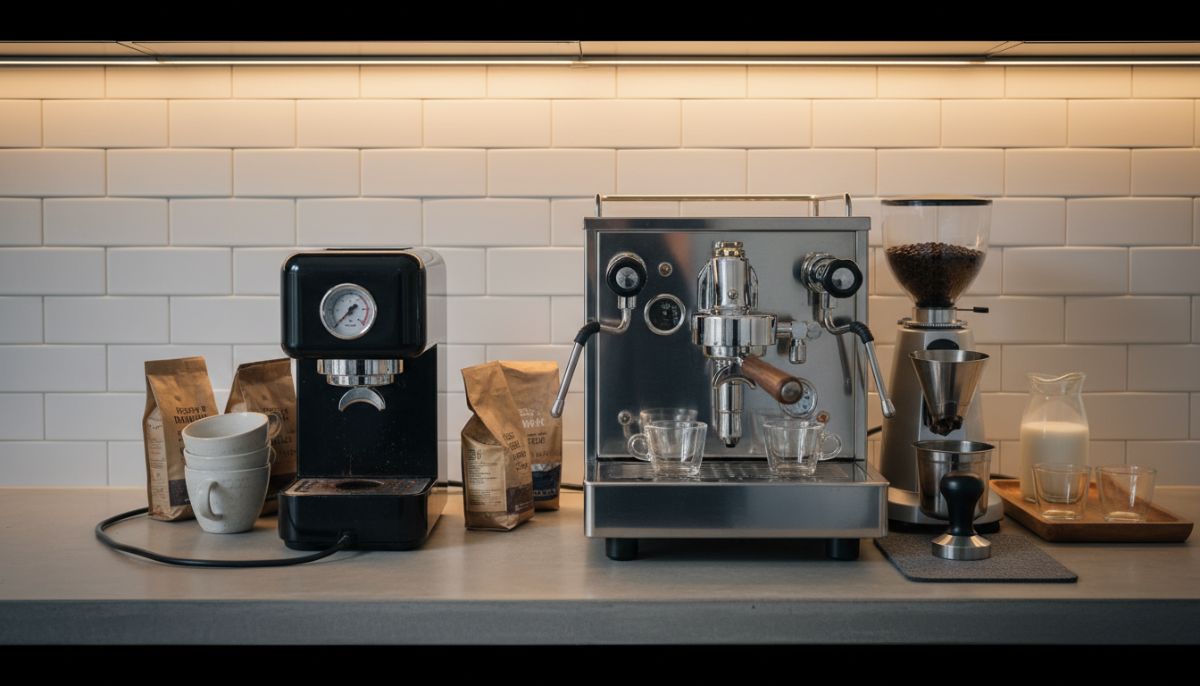
Hit a wall with your home espresso setup? Discover the 5 critical signs that you are ready to graduate from appliance-grade gear to a high-performance prosumer espresso machine.
Key Takeaways
- Consistency is King: Prosumer machines offer temperature stability that appliance-grade models simply cannot match.
- Steam Power: Upgrading means moving from weak, wet steam to powerful, dry pressure capable of latte art.
- Standardization: Gaining access to the universal 58mm ecosystem allows for better precision tools.
- Longevity: You move from disposable plastic components to repairable commercial-grade brass and copper.
There is a specific journey almost every home barista takes.
It starts with a budget-friendly machine—perhaps something you picked up at a big-box store. For the first six months, it was magic. You were making coffee at home that was better than instant and cheaper than the local chain.
But then, the plateau hit.
Suddenly, you notice your shots are sour one day and bitter the next, despite doing everything the same. You realize steaming milk for two cappuccinos takes ten minutes of waiting. You start eyeing accessories that don’t fit your portafilter.
This is the moment you transition from a coffee drinker to a hobbyist. It is the moment you realize you have outgrown “appliance grade” and are ready for the world of “prosumer” espresso.
Prosumer machines (Professional + Consumer) bridge the gap between countertop convenience and commercial capability. If you are wondering if the investment is worth it, here are the five undeniable signs you are ready to upgrade.
1. You Are Tired of Temperature Surfing
The number one killer of espresso quality is temperature instability.
Appliance-grade machines typically use small thermoblocks or tiny boilers controlled by simple thermostats. These thermostats have a wide “deadband,” meaning the water temperature might swing 10 to 15 degrees during the extraction. To combat this, users have to learn “temperature surfing”—a frustrating ritual of purging water and timing the brew button to catch the heating cycle at the right moment.
If you are trying to dial in a light roast and can’t get the acidity under control, your machine’s temperature is likely the culprit.
Prosumer machines solve this with significant thermal mass (brass boilers and group heads) and advanced technology. Most modern upgrades utilize PID controllers for temperature stability. Unlike a simple thermostat, a PID algorithm actively monitors and adjusts the heating element to keep your water at exactly 200°F (or whatever you set it to) within a fraction of a degree.
When you stop blaming your beans and start blaming your boiler, it’s time to upgrade.
2. Your Milk Texture is Holding You Back
Have you watched videos of baristas creating silky, paint-like milk in seconds, while you are stuck staring at a wand that dispenses bubbly, watery foam?
Appliance machines often suffer from two steaming issues:
- Lack of Power: They take a long time to build pressure, and that pressure drops rapidly once you open the steam valve.
- Wet Steam: Thermoblocks often pulse water into the heating element, resulting in steam that carries a lot of liquid water. This dilutes your milk and prevents the rolling vortex needed for microfoam.
A prosumer machine with a dedicated service boiler provides a constant supply of dry, high-pressure steam. This is essential for creating cafe-quality microfoam that is sweet, creamy, and capable of intricate latte art.
3. The Workflow Bottleneck: Brew, Wait, Steam
If you only drink straight espresso, a single-boiler appliance is fine. But if you entertain guests or make milk drinks daily, the workflow of a basic machine can be soul-crushing.
On an entry-level single-boiler machine, you cannot brew coffee and steam milk at the same time. You must brew your shot, flip a switch to “steam mode,” and wait for the temperature to rise. After steaming, you must purge the boiler and refill it with cold water to bring the temperature back down for the next shot.
This delay ruins the crema on your espresso and makes making two lattes a 15-minute chore.
Prosumer machines generally fall into the Heat Exchanger (HX) or Dual Boiler categories. Both designs allow for simultaneous brewing and steaming. Understanding the difference between a single boiler, heat exchanger, and dual boiler is critical for choosing your next machine. If the waiting game is ruining your morning routine, a Dual Boiler or HX machine is the answer.
4. You Have “Accessory Envy” (The 58mm Standard)
This sounds superficial, but it is actually a matter of physics and precision.
Most appliance machines use proprietary portafilter sizes, commonly 51mm or 54mm. While capable, these smaller diameters create a thicker puck of coffee for the same dose, which increases the risk of channeling (water finding a path of least resistance).
The commercial standard is 58mm. When you upgrade to a machine with a 58mm group head, you unlock the entire world of professional barista tools. We are talking about:
- High-Flow Baskets: Switching to precision baskets like VST or IMS can drastically improve extraction clarity.
- Precision Tampers: Tools that fit the basket perfectly edge-to-edge.
- Puck Screens and Distribution Tools: Advanced tools to refine your puck prep.
If you find yourself browsing forums looking for 54mm hacks to make your gear work better, you are ready for the industry standard.
5. You Want a Machine That Can Be Fixed, Not Replaced
Appliance-grade espresso machines are built much like toasters or microwaves. They are mostly plastic, assembled with proprietary clips, and designed to be disposable. If a pump fails or a board fries after three years, the cost of repair often exceeds the value of the machine.
Prosumer machines are built like tanks. They utilize commercial-grade components—brass fittings, copper piping, and heavy stainless steel chassis.
Take the classic E61 grouphead, for example. It was invented in 1961 and is still used today on high-end machines because it is mechanically simple, thermally stable, and entirely repairable.
Furthermore, upgrading often gives you the choice between rotary vs. vibratory pumps. While appliance machines always use loud vibratory pumps, high-end prosumer gear often features rotary pumps, which are whisper-quiet and allow you to plumb the machine directly into your water line.
Conclusion: Is It Worth the Cost?
Moving from a $400 machine to a $1,500 or $3,000 machine is a leap. However, the value proposition is clear.
An appliance machine is a consumer electronic device with a lifespan of 3-5 years. A prosumer machine is an investment in mechanical engineering that can last 15-20 years with proper maintenance. Beyond the longevity, the immediate jump in cup quality and consistency is often shocking to new owners.
If you found yourself nodding along to these five signs, your skills have likely outpaced your equipment. It is time to stop fighting your machine and start enjoying the coffee.
Frequently Asked Questions
Appliance grade machines are mass-produced with plastic components, thermoblocks, and are designed for convenience and low cost. Prosumer machines use commercial-grade parts (brass/copper boilers, rotary pumps), offer standard 58mm sizing, and prioritize temperature stability and steam power.
It depends on your budget and habits. Dual Boilers offer the best temperature control and allow simultaneous brewing and steaming with no cooling flush required. Heat Exchangers are cheaper and compact but may require a ‘cooling flush’ to manage brew temperature.
Yes, primarily due to consistency. The stable temperature and pressure provided by prosumer machines allow you to extract flavors that cheaper machines often miss, resulting in less sourness or bitterness.
They require more maintenance than a drip coffee maker (backflushing, descaling, gasket changes), but because they are built with commercial parts, they are easier to repair and can last for decades.