
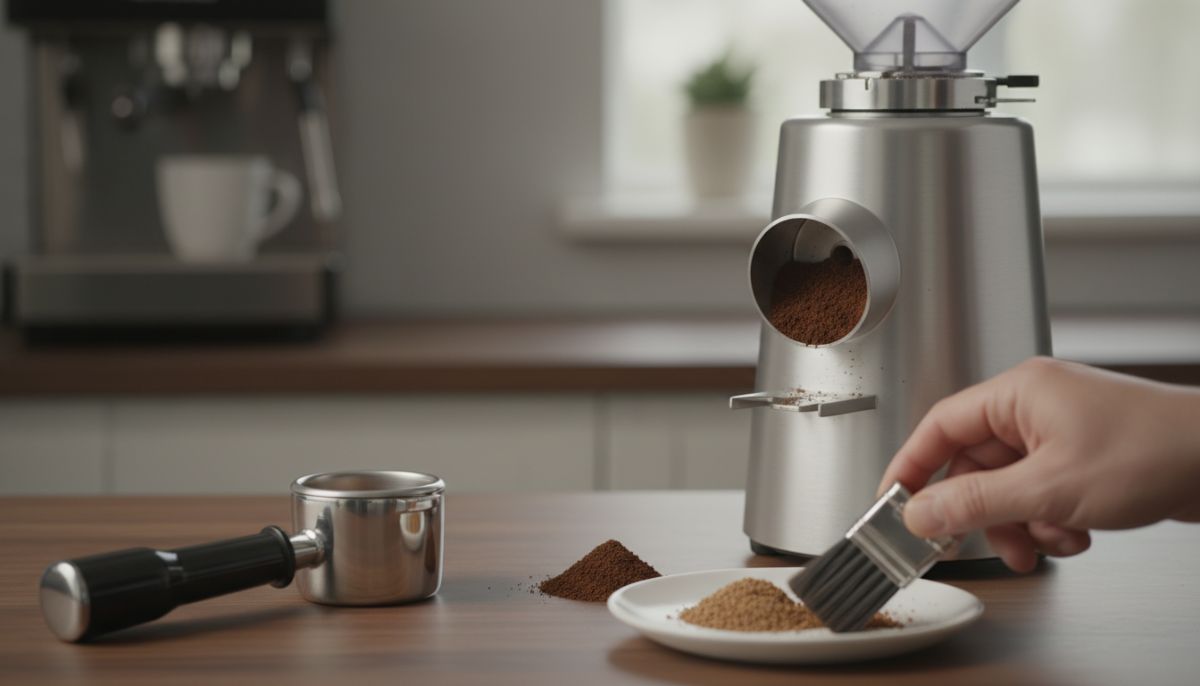
Is your morning espresso tasting off despite fresh beans? Hidden grounds inside your grinder might be the culprit. Learn why purging is essential for peak flavor.
Key Takeaways
- Retention is inevitable: Almost all electric grinders hold onto a small amount of coffee after grinding.
- Exchange vs. Retention: The real enemy is “exchange,” where old, stale grounds are pushed out by fresh beans into your portafilter.
- Purging is essential: Discarding a small amount of coffee before your first shot of the day ensures you are brewing with fresh grounds.
- Workflow matters: Single-dosing workflows minimize this issue, while hopper-fed setups require more diligent purging.
You have bought high-quality, freshly roasted beans. You have invested in a prosumer espresso machine. You have carefully calculated your yield. Yet, that first shot of the morning tastes flat, slightly astringent, or just plain "off."
Before you blame the beans or your tamping technique, look at your grinder. Specifically, look at what you can’t see: the grounds hiding inside the grind chamber.
Grinder retention is the silent killer of great espresso. It is the reason your first shot often flows faster or tastes worse than the second. If you aren’t purging your grinder daily, you are likely brewing with a mix of fresh coffee and stale, oxidised grounds from yesterday morning.
Here is why retained grounds matter and how to fix your workflow for the ultimate flavor clarity.
What Exactly is Grinder Retention?
In the world of precision coffee, retention refers to the amount of ground coffee that stays inside the grinder after the motor stops. It gets stuck in the chute, trapped behind the burrs, or electrostatically clung to the walls of the grind chamber.
There are two types of retention to understand:
- Total Retention: The total mass of coffee trapped inside a clean grinder after use.
- Exchange Retention: The amount of old coffee that gets pushed out when you grind a new dose.
Total retention is annoying because it wastes coffee. However, exchange retention is the flavor killer. If your grinder retains 3 grams of coffee, and you grind 18 grams for your morning shot, up to 3 grams of that dose could be stale coffee from 24 hours ago. That is nearly 17% of your puck!
The Science of Stale: Why "Yesterday’s Coffee" Ruins the Shot
Ground coffee loses its volatile aromatics exponentially faster than whole beans. Within minutes of grinding, oxidation begins to degrade the flavor compounds. Within 24 hours, those grounds are effectively stale.
When you mix stale, dried-out grounds with fresh ones, you create an uneven extraction. The stale grounds absorb water differently than the fresh ones, often leading to channeling or uneven flow. This inconsistency makes it incredibly difficult to troubleshoot flavor issues.
If you have ever been confused by flavor notes and wondered why your shot tastes strange, you might be diagnosing the wrong problem. For a deeper dive into taste diagnosis, read our guide on why your espresso tastes sour and how to troubleshoot it. Often, the sourness comes from the underextraction of fresh beans mixed with the over-extraction of stale fines.
The Solution: The Daily Purge
The most effective way to combat retention in a standard hopper-fed grinder is the "purge."
Purging simply means grinding a small amount of coffee and discarding it before you grind your actual dose for brewing. This pushes the old, retained grounds out of the chute and ensures the chamber is primed with fresh coffee.
How to Purge Correctly
- Turn on the grinder: Let it run for a second.
- Grind a small amount: Usually, 2 to 5 grams is sufficient, depending on the size of your grinder. Commercial grinders with large chutes may need more; home grinders usually need less.
- Discard: Throw these grounds away or save them for compost. Do not use them for brewing.
- Grind your dose: Now, grind your full 18-20g dose into your portafilter.
While this wastes a small amount of coffee, the improvement in cup quality is worth the cost. It effectively resets your grinder to "fresh" status.
Workflow Wars: Single Dosing vs. Hoppers
The annoyance of wasting coffee has led to a massive shift in home barista trends: the rise of single-dosing.
Single-dosing grinders are designed with low-retention chambers, bellows to blow out fines, and straight-through chutes. The goal is "Zero Retention" (or as close to it as physics allows). If you put 18.0g in, you want 18.0g out.
If you are tired of purging and wasting expensive beans, you might want to consider switching your equipment workflow. We explore the pros and cons of these setups in our article on single dosing vs. hopper fed grinder workflows.
Burr Geometry and Design
Not all grinders retain coffee equally. The physical design of the burrs and the angle of the motor play a significant role.
Large flat burrs, while excellent for flavor clarity and unimodal particle distribution, often require larger grind chambers which can trap more coffee. Conical burrs often rely on gravity more efficiently but can still hide grounds in the crevices.
Furthermore, the geometry affects not just retention, but the flavor profile itself. If you are debating which burr type suits your palate, check out our comparison of flat vs. conical burrs and how they change your espresso. Regardless of the type you choose, keeping them clean is paramount.
The Manual Alternative
If the idea of purging waste bothers you, and electric single-dosing grinders are out of your budget, there is another solution: manual grinding.
High-end hand grinders generally have incredibly low retention because there is no complex chute or electronic componentry for grounds to stick to. You grind directly into the catch cup. It requires more elbow grease, but the efficiency is unmatched.
Is the effort worth it? Read our analysis on hand grinders vs. electric and the flavor payoff to see if a manual workflow fits your morning routine.
Impact on Dialing In
Retention does not just hurt flavor; it hurts your ability to dial in a recipe. Imagine you adjust your grind setting finer because your shot was running too fast.
If your grinder retains 4 grams of coffee, the first shot you pull after adjusting the knob will still contain 4 grams of the previous coarser setting. You might think the adjustment didn’t work, so you go even finer. Suddenly, the next shot chokes the machine completely.
To avoid chasing your tail, you must purge after every grind adjustment. This ensures the grounds in the basket actually correspond to the setting on the dial. Mastering this is a crucial step in learning how to dial in espresso ratios and yield.
Maintenance is Key
Purging handles the day-to-day "exchange," but it does not replace the need for deep cleaning. Oils accumulate over time, becoming rancid and sticky, which causes even more grounds to stick to the chamber walls.
Just as you descale and backflush your espresso machine, you must brush out and vacuum your grinder regularly. A clean grinder retains less coffee and produces fluffier, clumpless grounds.
Conclusion
Ignoring grinder retention is one of the most common mistakes home baristas make. It introduces a variable of stale coffee that undermines the precision you strive for with expensive machines and high-quality beans.
Whether you choose to purge a few grams every morning or switch to a dedicated single-dosing grinder, addressing retention is non-negotiable. Your palate will thank you when that first shot of the day tastes just as vibrant and sweet as the second.
Frequently Asked Questions
For most home grinders, purging 2 to 4 grams is sufficient to clear the chute. Commercial grinders with larger chambers may require purging up to 7 grams.
Ideally, no. Single-dose grinders are designed to have near-zero retention. However, using a bellows (air puffer) at the end of the grind is usually necessary to ensure the very last fines are expelled.
You should not use them for espresso as they are stale. However, they can be collected and used for garden compost or as an exfoliating body scrub.
Yes. When you change your grind setting, the old particle size remains in the chamber. You must purge after every adjustment to ensure the new setting is actually being produced.