
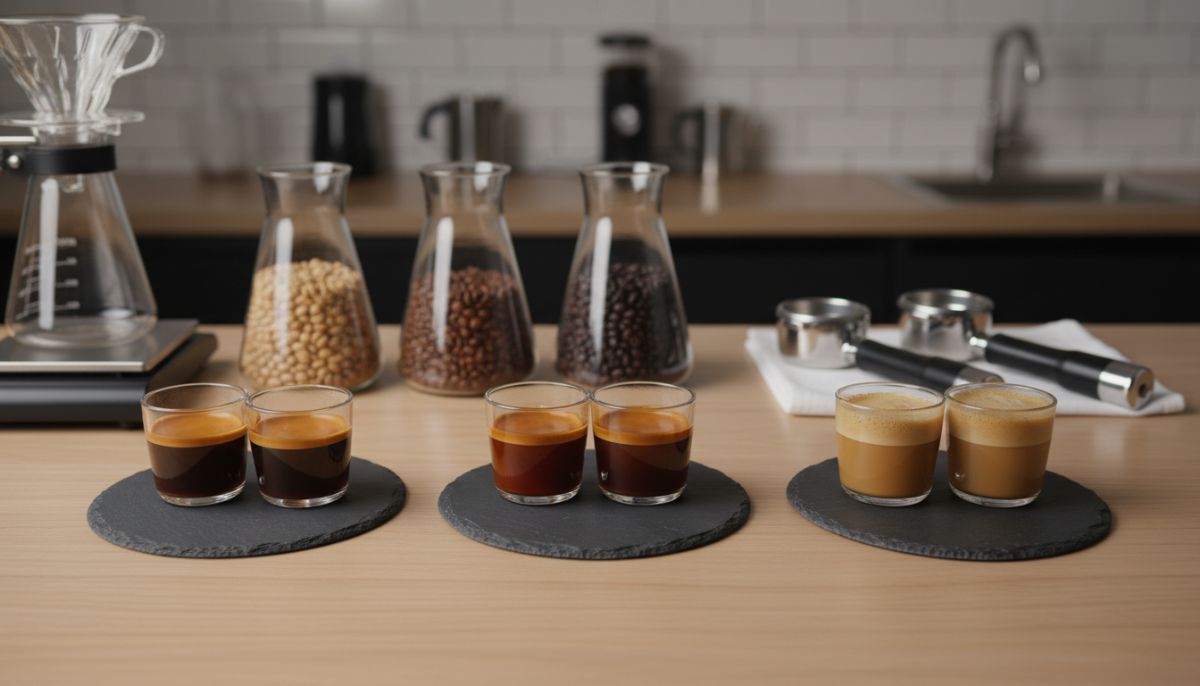
Stop guessing your ratios. Learn the specific science behind Ristretto (1:1) and Lungo (1:3) extractions and how to map them to Light, Medium, and Dark roasts for the perfect flavor balance.
Key Takeaways
- The Ratio Defines the Drink: A Ristretto is typically a 1:1 to 1:1.5 ratio (high body, low clarity), while a Lungo is a 1:3 ratio or higher (high clarity, lower body).
- Roast Matters: Dark roasts differ chemically from light roasts. Dark roasts require restricted water flow (Ristretto) to avoid bitterness; light roasts need extended water contact (Lungo) to extract sweetness.
- Grind Size is Critical: You cannot effectively switch between Ristretto and Lungo without adjusting your grinder. Ristrettos require finer grounds; Lungos require coarser grounds to prevent over-extraction.
- Caffeine Content: A Lungo generally contains more total caffeine than a Ristretto because the increased water volume extracts more compounds from the grounds.
Introduction: It Is Not Just About Size
Most home baristas view the difference between a Ristretto and a Lungo simply as the amount of liquid in the cup. While volume is the visible difference, the actual chemical divergence occurs in extraction efficiency and solubility.
If you are brewing a light roast Kenyan coffee as a tight Ristretto, you are likely tasting sour, saline battery acid. Conversely, pulling a dark Italian roast as a long Lungo introduces dry, ashy bitterness. To master espresso, you must move beyond the default settings on your machine and understand the relationship between roast profile and brew ratio.
This guide abandons the vague “short shot” definitions and focuses on mass-based recipes (grams in vs. grams out) to help you dial in the perfect shot for your specific bag of beans.
Defining the Terms: Ristretto vs. Normal vs. Lungo
In modern specialty coffee, we define these drinks by their Brew Ratio. This is the relationship between the dose of dry coffee and the weight of the liquid espresso in the cup.
1. The Ristretto (Restricted)
- Ratio: 1:1 to 1:1.5
- Recipe Example: 18g Dose → 18g to 27g Yield.
- Profile: Intense body, syrupy mouthfeel, lower clarity, diminished acidity.
- TDS (Total Dissolved Solids): Very High (12% to 15%+).
2. The Normale (Standard Espresso)
- Ratio: 1:2
- Recipe Example: 18g Dose → 36g Yield.
- Profile: Balanced body and clarity. The standard starting point for dialing in.
3. The Lungo (Long)
- Ratio: 1:3 to 1:4
- Recipe Example: 18g Dose → 54g to 72g Yield.
- Profile: Thinner body, high clarity, distinct flavor notes, higher extraction yield.
- TDS: Lower (7% to 9%), but higher total extraction.
To achieve these ratios accurately, you must use a scale. If you are still timing shots without weighing them, refer to our guide on mastering the espresso ratio before proceeding.
The Chemistry of Roast Profiles
Why do we pair specific roasts with specific ratios? It comes down to solubility.
Dark Roasts: High Solubility
Dark roasted beans have been exposed to heat longer, breaking down the cellular structure and creating a porous bean. The solids in dark roasts dissolve into water rapidly. If you expose them to too much water (a Lungo), you will extract harsh tannins and ashy flavors.
Light Roasts: Low Solubility
Light roasts retain a dense cellular structure. They are stubborn. It takes more work (heat, time, and water solvent) to dissolve the sugars and desirable acids. If you restrict the water (Ristretto), you will only extract the easily accessible sour acids, missing the sweetness that comes later in the extraction.
The Roast-to-Ratio Mapping Guide
Use this chart as your baseline for dialing in new beans. This approach solves the common pain points of sourness in light roasts and bitterness in dark roasts.
1. The Dark Roast Strategy: The Ristretto Approach
- Target Ratio: 1:1.2 to 1:1.5
- Why: You want to restrict flow to capture the rich oils and chocolate notes while cutting the shot before the bitter, burnt flavors solubilize.
- Temperature: Lower (195°F / 90.5°C) to further prevent over-extraction.
- Grind: slightly finer than standard to maintain pressure with less water flow.
- Crema: You will see a thick, dark, tiger-striped crema due to the high presence of CO2 and oils.
2. The Medium Roast Strategy: The Balanced Center
- Target Ratio: 1:2
- Why: Medium roasts strike a balance between structural density and developed sugars. The standard 1:2 ratio usually provides the best compromise between body and flavor clarity.
- Temperature: Standard (200°F / 93°C).
3. The Light Roast Strategy: The Lungo Approach
- Target Ratio: 1:2.5 to 1:3
- Why: To access the complex floral and fruit volatiles in a light roast, you need to push extraction higher. The extra water acts as a solvent to pull out the sweetness that balances the natural acidity.
- Temperature: Higher (208°F / 97°C) to aid solubility.
- Grind: Slightly coarser than standard. If you keep the grind fine and push 54g of water through, you risk channeling and astringency.
- Crema: Expect a thinner, paler crema. This is normal for light roasts and high ratios; it does not indicate a bad shot.
Detailed Brewing Recipes
Recipe A: The Classic Italian Ristretto (For Dark Roasts)
- Roast: Dark / Italian Blend (Robusta inclusion works well here).
- Dose: 20g (Use a slightly larger basket if possible).
- Yield: 22g liquid.
- Time: 25–30 seconds.
- Workflow: Grind fine enough that the flow looks like dripping honey. The goal is viscous, heavy body.
Recipe B: The Modern Light Roast Lungo
- Roast: Light / Single Origin (e.g., Ethiopia, Colombia).
- Dose: 18g.
- Yield: 54g liquid.
- Time: 28–35 seconds.
- Workflow: Grind slightly coarser to allow a faster flow rate initially. The larger volume of water will ensure high extraction yield. If the shot tastes sour, do not grind finer—increase the yield to 60g. For further troubleshooting on sour shots, read our guide on troubleshooting underextraction.
Common Misconceptions
Lungo vs. Americano
Do not confuse a Lungo with an Americano. An Americano is a standard espresso shot diluted with hot water after brewing. A Lungo involves passing all that water through the coffee puck. This changes the chemical composition of the drink. A Lungo contains compounds extracted late in the process that are physically absent in an Americano.
Volume Brewing vs. Mass Brewing
Nespresso and automatic machines often treat Ristretto and Lungo as buttons that simply dispense different amounts of water. However, on a semi-automatic machine, you cannot simply let a shot run longer to make a Lungo without adjusting the grind. Doing so usually results in over-extracted, bitter coffee. Proper extraction requires dialing in the grind size to match the intended water volume.
The Verdict: Which Should You Choose?
Your choice should be dictated by the bean first, and preference second.
- Choose Ristretto if: You have dark roast beans, you want a drink with a thick texture to cut through milk (like in a Flat White or Cortado), or you dislike acidity.
- Choose Lungo if: You have light roast beans, you enjoy complex flavor notes, or you prefer a drink with clarity over heavy body.
Mastering these two extraction styles allows you to salvage roasts that might otherwise taste unpleasant. If a bean is too bitter, pull it shorter (Ristretto). If it is too sour, pull it longer (Lungo).
Frequently Asked Questions
Yes. While a Ristretto has a higher concentration of caffeine per milliliter, a Lungo contains more total caffeine because the larger volume of water extracts more soluble solids from the coffee grounds.
A bitter Lungo is usually the result of over-extraction or channeling. To fix this, try grinding slightly coarser to increase the flow rate, or lower your water temperature if your machine allows it.
You can, but it is technically difficult. Light roasts are less soluble, so a 1:1 Ristretto extraction will often result in a sour, under-extracted flavor profile (the ‘battery acid’ effect) because the water hasn’t had enough contact time to extract the sugars.
For dark roasts, a Ristretto ratio of 1:1 to 1:1.5 is recommended. This minimizes the extraction of bitter compounds and emphasizes the body and chocolatey notes typical of dark roasts.
No. A Lungo is brewed by running all the water through the coffee puck, extracting different flavors. An Americano is a standard espresso with hot water added afterwards. A Lungo typically has a fuller body and more distinct extraction flavors than an Americano.