
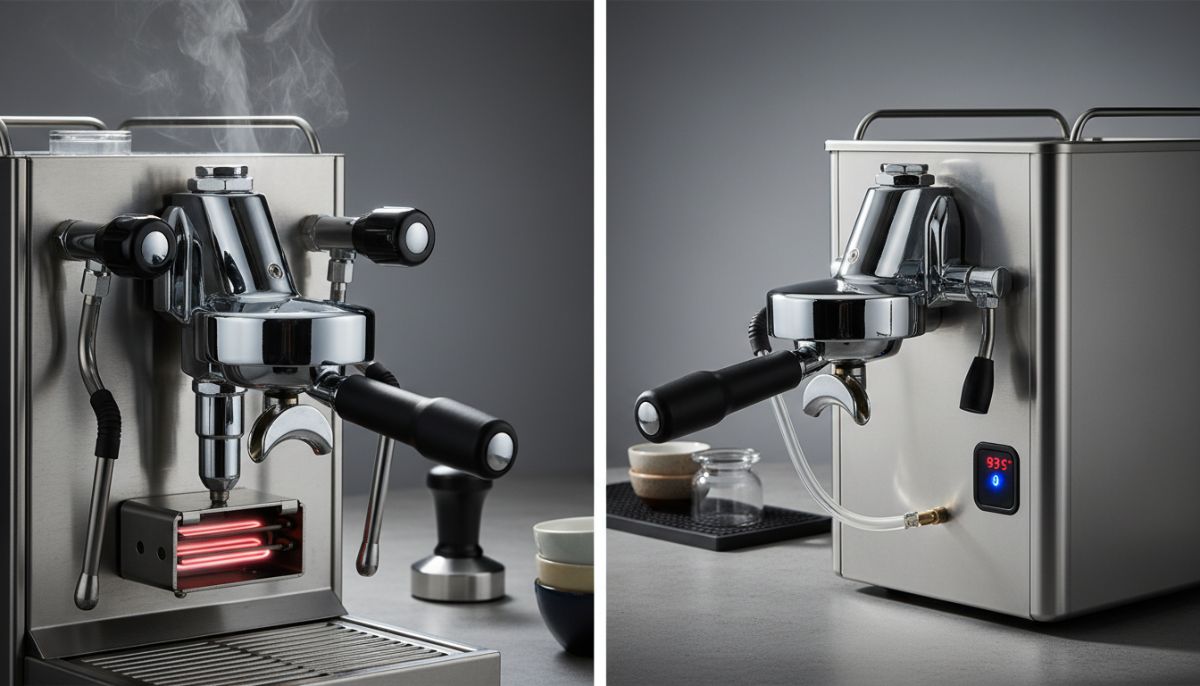
Deciding between a classic E61 and a modern saturated grouphead? We break down the science of thermal stability, warm-up times, and maintenance to help you choose the best espresso machine for your home bar.
Key Takeaways
- The Mechanism: E61 groups use a thermosyphon loop to circulate hot water, while saturated groups are essentially an extension of the boiler itself.
- Thermal Stability: Saturated groups offer superior temperature consistency, recovering faster between shots than the E61.
- Maintenance: E61 groups are easier to service at home but require more frequent lubrication compared to the sealed design of saturated groups.
- Cost vs. Performance: While saturated groups provide precision, E61 machines offer excellent value and the ability to add flow control profiling.
When you step into the world of prosumer espresso machines, you are immediately confronted with a technical divide. On one side stands the shiny, exposed brass of the legendary E61 grouphead. On the other sits the understated, integrated look of the saturated grouphead.
This isn’t just an aesthetic choice. It is a debate about thermodynamics, engineering philosophy, and ultimately, how much control you want over your morning brew. Thermal stability is the holy grail of espresso; without it, even the best beans can taste sour or bitter.
In this guide, we will strip away the jargon and compare these two titans of espresso engineering to help you decide which technology belongs on your counter.
The E61 Grouphead: The Heavyweight Champion
Invented by Faema in 1961, the E61 grouphead changed coffee history. Before this invention, espresso machines relied on lever springs or direct boiler pressure that was hard to control. The E61 introduced a continuous circulation of water, known as a thermosyphon, to keep the grouphead hot.
How the E61 Works
The E61 is a massive chunk of chrome-plated brass, often weighing nearly 9 pounds. Two copper pipes connect the grouphead to the boiler (or heat exchanger). Hot water flows out of the top of the boiler, circulates through the grouphead to heat the brass, and returns to the bottom of the boiler as it cools.
This thermal mass acts as a battery. Once the brass is hot, it retains heat incredibly well, smoothing out minor temperature fluctuations during the extraction.
The Pros of the E61
Modifiability: The mechanical nature of the E61 allows for incredible upgrades. For enthusiasts who want to experiment, you can easily install kits to unlock flow control capabilities. This allows you to mimic the pressure profiling of machines costing three times as much.
Parts Availability: Because this design is over 60 years old and used by dozens of manufacturers, spare parts are ubiquitous and affordable.
The Cons of the E61
Warm-Up Time: That 9 pounds of brass takes a long time to heat up. You are typically looking at a 30 to 45-minute wait before the machine is truly temperature stable. If you brew too early, the cold metal will suck the heat out of your brew water, leading to sour shots. If you are struggling with flavor notes, check out our guide on troubleshooting underextraction.
Maintenance: The E61 uses a cam and lever system to engage the pump. Over time, metal-on-metal friction wears down the internal components. You will need to adhere to a strict cleaning and maintenance routine, which includes lubricating the cam lever periodically.
The Saturated Grouphead: The Precision Instrument
Popularized by La Marzocco with the GS series in the 1970s, the saturated grouphead takes a different approach. Instead of relying on a loop of water to heat a separated piece of metal, the grouphead is welded directly to the boiler.
How Saturated Groups Work
The term “saturated” means the grouphead is literally filled with water from the boiler at all times. There is no separation. The grouphead acts as an extension of the boiler itself. Because water has a high specific heat capacity, surrounding the brew path with boiler water ensures that the temperature at the shower screen is nearly identical to the temperature inside the boiler.
This design is most commonly found in high-end dual boiler configurations where precision is paramount.
The Pros of Saturated Groups
Ultimate Stability: Because the distance between the boiler and the coffee puck is nonexistent, there is almost no temperature loss. If you set your PID to 200°F, you get 200°F at the puck, shot after shot.
Faster Warm-Up: While the water still needs to heat up, you aren’t waiting for a massive external block of brass to absorb heat via a siphon loop. Many saturated group machines are ready to brew in 15 to 20 minutes.
The Cons of Saturated Groups
Cost and Complexity: Welding a grouphead to a boiler requires precise manufacturing, making these machines significantly more expensive. Repairs can also be trickier, as you cannot simply unbolt the grouphead as easily as you can with an E61.
Head-to-Head: Thermal Stability and Performance
Now that we understand the mechanics, how do they compare in the real world? The primary goal is maintaining the target temperature during the extraction.
Modern E61 machines often pair the group with PID controllers to manage the boiler temperature. However, the E61 still relies on an “offset.” The boiler might be 220°F to ensure the water is 200°F by the time it travels through the group. This offset can vary depending on the ambient room temperature or how long the machine has been idling.
Saturated groups eliminate the guesswork. The sensor is usually placed right at the point of extraction. For light roast coffees that require very specific temperatures to shine, the saturated group offers a clear advantage.
Which One Should You Choose?
The choice between Saturated and E61 comes down to your budget, your patience, and your desire for manual control.
Choose the E61 if:
You love the tactile feel of a manual lever. You enjoy tinkering with your gear and potentially adding flow control later. You want a machine with a classic Italian aesthetic and don’t mind waiting 30 minutes for it to warm up. You are looking for a robust machine that is easier to service at home.
Choose the Saturated Group if:
You are chasing the absolute highest percentage of extraction yield. You primarily drink light roasts where temperature precision is critical. You want a machine that heats up faster in the morning. You prefer a modern, clean aesthetic over the retro industrial look.
Conclusion
Both the E61 and saturated groupheads are capable of producing café-quality espresso. The E61 is the hot rod of the coffee world—classic, mechanical, and fun to drive. The saturated group is the modern electric performance car—precise, efficient, and consistent.
No matter which you choose, remember that the machine is only one part of the equation. Fresh beans, a good grinder, and good puck prep are equally important. If you are just starting out, ensure you aren’t overspending on the machine while neglecting the grinder.
Frequently Asked Questions
The E61 consists of roughly 9lbs of solid brass. It relies on a thermosyphon loop to circulate hot water from the boiler to heat this metal mass. It takes about 30-45 minutes for the brass to fully absorb the heat and become temperature stable.
Not necessarily. Steaming power is determined by the steam boiler size and pressure, not the grouphead type. However, saturated groups are typically found on high-end dual boiler machines which inherently have excellent steam power.
Generally, no. Most aftermarket flow control kits are designed specifically for the E61 mushroom valve. Some high-end saturated group machines (like the Slayer or La Marzocco GS3 MP) have built-in flow profiling, but they are much more expensive.
They require less mechanical lubrication than an E61 because they don’t have a cam-and-lever mechanism. However, if a seal fails or a heating element breaks, the repair can be more labor-intensive due to the integrated design.