Is the WDT tool just an Instagram trend or a brewing necessity? We dive deep into the science of espresso distribution, channeling, and extraction yields to give you the verdict.
Key Takeaways
- Homogenization is Key: The WDT (Weiss Distribution Technique) effectively breaks up clumps and creates uniform density across the coffee bed.
- Channeling Reduction: proper needle distribution minimizes the path of least resistance for water, reducing sour, uneven shots.
- Extraction Efficiency: Using WDT can increase your extraction yield, allowing you to get more flavor out of the same amount of coffee.
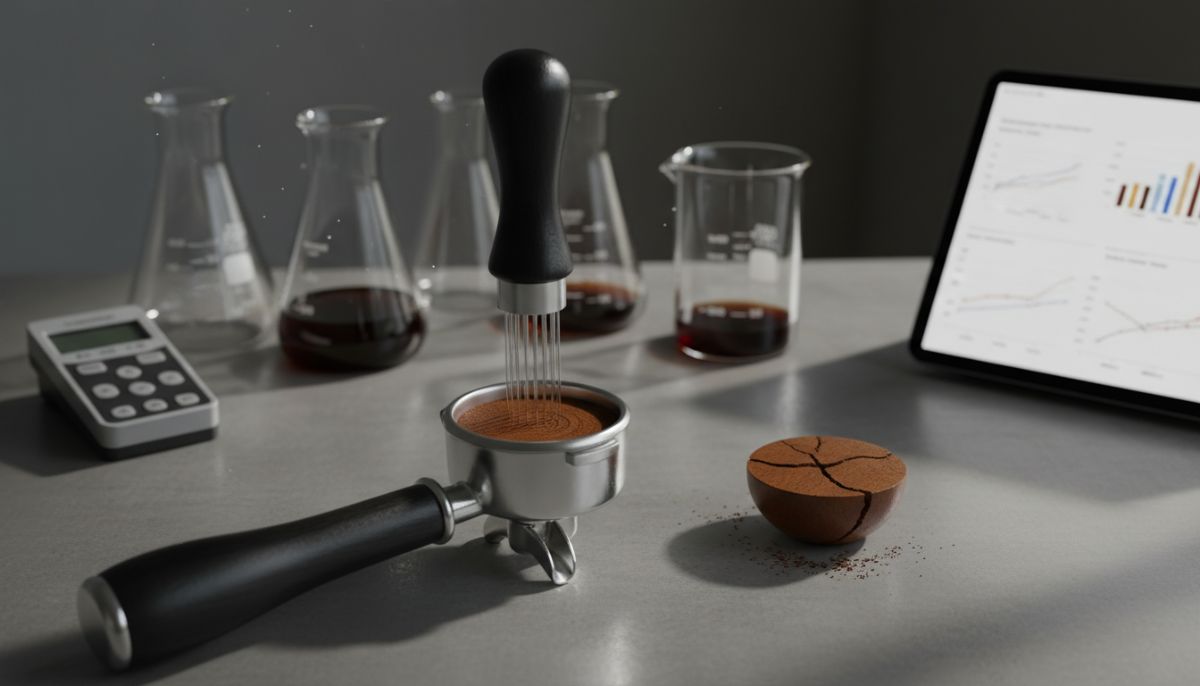
If you have scrolled through social media recently, you have likely seen it. A barista takes a small tool resembling a whisk or a set of acupuncture needles and vigorously stirs the ground coffee inside the portafilter.
It looks satisfying. It looks scientific. But does it actually make the coffee taste better?
This method is known as the Weiss Distribution Technique, or WDT for short. In the world of high-end specialty coffee, puck preparation is treated with the same precision as laboratory work. However, many home baristas wonder if this is just another unnecessary step or a crucial variable in the equation of the perfect shot.
Today, we are looking at the science behind puck prep. We will explore why clumps are the enemy, how water moves through coffee, and whether you really need to add another tool to your setup.
The Enemy: Clumping and Uneven Density
To understand why the WDT tool exists, we first have to understand the problem it solves. That problem is inconsistency within the coffee grounds.
When coffee is ground fine enough for espresso, static electricity and natural oils cause the particles to stick together. These clusters form clumps. Even high-end grinders can produce clumps depending on the humidity and the roast level of the beans.
If you simply dose your coffee into the basket and tamp it down, those clumps create areas of higher density. Conversely, the empty spaces between the clumps become areas of lower density. To the naked eye, the surface might look flat after tamping. But underneath, the structure is chaotic.
Hydrodynamics: How Water Flows
Water is lazy. In physics terms, it follows the path of least resistance. When pressurized water hits your coffee puck at 9 bars of pressure, it looks for the easiest way through.
If your puck has areas of low density (air pockets or loose grounds), the water will rush through those spots faster than the rest of the puck. This phenomenon is called channeling.
Channeling is disastrous for flavor. The coffee in the channel gets over-extracted, becoming bitter and dry. Meanwhile, the denser clumps don’t get enough water contact, leading to under-extraction. This is often the primary reason why your shot might taste sharp or acidic. Understanding why your espresso tastes sour is often the first step in realizing you have a distribution problem.
Enter the WDT Tool
The Weiss Distribution Technique was developed by John Weiss in 2005. The concept is simple: use thin needles to manually break up clumps and rake the coffee bed.
By stirring the grounds, you are doing two things:
- De-clumping: You physically break apart the clusters caused by static and oil.
- Homogenizing: You redistribute the grounds so that the density is the same from the center to the edges.
When the density is uniform, the water flows through the puck evenly. This is referred to as “even flow.” Even flow leads to a balanced extraction where all the flavor compounds are washed out at the same rate.
WDT vs. Wedge Distributors
For a few years, “wedge” or “grooming” tools were very popular. These tools sit on top of the basket and spin to flatten the surface. They look great and create a perfectly flat top.
However, science has shown they might not be as effective as we thought. Wedge distributors mostly polish the surface. They do not reach deep into the basket to address the density issues at the bottom of the puck. In some cases, they can even compress the coffee unevenly, pushing fines downward and clogging the basket holes.
The WDT tool, specifically one with long, thin needles (0.3mm to 0.4mm), reaches the bottom of the basket. It fluff the entire volume of coffee, not just the top layer. This creates a fluffy, aerated bed that is ready to be tamped into a perfectly uniform puck.
The Impact on Extraction Yield
Does this extra effort show up in the data? Yes. Refractometer tests, which measure the Total Dissolved Solids (TDS) in coffee, consistently show that good WDT usage increases extraction yield.
Higher extraction yield means you are getting more flavor out of your beans. It also means you can grind slightly finer without choking the machine, because you don’t have random boulders or clumps blocking the flow. This allows you to push the boundaries of flavor.
When you are learning how to dial in espresso, consistency is king. If you don’t use a distribution tool, one shot might channel and run fast, while the next one chokes. WDT removes a variable, making your shot times much more predictable.
How to Use a WDT Tool Correctly
Not all stirring is created equal. To get the benefits, you need good technique.
1. Choose the Right Tool
Avoid tools with thick loops or paperclips. They act like shovels and create furrows. You want acupuncture-style needles, ideally 0.3mm to 0.4mm thick.
2. The Deep Stir
Start by inserting the needles all the way to the bottom of the basket. Move in small circles to break up deep clumps. Be careful not to scratch the basket, but ensure you are moving the grounds at the very bottom.
3. The Rake
Slowly pull the tool upward while continuing to circle. This fluffs the upper layers. Finally, rake the top to level the bed before you tamp.
4. The Tamp
Once distributed, give the portafilter a vertical tap on the counter to collapse the air pockets. Then apply your tamp. This process ensures that your specific ratios and yield targets are met with precision, rather than being ruined by a bad pour.
Does It Matter for Dark Roasts?
This is a common question. Light roasts are denser and harder to extract, making them very prone to channeling. For light roasts, WDT is almost mandatory for good results.
Dark roasts are more porous and extract easily. While they are more forgiving, they are also oilier and stickier, leading to significant clumping. Even if you drink dark roasts, WDT helps prevent that harsh, uneven bitterness. It ensures the water touches every ground evenly.
Troubleshooting Your Setup
If you are using a WDT tool and still seeing spurting or rapid flow, look at your other variables. Is your grind size correct? Are your beans fresh?
Sometimes, even with perfect prep, a shot goes wrong. If you see signs of channeling despite using WDT, revisit our guide on troubleshooting underextraction. It will help you identify if the issue is the prep, the temperature, or the grind size.
Conclusion
So, does the WDT tool really matter? The science says yes. It is the most effective way to homogenize the density of your coffee puck. It is superior to wedge distributors and far better than tapping the side of the portafilter with your hand.
While it adds ten seconds to your workflow, the reward is consistent, sweeter, and more balanced espresso. You don’t need to spend a fortune; even a budget needle tool can drastically improve your morning routine.
Frequently Asked Questions
WDT stands for Weiss Distribution Technique. It is a method of preparing coffee for espresso by stirring the grounds with thin needles to break up clumps and ensure even density.
Technically yes, but it is not recommended. Paperclips are usually too thick (around 1mm). Thick needles plow the coffee rather than cutting through it, which can actually create more gaps. Acupuncture needles (0.3mm-0.4mm) are ideal.
Many experts argue yes. Wedge distributors mostly level the top surface. A WDT tool addresses the density of the entire puck, including the bottom, which wedge tools cannot reach.
Yes. By reducing channeling, WDT promotes an even extraction. This reduces sourness caused by underextraction and bitterness caused by overextraction, leading to a sweeter, more balanced cup.