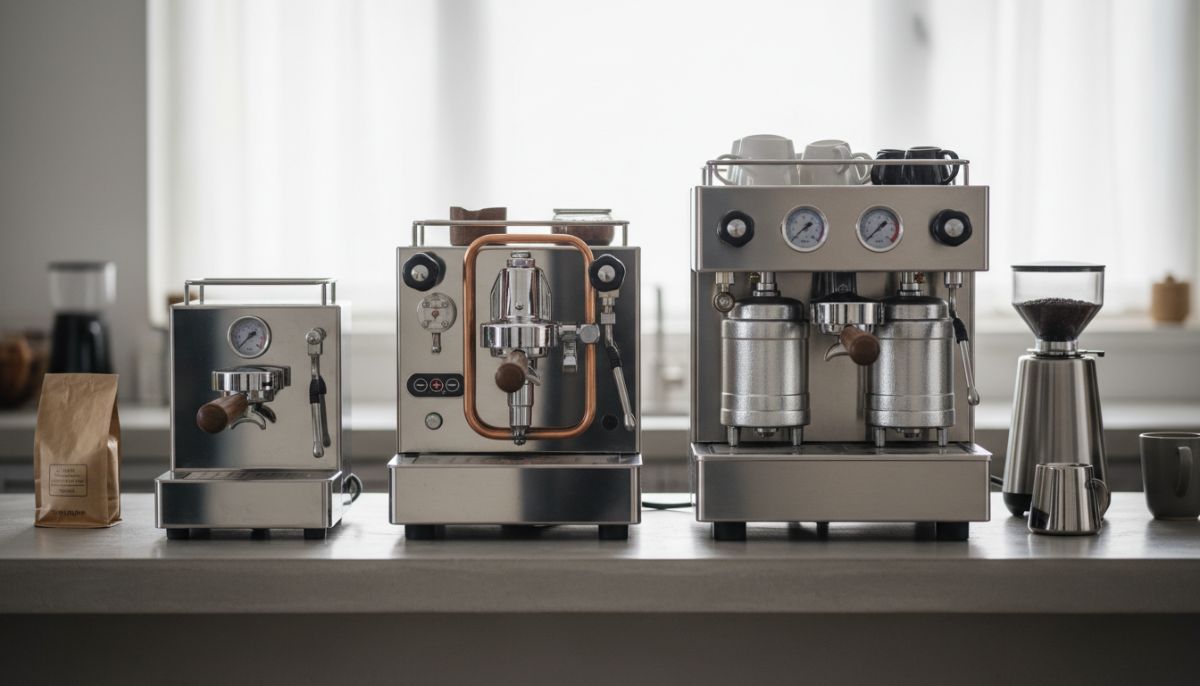
Confused by espresso machine specs? We break down the differences between single boiler, heat exchanger, and dual boiler machines to help you find the perfect fit for your home cafe.
Key Takeaways
- Single Boiler (SB): Most affordable and compact, but requires a wait time between brewing espresso and steaming milk. Ideal for espresso purists or low-volume milk drinkers.
- Heat Exchanger (HX): Allows simultaneous brewing and steaming with a single boiler design. Great for frequent milk drinks but requires "cooling flushes" for temperature precision.
- Dual Boiler (DB): The gold standard for consistency and workflow speed. Features dedicated boilers for brewing and steaming, offering precise temperature control but at a higher cost and footprint.
- Budget Balance: Never blow your entire budget on the machine; save room for a grinder.
Introduction
Walking into the world of high-end home espresso can feel like stepping into a physics lecture. You are bombarded with terms like thermal mass, PID controllers, and the holy trinity of machine types: Single Boiler, Heat Exchanger, and Dual Boiler. If you are suffering from "analysis paralysis," you are not alone.
Choosing the right machine is arguably the most critical decision in your home barista journey, second only to your grinder choice. The architecture of your espresso machine dictates your workflow, your speed, and ultimately, the consistency of your morning cup. Are you an espresso purist who drinks straight shots? Or are you looking to serve cappuccinos to a dinner party of six without missing a beat?
In this guide, we will dismantle the mechanics of these three machine types. We will explore the pros, cons, and ideal user profiles for each, ensuring you invest in equipment that matches your lifestyle rather than just buying the most expensive box on the shelf.
The Single Boiler (SB): The Entry-Level Specialist
The Single Boiler espresso machine is exactly what it sounds like: a machine with one boiler that does double duty. It is responsible for heating water to roughly 200°F (93°C) for brewing espresso, and then heating that same water up to roughly 250°F (121°C) to create steam for milk.
How It Works
Because the boiler can only be at one temperature at a time, you cannot brew and steam simultaneously. The workflow typically looks like this: you pull your espresso shot, flip a switch to "steam mode," wait for the boiler to heat up (which creates steam pressure), and then texture your milk. After steaming, if you want to pull another shot, you must refill the boiler and purge the superheated steam to bring the temperature back down to brewing range.
The Pros
The primary advantage here is cost and footprint. With fewer internal components, these machines are smaller and more affordable. For those who drink straight espresso or Americanos, a single boiler with a PID controller can offer exceptional temperature stability that rivals machines three times the price.
The Cons
The workflow gap is the killer. If you enjoy lattes, the delay between pulling the shot and steaming the milk can result in the crema on your espresso degrading. Furthermore, the small boiler size often makes these machines more susceptible to temperature fluctuations if you pull back-to-back shots.
Additionally, small boilers are more sensitive to scale buildup. Without proper care, you might find that tap water quality degrades performance quickly. Understanding how water chemistry affects scale accumulation is vital for keeping these smaller boilers running efficiently.
The Heat Exchanger (HX): The Prosumer Powerhouse
Heat Exchanger machines were the standard in commercial cafes for decades before multi-boiler technology took over. They offer a significant leap in workflow efficiency over single boilers.
How It Works
An HX machine features one large steam boiler that is kept constantly at steam temperature (above 250°F). Running through this steam boiler is a copper tube—the heat exchanger. Fresh water from the reservoir is pumped through this tube. As the water travels through the superheated environment of the steam boiler, it flash-heats to brewing temperature before hitting the group head.
The Pros
The headline feature is simultaneous brewing and steaming. Because the steam boiler is always ready, you can pull a shot and steam your milk at the same time. This is massive for anyone interested in texturing milk for latte art without the espresso shot sitting and dying on the counter.
The Cons
The downside is temperature ambiguity. Since the brew water temperature relies on how long it sits in the heat exchanger tube, the water can sometimes get too hot if the machine idles for too long. This requires a "cooling flush"—running water through the group head for a few seconds to expel the overheated water before locking in your portafilter. While manageable, it adds a variable to the process that can make dialing in your shot slightly more challenging compared to a PID-controlled dual boiler.
The Dual Boiler (DB): The Ultimate Home Cafe Experience
If you want no-compromise performance and have the budget (and counter space) to support it, the Dual Boiler is the pinnacle of home espresso technology.
How It Works
As the name implies, these machines house two completely independent boilers: one dedicated to brewing espresso and one dedicated to steam. The brew boiler is usually controlled by a PID (Proportional-Integral-Derivative) controller, which holds the temperature to within one degree of your set point. The steam boiler operates independently, often at a higher pressure to provide commercial-grade steam power.
The Pros
Consistency is king. You can pull shot after shot without worrying about temperature drops or cooling flushes. You have endless steam power for back-to-back lattes. This stability removes the variable of the machine from the equation, allowing you to focus entirely on your puck prep. Speaking of variables, minimizing equipment inconsistency helps you determine if flavor issues are actually due to your beans or technique, such as uneven water flow and channeling.
The Cons
Complexity and cost are the main barriers. These machines are heavy, large, and contain more parts that can fail over time. A robust routine maintenance schedule is non-negotiable for dual boilers to prevent expensive repair bills.
Comparison: Which One is Right for You?
To make the final decision, you need to be honest about your habits.
1. The Pure Espresso Drinker
If you drink 90% straight espresso or long blacks, a high-end Single Boiler with a PID is your best bet. You are paying for the quality of the brew boiler rather than paying for a steam boiler you won’t use. Just remember, the money you save on the machine should be redirected towards investing in a high-quality grinder, which has a larger impact on flavor than the boiler type.
2. The Weekend Latte Warrior
If you drink espresso during the week but love making cappuccinos for brunch on weekends, a Heat Exchanger is a fantastic middle ground. It gives you that commercial "feel" and steam power without the astronomical price tag of a dual boiler. It is also aesthetically pleasing, often serving as a centerpiece for the kitchen.
3. The Home Barista Perfectionist
If you are weighing your beans to 0.1g, using WDT tools, and trying to replicate third-wave cafe results, you want a Dual Boiler. The ability to control brew temperature and steam pressure independently allows you to extract light roasts that might taste sour on less stable machines. If you are chasing perfection, you do not want your equipment to be the limiting factor.
Conclusion
There is no single "best" machine, only the best machine for your specific workflow. The Single Boiler teaches patience and discipline; the Heat Exchanger offers a rhythm and flow akin to classic Italian bartending; and the Dual Boiler offers scientific precision.
Assess your counter space, define your budget, and most importantly, consider how many milk drinks you make in a row. Once you have made your choice, the real fun begins: mastering the art of the extraction.
Frequently Asked Questions
A Single Boiler machine is often best for beginners because it is cost-effective and simpler to operate. However, if you plan to make many milk drinks, the workflow can be frustrating, making a Heat Exchanger a better long-term starter choice.
Not necessarily. You only ‘need’ a dual boiler if you want to make multiple milk drinks back-to-back without waiting, or if you require precise temperature control for light roast coffees.
A cooling flush is the process of running water through the group head for a few seconds before brewing. This purges overheated water from the heat exchanger tube to ensure the brew temperature is not too high.
Yes, but differently than on a dual boiler. On a heat exchanger, the PID controls the steam boiler temperature. While this helps stability, the brew temperature is still indirectly managed via the heat exchange process, so it is less precise than a PID on a brew boiler.