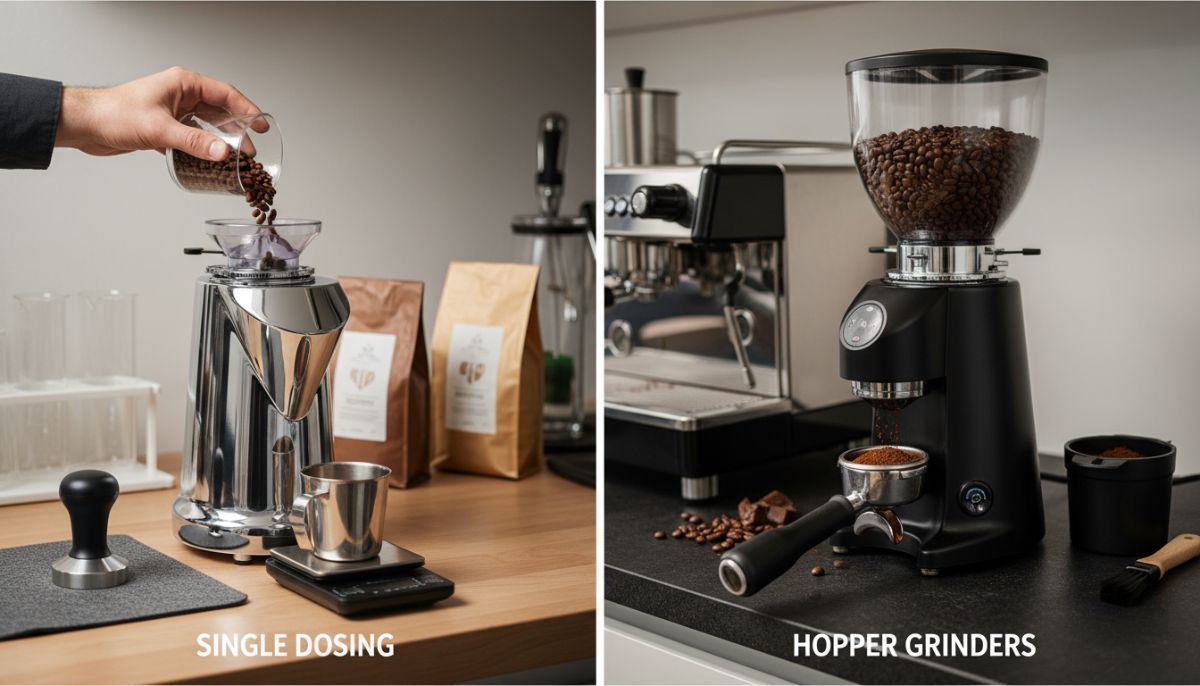
Torn between single dosing and a traditional hopper? We break down the workflow speed, waste analysis, and taste differences to help you decide which grinder fits your home espresso routine.
Key Takeaways
- Best for Purists & Switchers: Single dosing offers superior freshness, near-zero waste, and the ability to switch between decaf and regular beans instantly, but requires a more involved workflow.
- Best for Consistency & Speed: Hopper grinders excel in multi-person households or for back-to-back shots, provided you stick to one coffee blend.
- The "Pop-corning" Factor: Single dosing without an anti-popcorn disc can lead to inconsistent particle distribution due to a lack of bean weight pressure.
- Cost Reality: While hoppers seem faster, the cost of purging stale coffee (retention) adds up to significantly more financial waste over a year than the time "wasted" weighing beans.
The modern home barista faces a critical infrastructure decision: commit to the cafe-style efficiency of a hopper grinder or embrace the precision and flexibility of single dosing. This is not merely a question of hardware; it is a question of workflow, waste, and morning psychology.
Commercial environments rely on hoppers for speed. However, home espresso is a different discipline. You are not serving 50 customers an hour; you are crafting one or two precise shots. Understanding the mechanical and flavor implications of these two workflows is essential for maximizing your grinder’s potential and flavor profile.
Defining the Contenders: Mechanisms and Retention
To choose the right tool, you must understand the mechanics of grind retention. Every grinder has "dead space"—internal cavities where ground coffee gets stuck.
The Hopper System
A hopper-fed grinder uses a large reservoir of beans. It relies on time-based dosing (grinding for X seconds) or the weight of the bean column to push coffee through the burrs. This mimics a cafe setup.
- Exchange Retention: In a hopper, the grounds left in the chute from yesterday are the first to land in your portafilter today. This is stale coffee.
- Workflow: Load a full bag, dial in the timer, and grind on demand.
The Single Dosing System
Single dosing involves weighing an exact dose of beans (e.g., 18g) individually before grinding. The goal is zero retention: 18g in, 18g out.
- Gravimetric Dosing: You rely on a digital scale before the grind, not a timer during the grind.
- Workflow: Weigh beans, apply RDT (Ross Droplet Technique), grind, and often use bellows to clear the chute.
The Stopwatch Test: Is Single Dosing Actually Slower?
A common user pain point is the fear that single dosing adds too much friction to the morning routine. Let’s break down the real-world time difference for a standard espresso shot.
Hopper Workflow (Total: ~45 Seconds)
- Purge (Required for quality): Grind 3-5g to clear old grounds (5s).
- Grind: Press portafilter against switch (10s).
- Verify: Weigh output to ensure timer accuracy (10s).
- Adjust: Add or remove grounds to hit target weight (10s).
- Distribute/Tamp: Prepare puck (10s).
Single Dose Workflow (Total: ~65 Seconds)
- Weigh Input: Measure beans in a dosing cup (15s).
- RDT: Spray water to reduce static (5s).
- Grind: Pour beans in, wait for completion (20s).
- Bellows/Clean: Pump bellows to clear retention (5s).
- Transfer/Tamp: Pour into portafilter and prep (20s).
The Verdict: Single dosing takes approximately 20 seconds longer per shot. However, this assumes you are strictly managing quality with the hopper by weighing your output. If you blindly trust the timer, the hopper is significantly faster, but your espresso ratio and yield will fluctuate, leading to inconsistent flavor.
The Economics of Waste: Purging vs. Weighing
The hidden cost of owning a high-retention hopper grinder is the "purge tax." To avoid oxidation and stale flavors, you must purge the exchange retention (usually 3g to 7g depending on the grinder) every morning or anytime you adjust the grind setting.
If you purge 5g of specialty coffee ($20/12oz bag) daily:
Annual Waste: ~4lbs of coffee.
Annual Cost: ~$100+ wasted down the sink.
Single dosing grinders like the Niche Zero or DF64 virtually eliminate this waste. Over the lifespan of the grinder, single dosing pays for itself in saved beans.
Flavor and Physics: Oxidation and Pop-corning
Bean Freshness and Oxidation
Beans stored in a hopper are exposed to oxygen and light, accelerating the staling process. Even with a UV-tinted hopper, the seal is rarely airtight. Single dosing allows you to keep your main supply in an airtight container or vacuum-sealed freezer bags, pulling out only what you need. This maintains peak freshness relative to the roast date.
The Pop-corning Effect
One technical downside of single dosing is "pop-corning." Without the weight of a full hopper pressing down, the final few beans bounce around the burr chamber (especially with flat burrs). This results in:
- Inconsistent Particle Distribution: The beans are chipped rather than crushed uniformly, creating boulders and fines.
- Remedy: High-quality single dose grinders utilize anti-popcorn discs or variable RPM (Rotations Per Minute) to mitigate this. Retrofitted hopper grinders often struggle here unless modified.
Workflow Flexibility: The Multi-Bean Dilemma
The strongest argument for single dosing is flexibility. If you enjoy a light roast for a morning pour-over and a decaf espresso in the evening, a hopper is an obstacle. To switch beans in a hopper, you must:
- Close the hopper gate.
- Remove the hopper (often spilling beans).
- Vacuum or purge the remaining beans in the throat.
- Load the new beans.
With a single dose workflow, switching from regular to decaf requires zero friction. You simply weigh a different bean. For households with multiple coffee drinkers preferring different roasts, single dosing is the only logical solution.
Counter Clutter and Cleanliness
Static Electricity
Single dosing creates more static mess than hopper grinding because the lack of bean mass allows grounds to fly more freely. This necessitates the Ross Droplet Technique (RDT)—spritzing beans with a tiny amount of water before grinding. This dissipates charge and keeps the chute clean.
Modifying Hopper Grinders
Many home baristas attempt to convert machines like the Eureka Mignon or Baratza into single dosers by adding aftermarket bellows. While this reduces retention, be aware that the internal geometry of these grinders was designed for a full load. You may experience increased noise and pop-corning compared to a purpose-built single doser.
Final Verdict: Which Workflow Fits You?
Choose a Hopper Grinder If:
- You make multiple milk-based drinks back-to-back every morning.
- You stick to one bag of coffee at a time until it is finished.
- You prioritize speed and hate the fiddliness of weighing beans every time.
- You have plenty of vertical counter space (hoppers add height).
Choose Single Dosing If:
- You switch beans frequently (e.g., Decaf vs. Regular, Espresso vs. Filter).
- You want to minimize coffee waste and save money long-term.
- You are chasing the absolute highest clarity and consistency in extraction.
- You don’t mind a ritualistic workflow involving RDT and WDT tools for puck prep.
Frequently Asked Questions
Yes, generally speaking. Single dosing prevents oxidation by keeping beans in an airtight container until the moment of grinding, rather than letting them sit in a hopper. It also eliminates ‘exchange retention,’ ensuring you aren’t brewing with stale grounds left in the chute from the previous day.
In a direct stopwatch comparison, single dosing adds about 20-30 seconds per shot compared to a hopper. However, if you are purging your hopper grinder and weighing the output for accuracy (as you should), the time difference narrows significantly.
Yes, many popular grinders like the Eureka Mignon or Baratza Encore can be fitted with aftermarket bellows and single-dose hoppers. However, these grinders may still suffer from ‘pop-corning’ issues as their burr geometries were optimized for the pressure of a full bean column.
RDT stands for Ross Droplet Technique. It involves adding a tiny spray of water to your beans before grinding. For single dosing, it is almost mandatory to reduce static electricity, which prevents grounds from sticking to the chute and dosing cup.
Pop-corning occurs when beans bounce around the grinding chamber because there is no weight pushing them down. This causes the burrs to chip the beans unevenly, resulting in a wider particle distribution (less consistency) which can make dialing in espresso more difficult.