
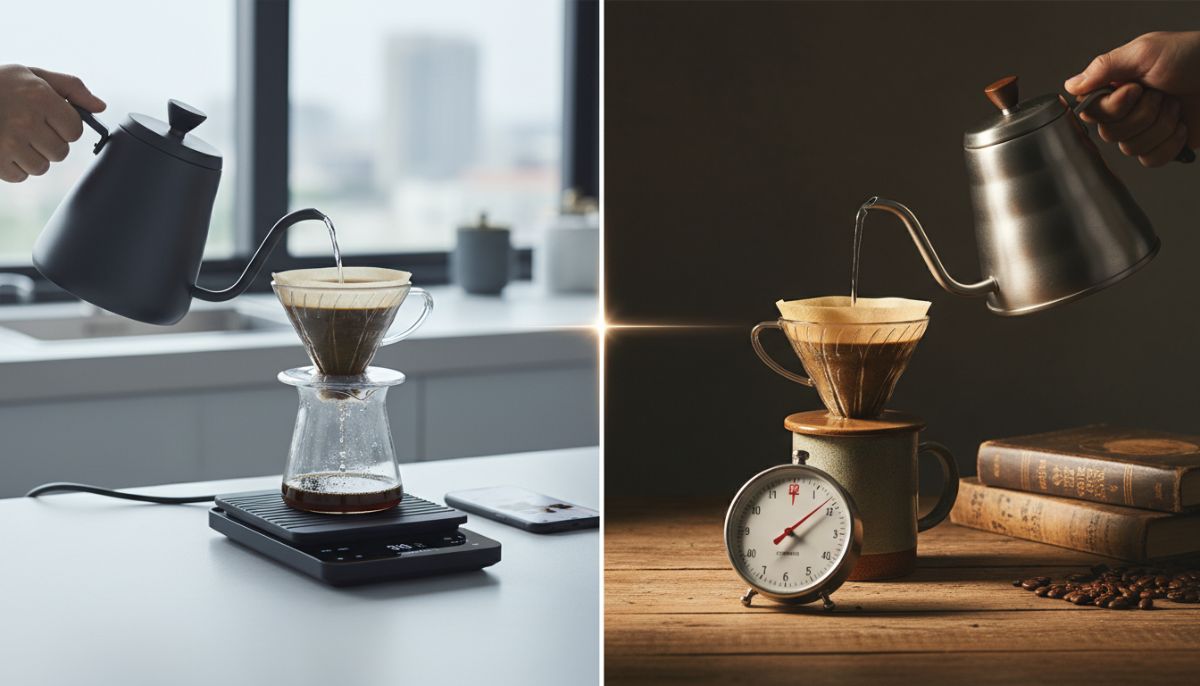
Is a $200 smart scale with Bluetooth essential for better coffee, or is a basic timer enough? We analyze response times, app connectivity, and daily workflows to help you decide.
Key Takeaways
- Taste Correlation: Smart scales do not inherently make coffee taste better than basic scales; they improve consistency through data logging and real-time flow rate feedback.
- Latency Matters: The primary hardware advantage of high-end scales (e.g., Acaia) is ultra-fast response time (low latency), preventing over-pouring, whereas budget scales often lag by 0.5–1.0 seconds.
- Workflow Friction: Using an app adds approximately 15–30 seconds of setup time per brew. Many users abandon app connectivity within months due to the "distraction factor."
- Auto-Start Utility: Essential for espresso workflow to capture the first drop automatically; less critical for slow brew methods like Chemex or V60.
- The Verdict: Buy "smart" for flow profiling and geeky data analysis; buy "basic" (but responsive) for reliable daily caffeine.
In the pursuit of the perfect extraction, the humble kitchen scale has evolved into a precision instrument capable of talking to your phone. For the home barista, the choice between a $20 Amazon scale and a $250 Bluetooth-enabled device like the Acaia Lunar often comes down to one question: Does the technology actually improve the coffee?
This guide dissects the functional differences between smart scales and basic timers, focusing on latency, workflow, and long-term value.
The Precision Gap: Load Cells and Response Time
The most critical specification in a coffee scale is not Bluetooth—it is response time. This is the delay between water hitting the brewer and the display updating the weight.
The "Ghost Pour" Effect
Basic kitchen scales often utilize cheaper load cells and processors with a lag time of 0.5 to 1.5 seconds. When dialing in espresso ratios, stopping your shot at exactly 36g is impossible if the screen reads 32g when the cup actually holds 36g. You cut the pump, but the scale continues to count up, resulting in an over-extracted, bitter shot.
High-end scales from Acaia, Felicita, and Hiroia boast response times under 20ms. This instant feedback allows you to stop pouring or cut the pump at the precise moment required. If you are struggling to fix over-extracted bitter espresso, the culprit might not be your grind size, but your scale’s inability to keep up with the flow.
The Connectivity Debate: Is Bluetooth a Gimmick?
Bluetooth connectivity allows the scale to transmit weight and time data to a mobile app in real-time. But does this feature solve a genuine user pain point?
The Case for Apps: Flow Profiling
For data-driven brewers, apps like Beanconqueror or the Acaia proprietary apps are invaluable. They visualize Flow Rate (grams per second) in a graph. This is particularly useful for:
- Espresso: Monitoring consistency with flow control machines. Seeing a declining flow rate can indicate puck degradation or channeling.
- Pour-Over: Training your muscle memory to maintain a steady pouring circle during a V60 brew.
The Case Against Apps: Connectivity Fatigue
Reliability remains the Achilles’ heel of smart coffee tech. User reports and long-term testing reveal that connection drops are frequent in lower-tier smart scales (e.g., earlier Timemore Black Mirror versions or generic clones). Even with rock-solid connection (like the Acaia Lunar), the workflow friction is real.
Setup Time Comparison:
- Basic Scale: Place cup, press Tare. (Time: 2 seconds)
- Smart Scale with App: Unlock phone, open app, wait for Bluetooth sync, select recipe, place cup, press Tare on phone. (Time: 20–40 seconds)
For many, the distraction of a screen ruins the meditative aspect of the morning ritual. Unless you are actively logging data for a roast capability analysis, the phone usually stays in the pocket after the initial "honeymoon phase" of ownership ends.
Smart Features That Actually Matter
Beyond Bluetooth, "smart" scales offer firmware features that directly assist workflow without requiring a phone.
Auto-Tare and Auto-Start
Auto-Tare automatically zeroes the scale when a cup is placed. Auto-Start begins the timer the moment the first drop of liquid hits the vessel (or when flow is detected).
For espresso, Auto-Start is a game-changer. When extracting on manual machines or even entry-level espresso machines, your hands are often busy managing the portafilter and pump. Having the timer start automatically ensures your Extraction Time data is consistent shot-to-shot.
However, implementation varies. Hario scales often have a slight delay in auto-start sensitivity compared to the instant reaction of a Felicita Arc or Acaia Lunar.
Hardware & Longevity: Battery, Water Resistance, and Size
When you pay a premium, you are paying for durability.
Water Resistance (IP Rating)
Espresso machines are wet environments. A purge from the steam wand or a leaky grouphead can drown a scale.
- Basic Scales: Rarely offer water resistance. A spill into the circuitry often means buying a new unit.
- Premium Scales: The Acaia Lunar is designed specifically for the drip tray, with PCB coating and water resistance. The Timemore Black Mirror offers decent resistance but is less rugged than the Lunar.
Rechargeable vs. Batteries
Modern smart scales use Lithium-ion batteries charged via USB-C. This eliminates the need for disposable AA batteries. However, battery life varies significantly. A basic LCD scale can last months on a pair of AAAs. A Bluetooth scale with an LED matrix display might need charging every few weeks, especially if the radio is constantly searching for a phone.
Form Factor and Drip Trays
Size dictates compatibility. Large scales like the Hario V60 Drip Scale or Acaia Pearl are perfect for Chemex but often too large for the drip trays of compact machines like the Gaggia Classic or various manual lever machines. The "Nano" or "Lunar" form factor is mandatory for espresso users who weigh output directly under the portafilter.
Price vs. Value: The Competitor Landscape
The Gold Standard: Acaia (Lunar/Pearl)
Pros: Unbeatable response time, rock-solid Bluetooth, frequent firmware updates, high resale value.
Cons: Extremely expensive. Overkill for casual brewing.
The Mid-Range Hero: Timemore (Black Mirror / Nano)
Pros: USB-C, aesthetic design, good response time, auto-timer features.
Cons: App is less polished than Acaia’s; touch buttons can be sensitive; Bluetooth reliability is mixed.
The Budget Option: Generic "Coffee Scale with Timer"
Pros: Cheap ($15-$30), reliable physical buttons (sometimes), long battery life.
Cons: Significant lag/latency, no flow rate data, not water-resistant, usually inaccurate for espresso increments (0.1g).
Verdict: Do You Need Bluetooth?
If you are obsessed with Extraction Yield, plot graphs of your shots, or practice complex flow profiling with scientific puck prep, Bluetooth is a tool you will use. It bridges the gap between taste and data.
However, if your goal is simply a delicious morning cup, you do not need an app. You need a scale with fast response time (low latency), 0.1g accuracy, and water resistance. A mid-range scale like the Timemore allows you to skip the app connectivity issues while still enjoying the hardware benefits of a rechargeable, fast-reacting sensor.
Ultimately, a scale is a tool for consistency. Whether that consistency comes from a graph on a screen or a simple timer on a plastic box depends on how much friction you are willing to accept in your workflow.
Frequently Asked Questions
Not directly. A scale cannot change the flavor of the beans. However, smart scales improve consistency and allow you to replicate successful brew ratios and flow rates precisely, which leads to better-tasting coffee over time.
No. While Bluetooth allows for data logging and flow profiling (useful for diagnosing extraction issues), it is not required for pulling a great shot. A fast response time and 0.1g accuracy are far more important.
High latency causes ‘ghost pouring,’ where the scale display lags behind the actual weight of the liquid. This leads to over-pouring water or over-extracting espresso because the scale reads a lower weight than what is actually in the cup.
In terms of single-charge duration, standard LCD scales with AA batteries often last longer (months) than LED smart scales (weeks). However, lithium-ion rechargeable scales are more convenient and environmentally friendly in the long run.
Auto-Tare automatically zeroes the weight when you place a cup on the scale. Auto-Start automatically begins the timer when the scale detects the flow of liquid (weight increase), which is highly useful for espresso workflow.