
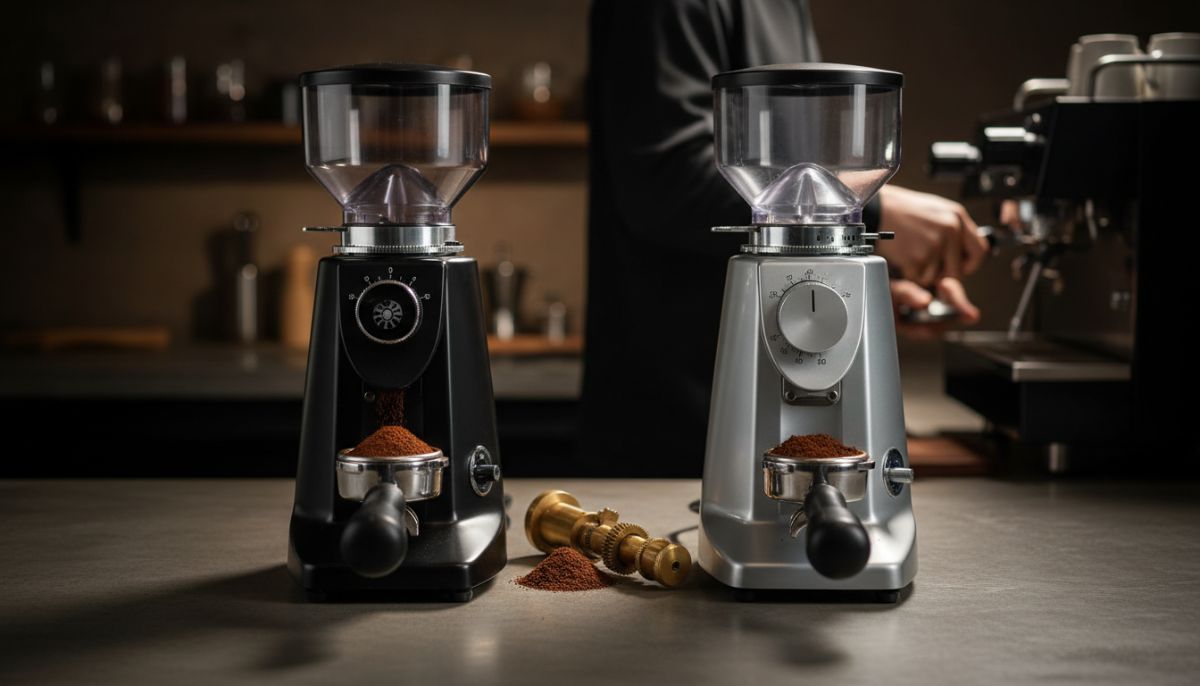
Struggling to dial in your shots? Discover the critical difference between stepless and stepped grinders. We explain why micrometric adjustments are the key to consistent espresso and how to manage flow rate precision.
Key Takeaways
- Precision is King: Espresso requires microscopic changes in grind size; stepped grinders often lack the resolution to hit the perfect extraction window.
- The “In-Between” Gap: A common frustration with stepped grinders is finding one setting chokes the machine, while the next runs too fast.
- Workarounds Exist: You can use a stepped grinder for espresso by adjusting your dose weight to compensate for large steps.
- Workflow Trade-offs: Stepless grinders are superior for espresso but difficult to switch back and forth for brew methods like French Press compared to stepped mechanisms.
If you have ever pulled a shot of espresso that choked your machine, adjusted the grinder one “click” coarser, and watched the next shot gush out like water, you have experienced the primary limitation of a stepped grinder. This phenomenon is the driving force behind the debate: Stepless vs. Stepped Grinders.
For the home barista, understanding the mechanics of grind adjustment is as critical as choosing the machine itself. While fresh beans and good puck prep are vital, your ability to control the flow rate determines whether you taste complex acidity or muddy bitterness. Here is the definitive guide to why micro-adjustments matter and how to choose the right gear for your bar.
The Mechanics: Stepped vs. Stepless Explained
To understand the impact on flavor, we must first look at the engineering.
Stepped Grinders: The Staircase
A stepped grinder uses a system of pre-set notches, indents, or “detents” to hold the burrs at a specific distance. When you turn the collar or dial, it clicks into place. These are common on entry-level grinders (like the Baratza Encore) and many commercial bulk grinders.
Think of this like a volume control on a TV that only goes up by 5 levels at a time (0, 5, 10, 15). It is easy to remember your setting, but you lack precision.
Stepless Grinders: The Ramp
A stepless grinder removes the detents entirely. The adjustment mechanism—often a worm gear or a direct-thread collar—allows for infinite adjustment. You can stop the burrs at any point.
This is analogous to a violin string or an analog volume knob. You can tune it to the exact frequency required. Brands like Eureka, Niche, and Rocket Espresso utilize this to allow for “micrometric” adjustments.
Why Espresso Demands Micro-Adjustments
Espresso is brewed under 9 bars of pressure. Under this intensity, the water acts as a magnifying glass for grind size inconsistencies. A change in burr gap of just a few microns can alter the extraction time by several seconds.
The Flow Rate Problem
When dialing in espresso, you are targeting a specific ratio in a specific time (e.g., 18g in, 36g out, in 28 seconds). On a standard stepped grinder intended for filter coffee, the gap between “Step 3” and “Step 4” might result in the following:
- Step 3 (Fine): 45-second extraction (Over-extracted, bitter, dripping slowly).
- Step 4 (Coarse): 18-second extraction (Under-extracted, sour, gushing fast).
Your perfect 28-second shot lives in the “phantom” space between those two steps. With a stepless mechanism, you can rotate the worm gear a fraction of a millimeter to hit that exact resistance.
The Stepped Grinder Workaround: Dose Adjustment
If you own a stepped grinder and cannot upgrade yet, you are not entirely out of luck. You can manipulate the puck resistance by changing the dose weight rather than the grind size.
If “Step 4” runs too fast, but “Step 3” chokes the machine, keep the grinder on “Step 4” but increase your dose. Going from 18g to 18.5g or 19g adds more coffee bed depth, increasing resistance and slowing down the flow. This requires a precise scale, but it effectively bridges the gap between steps. For more on how dose affects flow, read our guide on mastering the espresso ratio.
The Workflow Nightmare: Switching Brew Methods
While stepless grinders reign supreme for espresso, they can be a nightmare for the multi-method brewer. If you drink espresso in the morning and V60 or French Press in the afternoon, a stepless grinder with a worm gear (like the Eureka Mignon series) is difficult to manage.
Because the adjustment is so fine, moving from espresso to French Press might require 40 full rotations of the knob. Returning to your exact espresso setting the next morning is nearly impossible without significant waste involved in re-dialing. In contrast, a stepped grinder allows you to click back to “Setting 5” instantly.
The Solution? If you brew both, consider:
- Two Grinders: One dedicated to espresso (stepless), one for filter (stepped).
- Single Dosing Grinders: Modern grinders like the Niche Zero or DF64 use a large dial system that is stepless but clearly marked, making it easier to switch back and forth compared to worm-gear adjustments. See our comparison on single dosing vs. hopper grinders.
Burr Geometry and Consistency
While the adjustment mechanism is the focus here, the burrs themselves play a role. Whether you use flat or conical burrs, the stability of the carrier is vital. A stepless mechanism is useless if the internal components wobble. High-end stepless grinders often feature tighter manufacturing tolerances to ensure that when you adjust by 0.01mm, the burrs actually move that distance and stay there.
If you are debating between burr types alongside your adjustment mechanism choice, review our analysis on flat vs. conical burrs to understand how geometry changes flavor profiles.
Budget Modifications: Removing the Detent
For the tinkering enthusiast, many stepped grinders can be modified. A popular “hack” for grinders like the Rancilio Rocky or Baratza Encore involves opening the casing and removing the plastic pin or spring responsible for the “click.” This effectively converts the grinder to stepless. However, rely on friction to hold the setting; without the click, vibrations from the motor may cause the setting to drift during grinding, leading to channeling issues.
Conclusion: Which One Do You Need?
The choice comes down to your primary brewing method:
- Buy a Stepless Grinder If: You primarily drink espresso. The ability to fine-tune flow rate is non-negotiable for unpressurized baskets and café-quality results.
- Buy a Stepped Grinder If: You primarily brew filter coffee (Pour-over, Drip, French Press). The ease of switching settings outweighs the need for microscopic precision.
Investing in a stepless grinder is often the single most impactful upgrade you can make for your home espresso setup—even more so than upgrading the machine itself.
Frequently Asked Questions
Yes, but it is difficult. You will likely face situations where one setting is too fine and the next is too coarse. To fix this, you must adjust your dose weight (e.g., add 0.5g of coffee) to increase resistance without changing the grind setting.
A worm gear is a specific type of stepless adjustment mechanism found on grinders like the Eureka Mignon. It uses a screw-like knob that rotates a gear to move the burrs. It allows for extremely precise, infinite adjustments but is slow to move from fine to coarse settings.
Not necessarily. While it can grind coarse enough for French Press, changing a stepless grinder from an espresso setting to a coarse setting takes many rotations. It is also difficult to return to the exact espresso setting afterward. Stepped grinders are generally preferred for filter coffee workflow.
This can happen due to retention (old grounds mixing with new), changes in bean freshness (beans off-gas CO2 over time), or temperature fluctuations. It is rarely the fault of the stepless mechanism itself, provided the grinder is clean.