
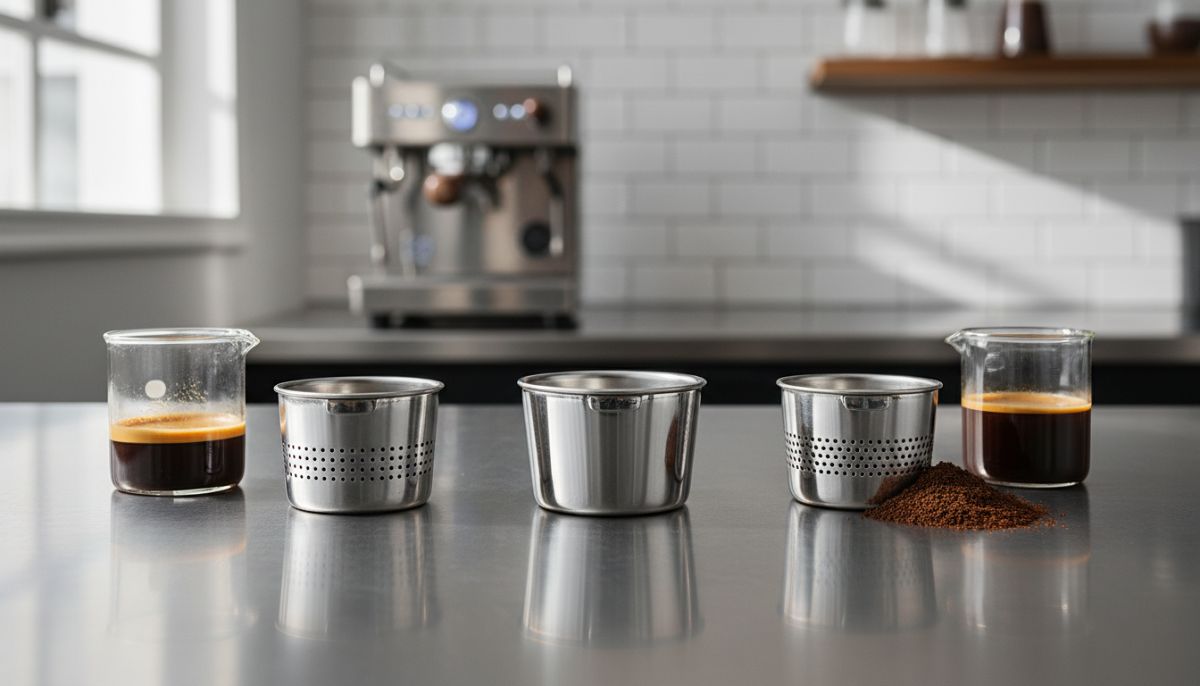
Is a $30 piece of steel the secret to better espresso? We compare stock baskets against VST and IMS precision filters to determine if the upgrade improves extraction, clarity, and consistency.
Key Takeaways
- Hole Uniformity: Precision baskets feature optically scanned holes that prevent clogs and ensure even water distribution compared to stamped stock baskets.
- Flow Rate: Brands like VST and IMS allow for higher flow rates, requiring a finer grind size to maintain pressure.
- Flavor Profile: Precision filters generally offer higher clarity and acidity, while stock baskets may mute flavors but offer more body.
- Puck Prep Demands: High-flow baskets are unforgiving; they will expose flaws in tamping and distribution immediately.
In the world of home espresso, Gear Acquisition Syndrome (GAS) is a very real condition. Enthusiasts often convince themselves that the next dual-boiler machine or a monolithic grinder is the only barrier standing between them and the God Shot. However, one of the most impactful upgrades you can make costs less than a bag of high-end geisha beans.
We are talking about the portafilter basket. That small perforated cup of steel holding your coffee grounds is the final gatekeeper before your espresso hits the cup. Most machines come with “stock” baskets, but brands like VST and IMS have built reputations on “precision” engineering.
But does hole geometry really matter, or is this just marketing fluff? Let’s dive into the microscopic world of extraction mechanics to see if upgrading your basket is truly necessary.
The Anatomy of a Stock Basket
To understand the upgrade, you must first understand what you are replacing. Stock baskets are typically mass-produced using a stamping method. If you were to look at a stock basket under a microscope, you would likely see inconsistent hole sizes, jagged metal burrs, and some holes that are partially blocked.
These inconsistencies create uneven resistance. Water, being lazy, will always find the path of least resistance. If one side of your basket has larger holes than the other, water will rush to that side, leading to over-extraction in one area and under-extraction in another. This creates a muddled flavor profile where bitter and sour notes exist simultaneously.
Enter the Precision Basket: VST and IMS
Precision baskets, notably those from VST and IMS, approach manufacturing differently. They use laser imaging and specialized fabrication techniques to ensure that every single hole is perfectly round and identical in size. The holes are also typically distributed all the way to the edge of the basket bottom, whereas stock baskets often leave a solid metal rim.
This uniformity drastically changes the hydrodynamics of your shot. Because the holes are open and consistent, the basket itself offers less resistance to the water flow. This shifts the burden of resistance entirely onto your coffee puck.
The Grind Adjustment: Why You Must Grind Finer
This is the first hurdle new users face when swapping to a VST or IMS basket: the flow rate is significantly faster. If you use your standard grind setting, your shot will likely gush out in 15 seconds, resulting in a thin, sour mess.
Because the basket offers less resistance, you must compensate by grinding finer. This increase in surface area allows for higher extraction yields. You can extract more soluble solids (flavor) from the coffee without hitting the bitterness wall as quickly.
However, this puts more pressure on your grinder. If you are already struggling with your equipment, you might want to review how grinder geometry affects flavor profiles before upgrading your basket, as you will need a grinder capable of micro-adjustments.
VST vs. IMS: The Titan Battle
While both brands are superior to stock options, they behave differently.
VST Baskets
VST baskets are the industry standard for competition. They are engineered to provide a specific flow rate with zero variance. They are clinical, unforgiving, and designed for maximum clarity. If your puck preparation is perfect, VST will give you the most accurate representation of the roast.
IMS Baskets
IMS baskets (and their “Nano” coated variants) often have a slightly different hole shape and a smoother finish. Many baristas find IMS baskets slightly more forgiving than VSTs. The Nano-coating also features hydrophobic properties, making the puck knock out cleaner, which aids in your daily machine cleaning routine.
The Double-Edged Sword: Channeling Risks
Here is the uncomfortable truth about precision baskets: they are tattle-tales. A stock basket, with its fewer holes and restricted flow, can actually mask bad puck preparation. It acts as a restrictor valve, artificially slowing down the water even if your tamp was uneven.
A precision basket hides nothing. If your distribution is poor, the water will blast through the weak points, causing severe channeling (spraying). If you decide to upgrade, you must be proficient in spotting and fixing uneven water flow.
To combat this, the use of puck preparation tools becomes non-negotiable. This is where the Weiss Distribution Technique (WDT) shines. The science behind the WDT tool proves that de-clumping the grounds is essential when using high-flow baskets to prevent the water from drilling holes through the puck.
Flavor Profile: Clarity vs. Texture
Does the coffee actually taste better? Generally, yes, but it depends on your preference.
Precision baskets tend to highlight acidity, fruit notes, and sweetness. They provide “separation of flavor,” allowing you to taste distinct notes in single-origin coffees. If you love light to medium roasts, a VST or IMS basket is a must-have.
However, if you strictly drink dark roasts and prefer a thick, syrupy, heavy-bodied Italian-style espresso, a precision basket might actually work against you. The increased flow and clarity can sometimes reduce the perceived viscosity (mouthfeel) of the shot.
Dialing In: A New Approach
When you switch to a precision basket, you are effectively resetting your recipe. You cannot rely on your old timings.
- Dose Accuracy: Precision baskets are rated for specific grammages (e.g., 18g, 20g). Overfilling or underfilling them affects headspace and extraction significantly.
- Ratio Adjustments: Because extraction is higher, you might find that you can pull slightly shorter shots (1:1.5 or 1:2) and still get full flavor, or pull longer “turbo shots” without astringency.
For a refresher on managing these variables, refer to our guide on how to dial in espresso ratios and yield.
Troubleshooting the Sour Shot
A common complaint after upgrading is that shots taste sour despite grinding finer. This usually happens because the user hasn’t gone fine enough, or the temperature stability is faltering due to the increased flow rate cooling the group head.
If you find yourself stuck in a sour loop with your new VST basket, check our guide on troubleshooting underextraction. Often, the solution is pushing the extraction even further than you think is possible.
Conclusion: Is It Worth the Upgrade?
Upgrading to a VST or IMS basket is arguably the best value-for-money upgrade in the espresso world, provided you have a grinder that can keep up. It offers a window into higher extraction yields and flavor clarity that stock baskets simply cannot physically achieve.
However, it comes with a learning curve. It demands better puck prep and finer grinding. If you are willing to put in the work, the reward is a sweeter, cleaner, and more professional-tasting espresso right at home.
Frequently Asked Questions
Ideally, yes. VST baskets have strict diameter tolerances (usually 58.7mm for a ’58mm’ basket). Standard 58mm tampers may leave a ring of untamped coffee at the edges (the donut effect). A precision tamper sized 58.4mm or 58.5mm is recommended.
The ridge is an indentation on the side of the basket that locks into the portafilter spring. Ridged baskets stay in place better when knocking out pucks, while ridgeless baskets have smooth walls for a theoretically cleaner puck ejection but may fall out if the spring is loose.
This is channeling. Precision baskets have higher flow and less resistance, which exposes flaws in puck preparation. You likely need to improve your distribution (WDT) and ensure a level tamp.
No. Precision baskets are designed for unpressurized extraction where the coffee puck creates the resistance. Using them in a pressurized system defeats the purpose and may cause messy extraction issues.