Torn between the convenience of a button-push and the craft of a portafilter? We break down the pros, cons, and daily realities of owning super-automatic versus semi-automatic espresso machines.
Key Takeaways
- Super-Automatic machines offer “bean-to-cup” convenience at the push of a button but limit your control over the extraction variables.
- Semi-Automatic machines require manual puck prep and skill but reward you with cafe-quality flavor and texture.
- Maintenance differs significantly; super-autos have complex internal brewing units, while semi-autos require regular backflushing and descaling.
- Your choice depends on whether you view morning coffee as a quick fuel stop or a meditative ritual.
It is 7:00 AM on a Tuesday. Do you want to press a single button and walk away with a decent cup of coffee while you check your emails? Or do you look forward to the ritual of weighing beans, tamping grounds, and watching a golden stream of espresso drip slowly into your cup?
This is the fundamental question when choosing between a super-automatic and a semi-automatic espresso machine. It is not just about the machine specifications; it is about your lifestyle and how much effort you are willing to invest in your morning brew.
In this guide, we will dismantle the differences between these two machine types to help you decide which one deserves the counter space in your kitchen.
What is a Super-Automatic Espresso Machine?
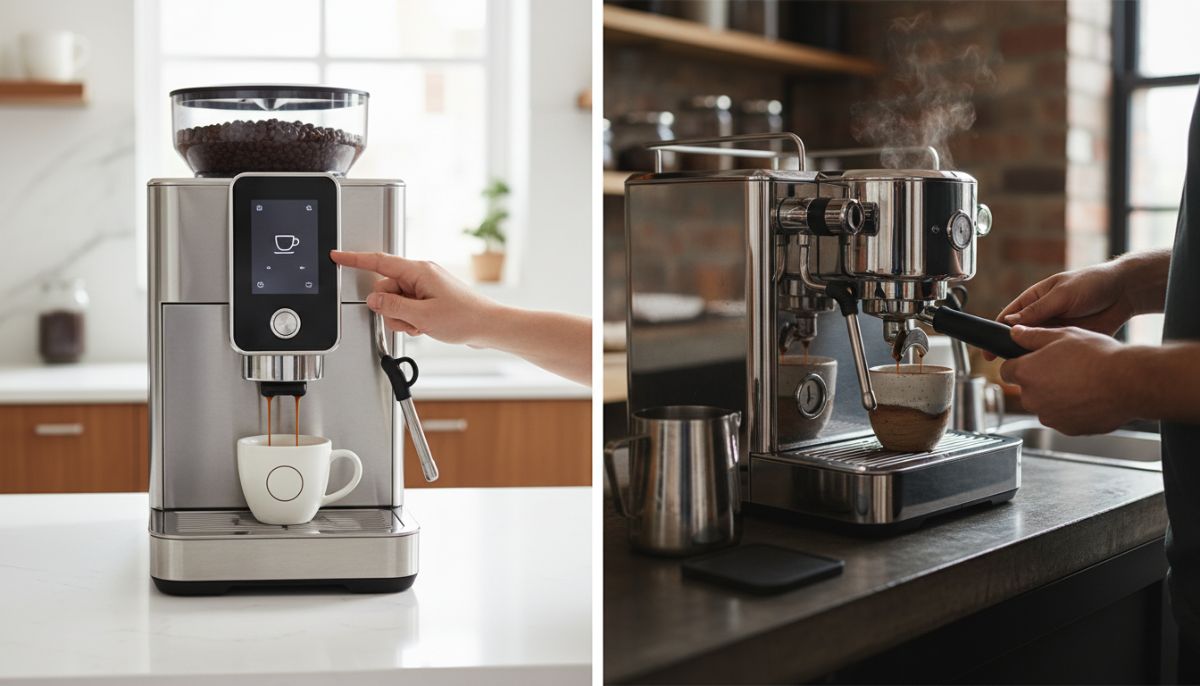
A super-automatic espresso machine is a “bean-to-cup” robot. It houses a built-in grinder, a tamping mechanism, a brewing unit, and often an automatic milk frother all inside one casing.
The workflow is simple: you fill the hopper with beans and the tank with water. When you want a latte, you press the “Latte” button. The machine grinds the specific dose, tamps it internally, extracts the shot, froths the milk, and dispenses the drink. Once finished, it dumps the spent coffee puck into an internal waste bin.
The Pros
- Unbeatable Convenience: No skills required. If you can push a button, you can make espresso.
- Consistency: The machine does the exact same thing every time, removing human error from the equation.
- Speed: Ideal for busy households where multiple people need coffee quickly.
The Cons
- Limited Control: You cannot easily adjust the grind size or temperature to the same degree as manual machines.
- Flavor Ceiling: While good, the espresso usually lacks the syrup-like body and complex notes found in a well-pulled manual shot.
- Repair Difficulty: With so many electronic parts and plastic gears, repairs can be costly and difficult.
What is a Semi-Automatic Espresso Machine?
A semi-automatic machine is what you see in your local coffee shop. It has an electric pump to maintain pressure and a boiler to heat water, but the “barista work” is up to you.
You must grind the coffee using a separate grinder, load the portafilter, tamp the grounds, and lock it into the grouphead. You then start and stop the pump (or the machine stops it based on volume). If you want milk, you steam it yourself using a steam wand.
If you are just starting out and watching your budget, you might look at top entry-level espresso machines to get a feel for this workflow without breaking the bank.
The Pros
- Maximum Control: You dictate every variable, allowing you to dial in specific flavor profiles.
- Superior Taste: With practice, you can pull shots that rival or exceed professional cafes.
- Durability: These machines often use commercial-grade parts like brass and stainless steel.
The Cons
- Learning Curve: You will make bad coffee before you make good coffee. It takes time to learn.
- Mess: Coffee grounds can stray, and milk splatters happen.
- Time: A latte might take 5-10 minutes to prepare and clean up after.
Head-to-Head Comparison
1. The Workflow and Ritual
The biggest difference is the involvement. With a super-automatic, you are a consumer of coffee. With a semi-automatic, you are the creator.
Semi-automatic owners often enjoy the process of “dialing in” their beans. This involves adjusting the grind size and dose to get the perfect ratio. If you are curious about what this entails, read our guide on how to dial in espresso ratios and yield. Super-automatics generally do not allow for this level of precision puck preparation.
2. Grind Quality and Mechanics
The grinder is the most important part of the espresso equation. Super-automatics have built-in grinders, which are convenient but often use smaller ceramic burrs that are harder to calibrate. If the grinder fails, the whole machine is out of commission.
Semi-automatic users usually pair their machine with a dedicated, high-quality standalone grinder. This allows you to choose between different burr geometries that affect flavor. For a deeper dive, check out our comparison of flat vs. conical burrs.
3. Milk Texturing Capabilities
Do you like a cappuccino with stiff foam or a flat white with silky microfoam? A super-automatic usually produces one type of foam: airy and bubbly. It uses a venturi system to suck air into the milk automatically.
A semi-automatic with a steam wand allows you to create true microfoam necessary for latte art. It takes practice to learn the vortex technique, but the texture is smoother and sweeter. For tips on mastering this, see our guide to milk texturing.
4. Maintenance and Cleaning
Do not be fooled into thinking super-automatics are maintenance-free. Because they brew internally, mold can grow inside the brewing unit if not cleaned religiously. They require chemical cleaning cycles and regular descaling.
Semi-automatics are easier to keep clean because the brewing happens in the portafilter, which you remove and rinse. However, you still need to backflush the grouphead to prevent oil buildup. For a full breakdown of what is required, read our cleaning manifesto for daily, weekly, and monthly maintenance.
5. Internal Components and Repair
Semi-automatic machines are often built with standardized parts. Whether you choose a Single Boiler, Heat Exchanger, or Dual Boiler, the mechanics are generally accessible for repairs. To understand the different heating systems in semi-autos, check out our comparison of single boiler vs. heat exchanger vs. dual boiler machines.
Super-automatics are dense with sensors, plastic gears, and proprietary electronics. If a sensor fails, it usually requires a certified technician to fix, which can be expensive once the warranty expires.
Which One Should You Buy?
Choose a Super-Automatic if:
- You want coffee immediately with zero fuss.
- You have limited counter space and do not want a separate grinder.
- You prefer darker roasts and standard coffee drinks over specialty espresso nuances.
- Multiple family members want different drinks at the touch of a button.
Choose a Semi-Automatic if:
- You want to taste the distinct floral or fruity notes of specialty beans.
- You enjoy the process of learning a new skill.
- You want to pour latte art.
- You want a machine that can last for 10+ years with proper maintenance.
The Verdict
There is no “wrong” choice, only a choice that is wrong for you. If you view coffee as high-octane fuel to start your day, the super-automatic is the ultimate luxury. However, if you view coffee as a culinary pursuit, a semi-automatic machine is the only way to truly unlock the potential of your beans.
Assess your morning routine honestly. If 10 minutes of preparation sounds like a burden, go automatic. If it sounds like a zen moment, grab a portafilter and start brewing.
Frequently Asked Questions
Generally, no. While super-automatics make consistent and good coffee, they cannot grind as fine or tamp as hard as a skilled barista on a semi-automatic. This results in a shot with slightly less body and complexity compared to a perfectly dialed-in semi-automatic shot.
Yes, unless the machine has one built-in (which is rare for high-end semi-autos). The grinder is arguably more important than the machine itself. Super-automatics always have built-in grinders.
Semi-automatic machines are generally easier to deep clean because the brewing happens externally in the portafilter. Super-automatics have complex internal brewing groups that can be prone to mold if not removed and rinsed frequently.
You are paying for the technology and miniaturization. Packing a grinder, pump, heater, milk frother, and computer into a small box requires complex engineering and many components.
It is very difficult. Super-automatics usually produce a ‘frothy’ foam with large bubbles rather than the wet-paint texture of microfoam needed for latte art. Semi-automatic steam wands are far superior for this.