
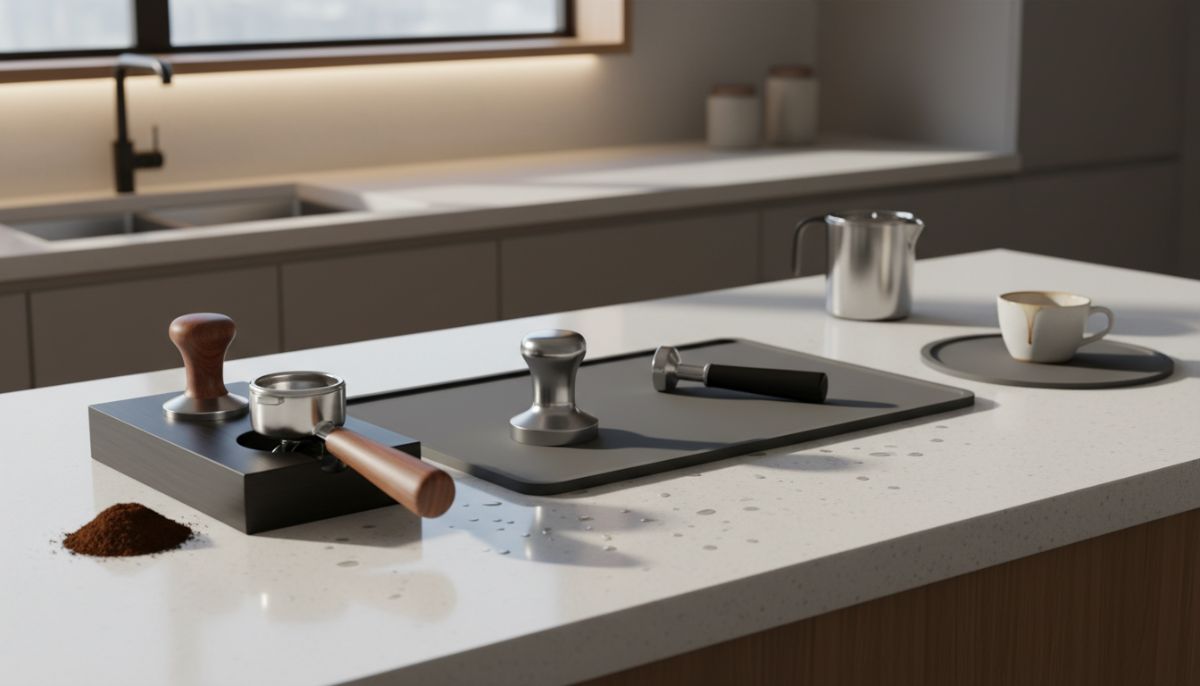
Key Takeaways
- Countertop Insurance: Tamping applies up to 30 lbs of pressure; mats and stations prevent chips, scratches, and cracks on expensive surfaces like granite and quartz.
- Ergonomics & Stability: A dedicated station stabilizes the portafilter, reducing wrist strain and ensuring a level tamp for better extraction.
- Hygiene Control: These tools catch stray coffee grounds, preventing oils from staining your workspace and making cleanup significantly faster.
- Workflow Optimization: Choosing between a mat and a station depends largely on your available counter space and portafilter style (spouted vs. bottomless).
You have invested in a high-end espresso machine and a precision grinder. You have dialed in your beans to perfection. But there is a hidden cost to home espresso that often goes unnoticed until it is too late: the damage to your kitchen.
Every time you prepare a shot, you are applying significant vertical force—typically around 20 to 30 pounds—onto a metal portafilter resting on your counter. Over weeks and months, this repetitive stress can scratch wood, etch sealant, and even crack marble or granite countertops. Beyond the damage, a slippery counter makes it nearly impossible to achieve the level tamp required for a great extraction.
This is where tamping mats and stations come into play. They are not just accessories; they are essential infrastructure for any home barista. In this guide, we will break down the differences, benefits, and how to choose the right protection for your brew bar.
The Physics of the Tamp: Why Protection Matters
To understand why you need a barrier between your gear and your counter, you have to look at the mechanics of puck preparation. Tamping is the act of compressing loose coffee grounds into a solid puck to create resistance against water pressure.
When you press down, you are driving the metal spouts or the bottom edge of the portafilter into the surface below. If you are using a naked (bottomless) portafilter, the metal rim is relatively dull. However, if you are using a standard spouted portafilter, the contact points are small and sharp. This concentrates that 30 pounds of pressure into tiny surface areas, turning your portafilter into a slow-motion chisel.
Furthermore, without a grip-heavy surface, your portafilter can slide during the tamp. This slippage often leads to an uneven coffee bed. As we know, an uneven bed causes channeling, where water rushes through the path of least resistance. For a deeper dive into how this ruins your shot, read our guide on channeling 101 and how to fix uneven water flow.
Tamping Mats: The Stealthy Solution
Tamping mats are the most common entry point for home baristas. They are typically made from food-grade silicone or heavy-duty rubber. They are designed to absorb shock and provide a non-slip surface.
Types of Tamping Mats
1. Flat Mats: These are simple squares or rectangles of silicone. They are versatile and can be moved easily. However, they don’t protect the edge of the counter if you prefer tamping with the portafilter resting against the table edge.
2. Corner (Edge) Mats: These are the gold standard for many. They feature a vertical overhang that hugs the edge of your countertop. This allows you to lock the portafilter against the counter edge for maximum stability without worrying about chipping the corner of your granite. This is particularly useful for those working in compact kitchens where surface area is at a premium.
Pros of Tamping Mats
- Cost-Effective: Generally cheaper than stations.
- Low Profile: They don’t add height to your setup.
- Easy to Clean: Most are dishwasher safe or can be rinsed in the sink alongside your other tools.
Tamping Stations: The Professional’s Choice
If a tamping mat is a shield, a tamping station is a scaffold. Often constructed from stainless steel, aluminum, or heavy wood with rubber inserts, stations are designed to elevate the portafilter off the counter entirely.
Why Choose a Station?
The primary benefit of a station is the cutout for the spouts. If you use a double-spouted portafilter, resting it on a flat mat can be unstable; the portafilter wants to wobble. A tamping station cradles the head of the portafilter, keeping the basket perfectly horizontal regardless of the spouts underneath.
This stability is crucial. If your basket isn’t level during the tamp, your extraction won’t be even. While tools like levelers help, a stable base is foundational. If you are debating between different distribution methods, check out our comparison on distribution tools vs. tampers.
Hygiene and Cleanliness
A tamping station also keeps the spouts from touching the counter. If you wipe your counters with a chemical cleaner, you don’t want your portafilter spouts picking up that residue. Conversely, you don’t want coffee oils from the spouts staining a porous wooden countertop.
Material Matters: Durability and Aesthetics
When selecting your gear, material plays a massive role in both longevity and aesthetics.
Silicone
Used in almost all mats, food-grade silicone is heat resistant, oil resistant, and shock-absorbent. It is soft enough to cushion the blow but firm enough to provide feedback. It is the utilitarian choice.
Wood and Metal Combinations
Tamping stations often serve as display pieces. Walnut or Oak stations with steel inlays look stunning next to high-end Italian machinery. However, wood requires care. It should not be submerged in water. If you are meticulous about your gear—perhaps you are the type who follows our cleaning manifesto religiously—a wood station is a beautiful upgrade.
The Workflow: Integrating the Station
Your tamping area is the “cockpit” of your coffee bar. It is where the transition from dry ground coffee to brewing takes place. Placement is key.
Ideally, your mat or station should be placed directly next to your grinder but on the side of your dominant hand. If you are right-handed, the workflow usually moves Left to Right: Grinder -> Tamping Station -> Espresso Machine -> Knock Box. Speaking of disposing of grounds, having your station next to your waste bin improves efficiency. See our knock box buying guide to see which style fits this flow best.
The Spout vs. Bottomless Factor
Your choice of portafilter dictates your need for a station. If you exclusively use bottomless portafilters, a simple flat mat is often sufficient because the bottom of the basket is flat. However, if you switch between spouted (for splitting shots) and bottomless, a station offers the versatility to handle both securely.
Addressing the “Mess” Factor
Coffee grounds are incredibly pervasive. No matter how careful you are with your dosing funnel, stray grounds will fall. A tamping mat acts as a catchment area.
Without a mat, those grounds end up in the pores of your counter or brushed onto the floor. With a mat, you simply lift it and rinse it. This sounds minor, but in the daily ritual of espresso making, these small friction points add up. A clean station leads to a clear mind, which leads to better coffee.
Conclusion: Which One Should You Buy?
The decision between a tamping mat and a station comes down to three factors: space, budget, and portafilter style.
Choose a Tamping Mat if:
- You have limited counter space.
- You are on a budget and want to prioritize spending on beans or burrs.
- You use a bottomless portafilter exclusively.
- You want the easiest possible cleanup.
Choose a Tamping Station if:
- You use spouted portafilters and struggle with stability.
- You want to protect your counters from the specific pressure points of spouts.
- You want a dedicated, aesthetic “home” for your tamper and portafilter.
- You value ergonomic consistency to reduce wrist strain.
Ultimately, doing nothing is not an option if you value your kitchen. Whether it is a simple $15 silicone mat or a $100 walnut station, protecting your countertop is the mark of a thoughtful, professional-grade home setup. Secure your station, level your tamp, and enjoy the extraction.