Torn between the rapid speed of a thermoblock and the raw power of a boiler? We dissect the heating technology inside your espresso machine to help you decide which system suits your morning routine.
Key Takeaways
- Speed vs. Power: Thermoblocks heat up in seconds, making them ideal for quick morning routines, while boilers can take 10-30 minutes but offer superior thermal mass.
- Steam Consistency: Boilers generally provide powerful, dry steam for texturing milk, whereas thermoblocks often produce “wetter” steam that pulses.
- Temperature Stability: Boilers maintain heat better during shots, but modern thermoblocks with PID controllers are closing the gap.
- Maintenance: Thermoblocks are less prone to sitting water issues but can scale up faster in hard water areas compared to large boilers.
Introduction
There is a defining moment in every home barista’s journey when they decide to upgrade their gear. You start looking at specs, and suddenly you are bombarded with technical jargon. One of the most critical debates you will encounter is the battle of the heating elements: Thermoblock vs. Boiler.
It sounds technical, but this choice dictates your entire coffee workflow. Do you want to push a button and have espresso in 45 seconds? or are you willing to wait 20 minutes for a machine to heat up in exchange for commercial-grade temperature stability?
Choosing the wrong system can lead to frustration. A boiler might feel too slow for a busy parent, while a thermoblock might feel underpowered for a latte artist. In this guide, we will break down exactly how these systems work and help you decide which one fits your lifestyle.
What is a Boiler System?
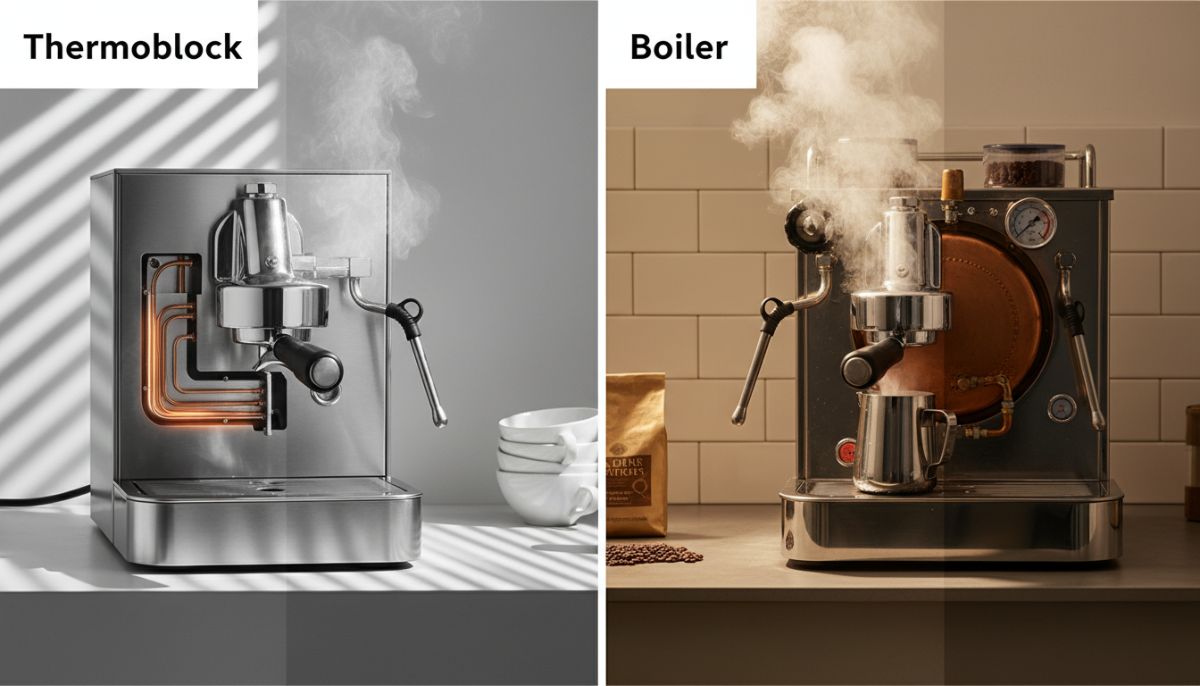
The boiler is the traditional heart of an espresso machine. Think of it as a kettle inside your machine. It holds a specific volume of water and keeps it at a set temperature. When you pull a shot, the pump draws this hot water directly from the reservoir.
Boilers are typically made from brass, copper, or stainless steel. They rely on thermal mass. Once that metal and water get hot, they stay hot. This is why commercial machines use them; they need to pull hundreds of shots without the temperature dropping.
The Pros of Boilers
Thermal Stability: Because a large volume of water is heated, the temperature doesn’t fluctuate easily. This is crucial for extraction consistency. If you want to understand why keeping heat constant matters, read about how PID controllers impact temperature stability.
Steam Power: Boilers usually hold steam at high pressure. When you open the steam wand, you get an immediate, powerful blast. This makes creating microfoam much easier.
The Cons of Boilers
Heat-Up Time: You cannot rush a boiler. Small single boilers might take 10 minutes, but larger units can take up to 30 minutes to fully saturate the grouphead.
Energy Consumption: Keeping a tank of water hot requires more energy than heating water on demand. If you leave the machine on all day, your electric bill might notice.
What is a Thermoblock?
A thermoblock is an on-demand water heater. Instead of a tank, it is a block of metal (usually aluminum) with a coiled pipe inside. As the pump pushes cold water through the pipe, the hot metal block heats the water instantly.
You will often find these in compact appliances. Many entry-level espresso machines utilize thermoblocks to keep costs down and footprints small.
The Pros of Thermoblocks
Speed: This is the main selling point. A thermoblock machine can be ready to brew in under 60 seconds. If you are always rushing out the door in the morning, this is a game-changer.
Fresh Water: Since there is no tank holding hot water, you are heating fresh water from the reservoir for every single shot.
The Cons of Thermoblocks
Inconsistent Temperature: Early thermoblocks were notorious for temperature swings. If the water flows too fast, it doesn’t get hot enough. If it flows too slow, it burns.
Weaker Steam: Thermoblocks create steam by pulsing water into the hot block. This creates a “puffing” effect rather than a continuous stream. It can make learning creating cafe-quality microfoam more difficult because the steam tends to be wetter.
Performance Showdown
Now that we know the mechanics, let’s look at how they perform in the cup. The differences become very apparent when you try to dial in specific roasts.
1. Shot Quality and Consistency
A boiler usually wins on consistency. When brewing espresso, temperature stability is key to avoiding sour or bitter flavors. If the temperature drops mid-shot, you lose sweetness.
However, high-end thermoblocks are catching up. Many now use PID technology to rapidly adjust the heating element, smoothing out the fluctuations. But for pure, rock-solid heat, a brass boiler combined with a heavy grouphead is still the gold standard. For deeper insight into machine configurations, check out our comparison of single boiler, heat exchanger, and dual boiler configurations.
2. Steam Pressure and Workflow
If you drink straight espresso, a thermoblock is fine. If you drink cappuccinos, you might struggle. Transitioning from brewing to steaming on a single thermoblock machine requires the heater to ramp up to nearly 300°F.
Once you are done steaming, you have to flush water through the system to cool it back down to brewing temperature. Boilers suffer from this workflow delay too (unless you have a Dual Boiler), but the quality of steam from a boiler is significantly drier and more powerful.
3. Durability and Maintenance
Scale is the enemy of all espresso machines. In a boiler, scale settles at the bottom. In a thermoblock, the narrow pipes can calcify and clog, which can be fatal for the machine.
Regardless of the system you choose, water quality is paramount. Using hard tap water will destroy a thermoblock very quickly. You should understand the basics of water chemistry and scale buildup to protect your investment.
Which System Fits Your Lifestyle?
Buying an espresso machine is personal. Here is how to choose based on your daily habits.
The “On-the-Go” Commuter
Winner: Thermoblock.
You wake up, you want coffee, and you leave. You do not have time to preheat a machine for 20 minutes. You likely drink Americanos or straight espresso and only occasionally steam milk.
The Home Barista Hobbyist
Winner: Boiler (Single or Dual).
You view coffee as a ritual. You enjoy the process of weighing beans and prepping the puck. You care about the texture of your milk. You are willing to use a smart plug to turn your machine on before you wake up so it is hot when you arrive.
The Entertainer
Winner: Large Boiler / Heat Exchanger.
If you need to make four lattes back-to-back for guests, a thermoblock will struggle to keep up. A large boiler has the thermal capacity to steam milk for multiple drinks without running out of pressure.
The Verdict
Technology is blurring the lines. We are seeing “Thermocoils” (advanced thermoblocks) that offer impressive stability, and we are seeing small boilers with fast-heating elements.
However, the rule of thumb remains: Choose a thermoblock for speed, convenience, and energy savings. Choose a boiler for thermal mass, steam power, and longevity.
Whichever you choose, remember that the machine is only one part of the equation. Your grinder, your beans, and your puck prep play equally large roles. Even the best boiler won’t save you if you have bad distribution. If you’re struggling with consistency, you might want to read up on the science of puck prep.
Frequently Asked Questions
It depends on your priorities. Thermoblocks are better for speed and energy efficiency, heating up in under a minute. Boilers are better for temperature stability and steam power but take much longer to heat up.
Generally, boilers are more durable and repairable. Thermoblocks have narrow internal pipes that can clog easily with scale buildup, often requiring the entire block to be replaced rather than repaired.
Yes, but it is more difficult. Thermoblock steam tends to be wetter and pulses, which can introduce large bubbles. It takes more practice to get the smooth microfoam required for latte art compared to the dry, constant steam of a boiler.
Yes, thermoblocks heat water on demand rather than maintaining a large volume of hot water constantly, making them more energy-efficient for home users who only pull a few shots a day.