
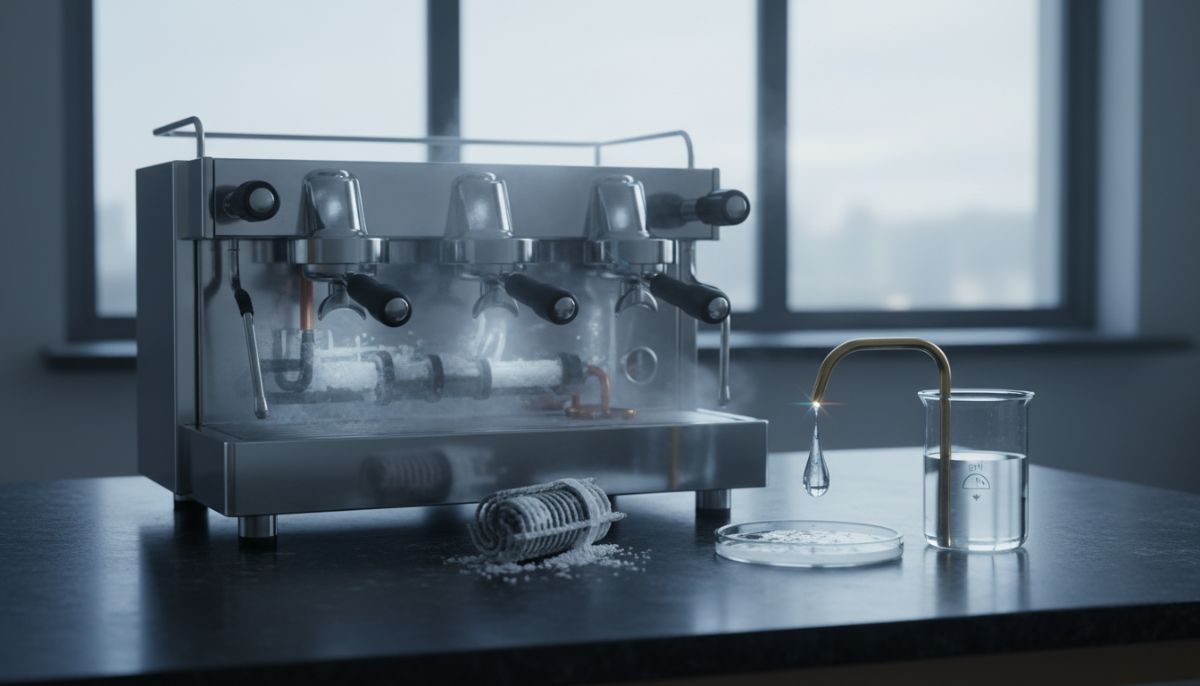
Is your tap water safe for your espresso setup? Discover how invisible minerals cause fatal scale buildup, ruin extraction flavor, and how to create the perfect water profile for longevity and taste.
Key Takeaways
- Scale is the Silent Killer: Calcium and magnesium buildup can clog boilers and destroy heating elements within months.
- Flavor Impact: Water acts as a solvent; incorrect mineral content leads to sour or flat espresso regardless of bean quality.
- Chlorides are Corrosive: Unlike scale, chloride damage is permanent and eats through stainless steel boilers.
- Filtration is Mandatory: Relying on standard pitcher filters is rarely enough for high-end espresso machines.
You have spent thousands on a dual-boiler espresso machine. You have paired it with a precision flat-burr grinder. You buy fresh, single-origin beans every week. Yet, there is one variable that makes up 98% of your final beverage that most home baristas completely ignore until it is too late: the water.
Using straight tap water in a high-end espresso machine is not just a culinary mistake; it is an expensive hardware gamble. The invisible chemistry inside your tap—specifically calcium, magnesium, and chlorides—determines two critical outcomes. First, whether your espresso tastes like sweet nectar or battery acid. Second, whether your machine lasts for ten years or suffers a catastrophic boiler failure in two.
In this guide, we will break down the complex science of water chemistry into actionable advice. We will explore why scale forms, how to test your supply, and the filtration solutions required to protect your investment.
The Chemistry of Scale: Calcium and Magnesium
To understand why your machine is at risk, you must understand what is dissolved in your water. Water is the universal solvent. As it travels through the ground to your tap, it picks up minerals. The two most relevant for coffee are calcium and magnesium. In the coffee world, we refer to the total measurement of these minerals as “General Hardness” (GH).
Magnesium acts as a flavor carrier. It helps water bond with flavor compounds in the coffee grounds, enhancing sweetness and fruit notes. Calcium helps with body and texture. However, when water is heated—as it is in your espresso boiler—calcium carbonate precipitates out of the liquid and solidifies onto hot surfaces. This is limescale.
A little bit of hardness is necessary for extraction. Too much creates a thick, rocky layer inside your plumbing. This restricts flow and insulates heating elements, causing them to overheat and eventually burn out.
How Scale Affects Machine Performance
Scale does not accumulate evenly. It builds up rapidly in the narrowest passages of your machine, such as the gigleur (flow restrictor) and the solenoid valves. When these passages narrow, your flow rate becomes inconsistent.
Many home baristas mistake this symptom for bad puck preparation. They see spurting or slow drips and assume their tamping is at fault. Before you tear your hair out trying to fix uneven water flow and channeling, consider that mineral buildup might be blocking the shower screen dispersion pattern. No amount of distribution technique can fix a group head clogged with calcium.
Furthermore, scale ruins temperature stability. If your boiler temperature sensor (PID probe) is coated in scale, it cannot read the water temperature accurately. This forces the machine to overheat or underheat, leading to inconsistent shots day after day.
The Flavor Equation: Buffer and Extraction
Protecting the machine is priority number one, but flavor is a close second. Water chemistry involves a delicate balance between General Hardness (GH) and Carbonate Hardness (KH), also known as Alkalinity or “Buffer.”
Alkalinity acts as a buffer against acid. Coffee is naturally acidic. If your water has zero buffer (like distilled water), the resulting espresso will be sharp, sour, and unpalatable. Conversely, if your water has too much buffer (hard tap water), it neutralizes all the pleasant fruit acids, resulting in a chalky, flat, and boring shot.
This chemical imbalance is often the culprit when you cannot dial in a roast. If your water lacks the necessary magnesium to extract flavor or lacks the buffer to balance acidity, you will struggle with flavor defects. This is a common reason why your espresso tastes sour due to underextraction, even when your brew time and ratio appear perfect on paper.
The Chloride Threat: Permanent Corrosion
While scale can be descaled (acid washed away), chloride damage is permanent. Chlorides (distinct from chlorine used to disinfect water) are found in many municipal water supplies, particularly in coastal areas.
Chlorides attack stainless steel. They cause pitting corrosion, eating tiny holes through boilers and welds. High-end machines with stainless steel boilers are highly susceptible to this. Standard water filters do not remove chlorides. Only Reverse Osmosis (RO) systems can effectively remove them. If your water report shows high chloride levels, standard filtration is not an option; you need an RO system.
Solutions: Filtration and Remineralization
So, how do you fix your water? The goal is water that is soft enough to prevent scale but mineral-rich enough to taste good. Here is the hierarchy of solutions:
1. In-Tank Resin Filters
For reservoir machines, pouches or specialized resin filters (like those from BWT) exchange magnesium for calcium. This reduces the scaling potential while keeping mineral content high enough for flavor. This is the minimum viable protection.
2. The “Recipe” Water (Distilled + Minerals)
A foolproof method is to buy distilled water (0 PPM) and add a specific packet of minerals (like Third Wave Water) or create your own buffer/hardness solution. This guarantees consistency. With a stable water base, you can confidently focus on other variables, such as dialing in espresso ratios and yield, knowing that your solvent is mathematically perfect.
3. Reverse Osmosis with Remineralization
For plumbed-in machines, this is the gold standard. The system strips everything out of the water (including dangerous chlorides) and then reintroduces a specific amount of minerals via a bypass valve or remineralization cartridge.
The Role of Puck Prep with Consistent Water
Once you have addressed your water chemistry, you eliminate the largest variable in your setup. Consistency is the key to elite espresso. When your water flows predictably and extracts efficiently, your mechanical tools become more effective.
For example, using advanced distribution techniques becomes much more rewarding. You can better observe the benefits of scientific puck prep methods like the WDT tool when the water interacting with the coffee bed isn’t actively fighting against extraction.
Conclusion
Tap water is a gamble that high-end equipment owners cannot afford to take. The damage caused by scale and chlorides is often silent until it becomes catastrophic. By testing your water and implementing a proper filtration or remineralization strategy, you safeguard your machine’s longevity and unlock the true flavor potential of your beans.
Don’t let chemistry hold your coffee back. Test your water today, choose a filtration path, and brew with confidence.
Frequently Asked Questions
No. Pure distilled water is corrosive to metal boilers and lacks the minerals required to extract flavor from coffee, resulting in a flat taste. You must add minerals back into distilled water.
You should use a drop-titration kit (like the API GH/KH test) for accuracy. TDS meters only show total solids, not the specific calcium content that causes scale.
Descaling removes calcium buildup, but it is harsh on machine seals and sensors. Furthermore, descaling cannot fix corrosion caused by chlorides. Prevention via filtration is far superior to reactive descaling.
Generally, a General Hardness (GH) between 70-120 ppm and an Alkalinity (KH) between 40-50 ppm is considered the ‘sweet spot’ for balancing machine protection and flavor extraction.