
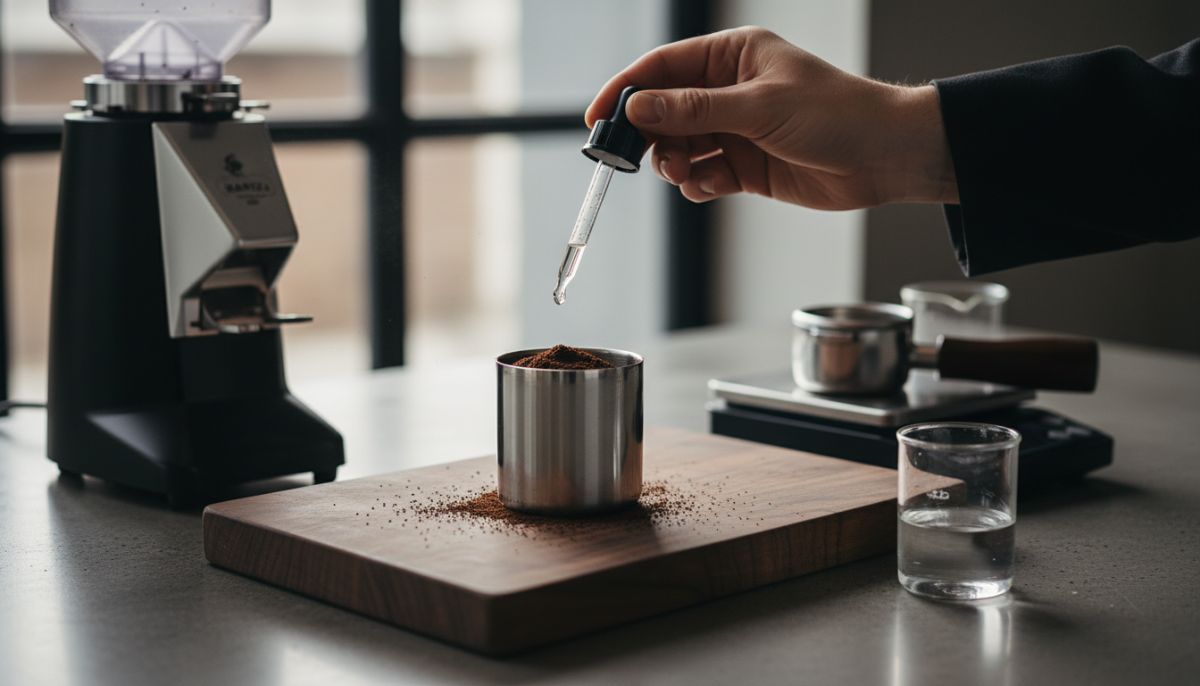
Tired of coffee grounds flying everywhere due to static? Discover the Ross Droplet Technique (RDT)—a simple, science-backed hack involving a single drop of water that eliminates mess and improves dosing consistency.
Key Takeaways
- Definition: The Ross Droplet Technique (RDT) involves adding a tiny amount of moisture to coffee beans before grinding to reduce static electricity.
- Mechanism: Moisture increases surface conductivity, allowing the electrical charge generated by friction to dissipate preventing grounds from sticking to the grinder.
- Benefits: Drastically reduces retention, minimizes counter mess, and improves dose consistency.
- Caution: Use sparingly on high-carbon steel burrs to prevent potential surface rust; it is generally safer for stainless steel and ceramic burrs.
It is a scenario familiar to almost every home barista. You weigh out precisely 18 grams of your favorite single-origin beans, dump them into your hopper, and turn on the grinder.
Suddenly, physics turns against you. Instead of falling neatly into your portafilter or dosing cup, the grounds cling to the side of the chute, fly sideways onto the countertop, and coat the body of the grinder in a fine brown dust.
This is the scourge of static electricity. Not only does it create a mess, but it also ruins your carefully measured dose, leaving valuable coffee stuck inside the machine.
Enter the RDT Method, or Ross Droplet Technique. This incredibly simple hack has revolutionized single-dosing workflows, proving that sometimes the best solutions cost absolutely nothing.
What is the Ross Droplet Technique (RDT)?
The Ross Droplet Technique is named after David Ross, a coffee enthusiast who first popularized the method on home barista forums around 2005.
The concept is deceivingly simple: you introduce a microscopic amount of water to your whole coffee beans immediately before grinding them. This is typically done using the handle of a spoon ran under a tap, or a small fine-mist spray bottle.
While it might sound counterintuitive to add water to dry beans—especially when we are told moisture is the enemy of bean storage—the amount used in RDT is negligible. It evaporates almost instantly during the grinding process and does not negatively impact the extraction or flavor profile in the cup.
The Science: Why Does Grinding Create Static?
To understand why RDT works, we have to look at what happens inside your grinder. When coffee beans are crushed against burrs at high speeds, a significant amount of friction occurs. This friction creates a triboelectric effect.
Electrons are stripped from the coffee particles, causing them to build up a static electrical charge. Because coffee grounds are generally insulators, this charge has nowhere to go. Consequently, the particles repel each other (flying over your counter) or attract to surfaces with an opposite charge (sticking to the metal chute or plastic bin).
How Water Solves the Problem
Water is a conductor. By coating the beans in a very fine mist, you increase the surface conductivity of the coffee.
This added moisture provides a pathway for the static charge to dissipate rather than build up. The result is a neat, fluffy pile of grounds that falls vertically from the chute without clinging to everything in sight.
The Impact on Grinder Retention
Static is one of the primary contributors to grinder retention—the discrepancy between the amount of coffee you put in and the amount you get out. If you put in 18g and get 17.5g out, that missing 0.5g is stuck inside the grind chamber.
This retained coffee eventually goes stale and mixes with your next shot, muddying the flavor. By eliminating the static cling, RDT ensures that almost all the coffee exits the grinder. This is crucial for maintaining a clean flavor profile and minimizing waste.
For a deeper dive into how retention affects your brew, read our guide on grinder retention and why it is the hidden enemy of fresh espresso.
Step-by-Step: How to Apply RDT
Implementing the Ross Droplet Technique is effortless, but precision matters. You do not want wet beans; you want humidified beans.
1. Weigh Your Dose
RDT is strictly a single-dosing technique. It is not suitable for hopper-based grinders where beans sit for days, as the moisture could cause mold or hopper jams. Weigh your single dose of beans into a small vessel.
2. Apply the Moisture
There are two main ways to do this:
- The Spray Bottle Method: Use a small atomizer (2oz glass or plastic bottles work well). Give the beans one single spray from a distance of about 4-6 inches.
- The Spoon Method: Run the handle of a teaspoon under a faucet, shake off the excess drops, and then stir the wet handle through your dry beans.
3. Shake to Distribute
Cover the dosing cup with your hand and give the beans a vigorous shake. This ensures the moisture is distributed evenly across the surface of all the beans, rather than soaking just a few.
4. Grind Immediately
Pour the beans into the grinder and grind as usual. You should notice an immediate difference in how the grounds flow.
RDT and Espresso Puck Prep
Using RDT is technically the first step in puck preparation. By reducing static, you reduce the clumping that often happens when statically charged particles bond together.
Fewer clumps mean a more even distribution of coffee in the basket. While RDT helps reduce clumps, it is not a replacement for proper distribution techniques once the coffee is in the portafilter.
Many baristas combine RDT with the Weiss Distribution Technique (WDT) for the ultimate workflow. While RDT handles the grinding phase, WDT handles the basket phase. To understand the difference, check out our article on the science of puck prep and the WDT tool.
The Safety Question: Will RDT Rust My Burrs?
This is the most controversial aspect of the RDT method. Since you are introducing water to metal parts, the risk of oxidation (rust) is theoretically non-zero.
However, the risk depends largely on your equipment and your environment.
Stainless Steel vs. Carbon Steel
Most modern burrs are made from stainless steel, which is highly resistant to corrosion. If you have stainless steel burrs, the tiny amount of moisture from one spray will evaporate due to the heat of grinding before it can cause damage.
However, some high-end burrs use high-carbon steel for its hardness and edge retention. Carbon steel is much more susceptible to rust. If you live in a humid climate or use too much water, you could see surface oxidation over time.
To understand the geometry and materials of your grinder better, take a look at our comparison of flat vs. conical burrs, which touches on how different burr sets behave.
Maintenance is Key
If you use RDT daily, it is wise to inspect your burrs more frequently. A quick visual check during your cleaning routine is sufficient. If you are unsure about how often you should be checking inside your machine, refer to our cleaning manifesto for daily, weekly, and monthly maintenance.
Does RDT Affect Extraction or Taste?
Directly? No. The water content is too low to change the brewing ratio or dilute the coffee. However, indirectly, it has a massive positive impact.
By ensuring that your output weight matches your input weight, RDT allows for much higher precision when dialing in your espresso ratios. If you are trying to hit a 1:2 ratio and your grinder retains 1g of coffee due to static, your extraction will be thrown off.
Furthermore, by reducing the static cling of “fines” (the smallest coffee particles), RDT ensures those fines end up in the basket rather than stuck to the grinder chute. This preserves the full spectrum of particle sizes intended by the grinder manufacturer.
When NOT to Use RDT
While RDT is a powerful tool, there are specific scenarios where you should avoid it:
- Hopper Grinding: Never spray beans that will sit in a hopper. The moisture will get trapped, leading to mold growth and gummy deposits that can seize the motor.
- Integrated Grinders: Be careful with built-in grinders on espresso machines if the chute is not easily accessible for cleaning.
- Already Oily Beans: Dark roast beans often have oils on the surface. These oils naturally reduce static to some degree, and adding water to oily beans can create a sludge that clogs the grinder.
Conclusion
The Ross Droplet Technique is a rare example of a coffee “upgrade” that costs nothing but yields immediate, visible results. By banishing static, you keep your counter clean, your dose accurate, and your workflow smooth.
Whether you use a fancy spray bottle or the back of a spoon, adding that drop of moisture is the secret handshake of the home barista. Give it a try on your next morning brew—your grinder (and your countertop) will thank you.
Frequently Asked Questions
It is unlikely if you use stainless steel burrs and only a tiny drop of water. However, high-carbon steel burrs are more prone to rust. Use the method sparingly and inspect your burrs regularly.
No. RDT is strictly for single-dosing. Adding moisture to a full hopper of beans can lead to mold growth and clog the grinder mechanism.
RDT itself does not change the flavor, but it improves dosing consistency and ensures all grind particle sizes make it into the basket, which can lead to more consistent and better-tasting extractions.
Less is more. A single pump from a fine-mist atomizer or a drop or two from a wet spoon handle is all that is needed for an 18-20g dose.